Search This Blog

Wednesday, February 15, 2006

Will Canada ever consent to prosecute Falun Gong's torturers?


PROSECUTE TORTURERS?

By Rochelle Squires


Best viewed in Mozilla

This is not the outcome we were hoping for... It is a big disappointment and a big loss for Communist China. Jiang Zemin and Luo Gan are the architects of the persecution of Falun Gong--by all means they should be punished by law. Read a news report by the WSun.

Winnipeg Sun: 04 April 2006 - TORTURE CHALLENGE NIXED

My Letter to the Editor:

I am appalled at the judge's decision. As if it wasn't enough for Zhang to go through the horrific torture by the CCP, because he wouldn't give up his belief in Falun Gong, now he is refuted the right to take his torturers to court! Somehow I fail to see the legitimacy of our judicial system. The architects of the seven-year persecution are allowed to run away scot-free. The evidence of the persecution has been well documented by many human rights organizations worldwide with countless testimonies from victims of this vicious persecution. And with the recent news of the organ-harvesting death camps in China, set up especially to eliminate thousands of Falun Gong for a profit, I can only say that this all contributes in amplifying this persecution greatly. I sure hope our new government can start weighing the circumstances and soon enlighten to the voice of justice. This genocide must be stopped and the perpertrators must be brought to justice.

###

Winnipeg Sun: 15 Feb, 2006 -The outcome of a federal court hearing in Winnipeg will determine if 45 individuals in China will face prosecution for allegedly torturing and detaining a Canadian professor in 2000.

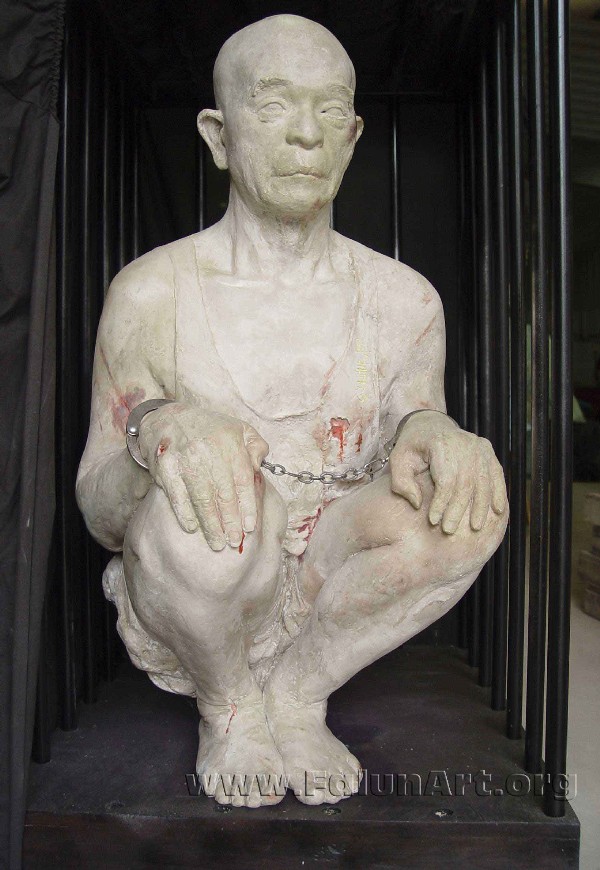
Kunlun Zhang, a Chinese-born Canadian citizen, was given electric shocks, had an electric baton shoved in his mouth and was beaten repeatedly while held in Chinese detention centres and labour camps for practising Falun Gong, says his lawyer David Matas.

Falun Gong is a spiritual practice outlawed as a dangerous cult in China.

"The problem of the torture of the Falun Gong in China is chronic, endemic, systematic, widespread and continuing. People in Canada have to do something about it," said Matas, who was in a Winnipeg courtroom yesterday on Zhang's behalf.

PRIVATE PROSECUTION

Matas is hoping the judge will reverse a 2005 decision by Canada's attorney-general that denied Zhang's request for a private prosecution against his torturers. That would clear the way for the Canadian government to attempt to begin extradition proceedings with China to bring the 45 people named in Zhang's suit to Canada for prosecution.

The judge reserved her decision.

"We need to get some deterrence to torture in China and this is one way to do it. It sends out a signal that there are consequences for torture," said Matas.

The human rights lawyer believes the federal government has a duty to consent to prosecution against those who torture and illegally detain Canadian citizens.

"We can't simply say, well it happened and we're not going to do anything about it," said Matas, noting the Canadian government did play a role in freeing Zhang in 2001 from the grasp of his Chinese persecutors.

Zhang is a Canadian university professor who now lives in Ottawa.

While in China in 2000 and 2001, Zhang was arrested four times and spent nearly three months in Chinese detention centres for practicing Falun Gong.

Practitioners of Falun Gong are persecuted by the Chinese Communist Party until their beliefs are renounced.

The Chinese spiritual discipline includes exercise, meditation and the pursuit of truth, compassion and tolerance.

Falun Gong was introduced to the public in China in 1992 and quickly drew widespread attention.

The Communist regime began its campaign to eradicate the practice and persecute practitioners in 1999.

"Falun Gong (practitioners) are primary targets of the oppressive Communist state in China," said Matas.

Related Article:
Winnipeg Free Press: Tortured prof seeks justice

Tuesday, February 14, 2006

US Hacktivists peacefully rising above the Great Firewall


By Geoffrey A. Fowler


Expatriate Bill Xia to the rescue; keeps the Web World-Wide

NEW YORK (WSJ) 13 Feb. 2006 - Surfing the Web last fall, a Chinese high-school student who calls himself Zivn noticed something missing. It was Wikipedia, an online encyclopedia that accepts contributions or edits from users, and that he himself had contributed to.

The Chinese government, in October, had added Wikipedia to a list of Web sites and phrases it blocks from Internet users. For Zivn, trying to surf this and many other Web sites, including the BBC's Chinese-language news service, brought just an error message. But the 17-year-old had loved the way those sites helped him put China's official pronouncements in perspective. "There were so many lies among the facts, and I could not find where the truth is," he writes in an instant-message interview.

Then some friends told him where to find Freegate, a software program that thwarts the Chinese government's vast system to limit what its citizens see. Freegate -- by connecting computers inside of China to servers in the U.S. -- enables Zivn and others to keep reading and writing to Wikipedia and countless other Web sites.

Behind Freegate is a North Carolina-based Chinese hacker named Bill Xia. He calls it his red pill, a reference to the drug in the "Matrix" movies that vaulted unconscious captives of a totalitarian regime into the real world. Mr. Xia likes to refer to the villainous Agent Smith from the Matrix films, noting that the digital bad guy in sunglasses "guards the Matrix like China's Public Security Bureau guards the Internet."

Roughly a dozen Chinese government agencies employ thousands of Web censors, Internet cafe police and computers that constantly screen traffic for forbidden content and sources -- a barrier often called the Great Firewall of China. Type, say, "media censorship by China" into emails, chats or Web logs, and the messages never arrive.

Even with this extensive censorship, Chinese are getting vast amounts of information electronically that they never would have found a decade ago. The growth of the Internet in China -- to an estimated 111 million users -- was one reason the authorities, after a week's silence, ultimately had to acknowledge a disastrous toxic spill in a river late last year. But the government recently has redoubled its efforts to narrow the Net's reach on sensitive matters.

It has required all bloggers, or writers of Web logs, to register. At the end of last year 15 Internet writers were in jail in China, according to the Committee to Protect Journalists, a New York group. China also has gotten some U.S. Internet companies to limit the search results they provide or the discussions they host on their Chinese services. A tiny firm Mr. Xia set up to provide and maintain Freegate had to lobby computer-security companies such as Symantec Corp., of Cupertino, Calif., not to treat it as a virus.

In response to China's crackdown, and to restrictions in many Middle Eastern countries as well, a small army has been mustered to defeat them. "Hacktivists," they call themselves.

The circumventor - Breaks Internet blockade

Falun gong practitioners in Canada use this software on their spare computers to allow people in China to access the Internet uncensored.

You just email them a special URL and they can surf the real Internet.

Bennett Haselton, a security consultant and former Microsoft programmer, has developed a system called the Circumventor. It connects volunteers around the world with Web users in China and the Middle East so they can use their hosts' personal computers to read forbidden sites.

Susan Stevens, a Las Vegas graphic designer, belongs to an "adopt a blog" program. She has adopted a Chinese blogger by using her own server in the U.S. to broadcast his very personal musings on religion to the world. She has never left the U.S., but "this is where technology excels," she says. "We don't have to have anything in common. We barely have to speak the same language."

In Boston, computer scientist Roger Dingledine tends to Tor, a modified version of a U.S. Naval Research Laboratory project, which disguises the identities of Chinese Web surfers by sending messages through several layers of hosts to obscure their path. In addition to the Department of Defense, Mr. Dingledine had also received funding from the Electronic Frontier Foundation, a nonprofit group that supports free speech online.

Freegate has advantages over some of its peers. As the product of ethnically Chinese programmers, it uses the language and fits the culture. It is a simple and small program, whose file size of just 137 kilobytes helps make it easy to store in an email program and pass along on a portable memory drive.

Mr. Xia says about 100,000 users a day use Freegate or two other censorship-defeating systems he helped to create. It is impossible to confirm that claim, but Freegate and similar programs from others, called UltraReach and Garden Networks, are becoming a part of the surfing habits of China's Internet elite in universities, cafes and newsrooms.

Freegate has a big booster in Falun Gong, the spiritual group China banned in 1999 as subversive. It is a practice of meditations and breathing exercises based on moralistic teachings by its founder, Li Hongzhi. Chinese expatriates -- marrying U.S. free-speech politics with protests over persecution of Falun Gong practitioners in China -- have focused their energy on breaking China's censorship systems. They have nurtured the work of Mr. Xia, himself a Falun Gong follower, and several other programmers.

Freegate also gets a financial boost from the U.S. government. Voice of America and Radio Free Asia, part of the federal government's Broadcasting Board of Governors, pay Mr. Xia and others to send out emails featuring links to their stories.

Kenneth Berman, manager of the anticensorship office of the board's International Broadcasting Bureau, declines to say how much it compensates Mr. Xia's company. He says the bureau pays less than $5 million a year to companies to help combat Internet censorship abroad, especially in China and Iran.

"Our policy is to allow individuals to get anything they want, when they want," Mr. Berman says. "Bill and his techniques help us do that."

Human Rights in China, a New York nonprofit group funded by individuals and charities founded by Chinese scientists and scholars in 1989, also helps fund Mr. Xia's enterprise, which runs on a budget of about $1 million a year, and pays it to send out emails.

The resources behind Freegate and others hacktivists could increase if Congress revives a bill to create an Office of Global Internet Freedom. U.S. Internet companies have drawn strong criticism in Congress for compliance with Chinese Web restriction, and hearings on their activities are set for Wednesday. Microsoft Corp., Redmond, Wash., Google Inc., Mountain View, Calif., and Yahoo Inc., Sunnyvale, Calif., all say that they abide by local laws. Microsoft's general counsel said this month that the software giant shuts down personal blogs only if it receives a "legally binding notice from a government."

Several Chinese agencies with jurisdiction over the Internet, including the ministries of Public Security, State Security, and Information Industry, didn't respond to faxed questions about Internet filtering. The State Council Information Office said the government would hold a news conference to address "Internet security" issues early this week. It didn't respond to specific questions. A position paper issued in 2000 by the National People's Congress said it is a criminal offense to use the Internet to "incite subversion," to "divulge state secrets" or to "organize cults." The paper said the laws were needed "to promote the good and eliminate the bad, encourage the healthy development of the Internet [and] safeguard the security of the State and the public interest."

It is this attitude that drives Mr. Xia's counterattack. Moving to the U.S. a decade ago to begin graduate studies in physics, he says, he never imagined becoming either a dissident or a programmer. Slowly, he became more uncomfortable with China's restriction of public discourse. In the U.S., he watched taped footage of the 1989 Tiananmen Square assault on protesters.

Mr. Xia says he taught himself computer science out of textbooks and in 2002 set up a small company called Dynamic Internet Technology Inc., hiring 10 people to help send out emails for such clients as Voice of America. He says he takes no salary, living a modest life off his savings and his wife's earnings.

Often working alone at his computer until 3 a.m., Mr. Xia lives like a secret agent, communicating with a small team of volunteer programmers across North America over secure email or coded phone calls. He combs his house with a device to detect the loose radio waves of bugging devices. In his 30s, Mr. Xia asked that the city in which he lives and works not be disclosed so he can maintain a low profile.

The programmer says he dashes to his computer as soon as he wakes up each morning, to make sure his system is still intact. He keeps a raft of programs running on his oversize flat-screen monitor, testing Freegate through a dozen different Web browsers and instant-message and chat programs.

Freegate works by constantly changing the address of its U.S. servers so that China can't block the connection, and users like Zivn, the 17-year-old, can read and write at will. Zivn says he uses Freegate three to four times a week to read domestic and international news. Besides the BBC site he frequents Radio Free Asia and the Epoch Times, a newspaper that champions Falun Gong. All have Chinese-language news services normally blocked by China's firewall.

Zivn says he isn't a member of Falun Gong and describes his political slant as "neutral." He says he has read about North Korean leader Kim Jong Il's recent secret visit to China and the closure of a liberal Chinese magazine called Freezing Point. He says he has copied some foreign news reports onto his personal blog, which is available inside China and periodically gets blocked itself.

One user, who describes himself online as a 22-year-old who works in Chinese media, praises the software but adds that its use is "limited to a small group of people who are knowledgeable about computers and the Internet." Most Chinese, he says, "have not realized the harmful effects from network blocking." China's Internet control system, called Golden Shield, doesn't aim for complete control over information but rather to discover and plug major breaches in the firewall.

Nor can Freegate prevent self-censorship. Many Chinese surfers and bloggers, having a sense of the forbidden words and topics, check themselves before they cross the line.

Then, too, many Chinese are as frivolous in their Internet use as anyone else. Most of China's estimated 33 million bloggers write about entertainment, fashion and such, not the free-speech or police crackdowns. Still, Mr. Xia says he sees a rise in Freegate traffic after events such as democracy protests or corruption scandals, which the state-controlled press doesn't cover.

Freegate's Web site supports an effort by Falun Gong's Epoch Times to get Chinese citizens who belong to the Communist Party to renounce their membership, and the paper claims nearly eight million have signed a petition doing so. Many did so through Freegate, Mr. Xia says.

Mr. Xia says he gets a mountain of feedback. He convinced Symantec not to treat Freegate as a virus. "The users are not technical. They just say, `It doesn't work!' and we have to ask them a lot of questions" to resolve problems, Mr. Xia says. He politely declines the help of volunteers inside China, fearing that they might be government spies or that they would be punished if discovered.

Occasionally, he says, he gets tips from Chinese who say they have been given the job of maintaining the Internet restrictions. "One guy told us, `Sorry, I participated in some efforts to block your software. I think it is not going to work in a few days,' " Mr. Xia says. "China may have many people working on the firewall, but for them it is just a job."

When Mr. Xia got into this work, the anticensorship movement's great hope at that time was dying. It was a program called Triangle Boy, which worked by connecting Chinese users to a regularly updated list of secret portals, called proxy servers, hosted overseas. It worked well until 2002, when China sped up its countering system to close those holes in its firewall within hours after noticing a leak. Short of resources and solutions, Triangle Boy couldn't keep up.

Similarly, with each new version of Freegate -- now on its sixth release -- the censors "just keep improving and adding more manpower to monitor what we have been doing," Mr. Xia says. In turn, he and volunteer programmers keep tweaking Freegate.

At first, the software automatically changed its Internet Protocol address -- a sort of phone number for a Web site -- faster than China could block it. That worked until September 2002, when China blocked Freegate's domain name, not just its number, in the Internet phone book.

The government accomplished that by actually taking over China's whole portion of the Internet naming system, the common directory that computers on the Internet use to talk with each other. It then diverted Freegate users from the company's North American servers to several addresses China had picked.

More than three years later, Mr. Xia still is amazed by the bold move, calling it a "hijacking." Ultimately he prevailed, through a solution he won't identify for fear of being shut down for good.

Confident in that fix, Mr. Xia continues to send out his red pill, and users like Zivn continue to take it. The teen credits his cultural and political perspective to a "generation gap" that has come of having access to more information. "I am just gradually getting used to the truth about the real world," he writes.
Monday, February 13, 2006

Communist China-Taiwan: An accident waiting to happen


Any China crisis will have impact on Taiwan

By Lee Yung-ming


Taipei Times: 13 Feb 2006 - In his book The World is Flat, Thomas Friedman, a US columnist who has served as a visiting professor at Harvard, sounds a warning about China's economic growth. According to Friedman, China will very quickly reach a point at which further economic growth will be impossible unless political reform takes place. Without freedom of the press, without healthy public and social institutions, it will be impossible to root out corruption. The economy will be stifled in the absence of an efficient legal system .

Friedman goes on to say that without transparency in government, without a voice for the people's complaints, there is no way that China will be able to deal with its inevitable future economic decline.

This brings to mind a recent report on views expressed by James Keith, senior adviser for the US State Department's Bureau of East Asia and Pacific Affairs, during a congressional hearing last week titled "What keeps China's leaders awake at night, and what are US leaders doing in response." In the report, US officials questioned whether there will come a day when violent mass protests, of which there has been an alarming increase, get out of hand.

What environmental disasters, they asked, will result from China's rapid economic growth? Will the huge income gap lead to social unrest in rural areas? And how is China to handle Taiwan's president, who is increasingly moving toward formal independence?

The report also included comments by US National Intelligence Director John Negroponte that China's domestic oppression could seriously endanger national stability and jeopardize its foreign policy.

Let us now look at former Taipei cultural chief Lung Ying-tai's "Please Use Civilization to Convince Us: An Open Letter to Mr. Hu Jintao” dated Jan 24. According to Lung, China's Gini coefficient (a measure of income inequality, with 0 being absolutely equal income and 1 being absolute income inequality) has topped 0.4, and will soon be 0.45, which is already considered the threshold for major social unrest. In fact, a Dec 10, 2004 report by the People's Daily Online's International Finance News said that China's Gini coefficient was already close to 0.47.

All this reminds me of certain official statistics released by China, which put the number of mass protests last year at 87,000, a vast increase from the previous year's figure of 74,000. It reminds me of other reports, such as how, with the scrapping of the China Youth Daily supplement the Freezing Point, the media in China has been given the cold shoulder.

It reminds me of reports of China's major problems with water pollution, and how something like 70 percent of China's rivers and lakes are seriously polluted by industrial waste and untreated sewage.
On the surface there seems to be little connection between the issues outlined above. But in fact, they all point to one phenomenon: China's ever more serious breakdown of political, social, economic and financial order, as well as potential chaos resulting from corruption, environmental pollution and industrial safety issues.

In other words, if China continues to resist reform, the situation will become even more unstable and domestic unrest could worsen. If it does come to this, there will be serious implications for the economies of both China and Taiwan. These problems will be more serious and more complex than the issues of independence or unification, or the scrapping of the National Unification Council and National Unification Guidelines. Taiwan had better prepare itself.


Lee Yung-ming is an associate professor in the department of aerospace and systems engineering at Feng Chia University.

Related Article:

Epoch Times: Widespread Discontent in the Rural Areas ofChina

Friday, February 10, 2006

China political crackdown prompts international hunger strike


Support is extended to Dr. Li Yuan who was violently attacked by CCP agents in his Atlanta home a few days ago

Kyoto News: 9 Feb. 2006 - More than 100 people in China and a growing number overseas have joined a rolling hunger strike to protest a series of recent actions by the Chinese government against human rights lawyers and activists.

Sparked by the beating of Guangdong Province lawyer Guo Feixiong over the weekend, suspended Beijing attorney Gao Zhisheng posted a letter in the Chinese-language Epoch Times, an overseas dissident website, calling for the strike.

More than 100 people have since signed up for the strike in China, said participant Zhao Xin, operations manager of the Beijing-based Empowerment and Rights Institute.

An unknown number of supporters in Canada, Japan, Hong Kong and Europe are forgoing food to support the Chinese hunger strikers, Zhao said.

Starting Tuesday night, participants stopped eating for 48 hours, doing so in turns so someone is always on strike. Most Chinese participants are one-time government protesters, political activists, lawyers and writers. They are going about their normal business as they avoid food.

''The specific goal is very simple,'' Zhao said. ''That is to strongly demand that police and the mafia stop the violence, stop beating people.''

On Wednesday, Gao and Zhao took their case to a gate of the Zhongnanhai central leadership residences in Beijing. After about 10 minutes, police took Gao into custody and released him that evening. Zhao said he has been unable to use his mobile phone or Internet service since then. He was beaten by unknown assailants near a restaurant in Sichuan Province last year.

Would-be activist Hu Jia of Beijing has also been asked not to leave his home, affecting his daily routine, Zhao said.

A series of recent incidents prompted the strike.

On Jan. 17, Gao was nearly killed by a staged traffic accident arranged by plainclothes police in Beijing, his supporters say.

This month, Zhejiang Province newspaper editor Wu Xianghu died from liver injuries after being beaten three months ago by traffic police over news articles alleging kickbacks, Radio Free Asia reported.

Also this month, blind human rights activist Chen Guangcheng has been kept under house arrest in Shandong Province, where he released information about illegal one-child policy enforcement practices. A witness told Radio Free Asia that 60 people, including police, were outside Chen's house with pipes and sticks.

Last Thursday, Guo was ''dragged'' out of a police station in Guangdong and beaten by several men in front of the officers, the Empowerment and Rights Institute said.

The hunger strike could last one or two months, covering the annual National People's Congress session in March, Zhao said. The campaign will end when the government makes a ''promise'' or ''statement'' on the issues central to the strike, he said.


Related Articles:

Epoch Times: Qi Zhiyong and Hu Jia Put Under House Arrest for Supporting Hunger Strike Relay

Taipei Times: Local Falun Gong members to join global hunger strike

Thursday, February 09, 2006

Falun Gong techie beaten and bound in Atlanta Home; computers stolen


FDI Asks U.S. Government to Crack Down on Chinese Communist Agents


Beijing's long arm extends to America; people live in fear of being attacked by CCP Agents

NEW YORK (FDI) 09 Feb. 2006 – The Falun Dafa Information Center has learned that Falun Gong practitioner Peter Yuan Li was assaulted and robbed by armed Asian men yesterday in his Atlanta home. Li is an information technology specialist who has been active in Falun Gong human rights advocacy over the past six years.

Around noon yesterday an Asian man, feigning a water delivery, appeared on Li’s doorstep. Before Li knew it, two men had forced their way in, pulled out a gun and knife, and wrapped him up in a blanket, attempting to suffocate him. They then used duct tape to cover his mouth, eyes, and ears, and an extension cord to tie up his arms and legs. The men beat him severely about the head and face, probably with the butt of the gun, Li said. He bled profusely. Moments later he heard one to two other men enter his home and one of them spoke Chinese (Mandarin). Half an hour later, they left. They had overturned his file cabinets and stolen two laptop computers and potentially other important documents, Li says, but no valuables. The wounds on Li’s face required 15 stitches.

“The incident was a deliberate attempt to undermine Li’s technical work against human rights violations in China and to intimidate him,” stated FDI spokesperson Gail Rachlin. A few years ago Li began working as a lead technical specialist with The Epoch Times, a newspaper known best for its highly critical Nine Commentaries on the Communist Party, which exposes the tyrannical reign of the Chinese Communist Party (CCP), including the violent suppression of the Falun Gong. Staff members of the paper speak of numerous attempts by the Chinese government to thwart their efforts. In a February 8 article The Epoch Times stated, “[The incident against Li] breaks new ground in the Chinese Communist regime's campaign against The Epoch Times.”

Of today’s incident, Li noted, “They seemed to be a well-coordinated team” and were “clearly very familiar with tying people up, not like regular people.” “This [happened] because the Chinese communist regime wants to destroy my computers,” Li continued, “But they have gotten it wrong: My computers are highly encrypted. Nor will I be scared.” Li holds a Ph.D. in computer science from Princeton.

What happened to Peter Yuan Li is part of a larger pattern of violence perpetrated against Falun Gong activists by Chinese agents in the United States. Congress has recognized the problem and in 2003 passed House Congressional Resolution 304, stating, “over the past 5 years China's diplomatic corps has been actively involved in harassing and persecuting Falun Gong practitioners in the United States.” In 2002, about 50 Falun Gong followers filed a lawsuit in the D.C. district court against two ministries of the People’s Republic of China government, alleging a systematic campaign of criminal activities designed to intimidate, harass, injure, limit, and terrorize U.S. citizens and residents who practice Falun Gong.

Despite Congress’ concerns, the incidents continue. “Congress has recognized the problem, law enforcement has recognized the problem, but what is being done? It’s time our government take concrete action to stop Chinese agents from running around this country and harming Falun Gong practitioners,” stated Gail Rachlin. “Thousands of us are having to look over our shoulders, lock our doors, and be wary of our surroundings at all times because agents of a foreign Communist regime may be lurking. This absolutely has to stop. We’re living in America, not communist China.”

The Falun Dafa Information Center calls upon U.S. law enforcement to investigate this matter. It is an assault on a U.S. resident by agents of the Chinese regime. The Center also calls upon the U.S. federal government to communicate to Chinese consular officials in clear and public terms that there will be zero tolerance for such illicit behavior here in the United States.

Wednesday, February 08, 2006

What is happening to Canada's freedom of press?


BCIT Refuses Admission to Reporters of Media Critical of Chinese Government
By Epoch Times Staff

VANCOUVER (Epoch Times) 7 Feb. 2006 – Reporters from both the Chinese and English editions of the Epoch Times and Dajiyuan had their press credentials refused admission at the last minute by the British Columbia Institute of Technology's (BCIT) media relations department shortly before a delegation of Chinese officials, namely top official Chen Zhili, was to arrive for a ceremony to celebrate the school’s new Confucius Institute. Chen, who is notorious for having implemented genocidal policies to persecute Falun Gong throughout Communist China's Education system while she was Minister of Education from 1998-2003, is facing a lawsuit for crimes against humanity and her participation in the persecution.

The reporters were given no advanced notice that their names had been taken off the list. BCIT media relations manager Allison Markin explained that the cancellation of the reporters’ credentials was due to restricted access. She declined to comment on whether any other media had been removed from the media list, and added that the Epoch Times was removed because the outlet is not well known to the school.

The Epoch Times is the most widely distributed newspaper in the world, with a weekly circulation in print of roughly 1.5 million in 30 countries and 12 languages worldwide. Its Chinese edition, Dajiyuan, is the largest Chinese newspaper outside of mainland China.

The Newspaper was founded inside mainland China in 2000 as an alternative to the state-run press, which neglected to cover issues which as government corruption, the spread of SARS, democracy movements, Falun Gong, and other human rights abuses.

“We believe that the visiting Chinese delegation applied pressure on BCIT to remove the Epoch Times from its media list, stifling freedom of speech in Canada.”

The newspaper has since established itself as a leader in its coverage of China, and is particularly critical of the Chinese communist regime. It is for this reason that we suspect our names were removed from BCIT’s press list. Although Markin declined answering questions about whether the media relations department had received any pressure from the visiting Chinese delegation, from past experiences we have reason to believe that the Chinese delegation may have intervened, stifling freedom of speech on Canadian soil.

Tuesday, February 07, 2006

Communist China: Silencing the hounds


Silencing the hounds

By Liu Kin-ming


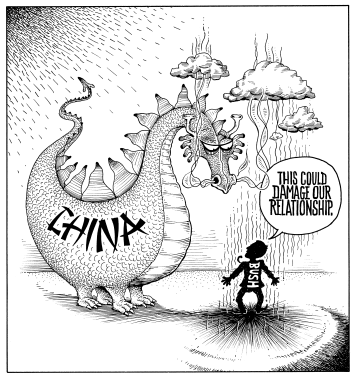
Is this an optical illusion? Why is President Bush so soft with China’s dictators?

HONG KONG (Standard) 07 Feb. 2006 - Keeping up with the tradition of cleansing dirt before the arrival of the Lunar New Year, Beijing was busy getting rid of "bad elements." In the Year of the Dog, Beijing wants to make sure no watchdog barks.

The dirt, in this case, was a weekly insert, Freezing Point, published every Wednesday in the China Youth Daily since 1995. The Communist Party's propaganda department, citing the publication "viciously attacking the socialist system," ordered the shutting down of the weekly, which the authorities also condemned as deviating from the orthodox historical viewpoints handed down by the party.

This is only the latest crackdown on China's never free but increasingly vibrant media. On January 19, a former deputy editor of Fuzhou Daily stood trial on charges of fabricating and spreading false information on terror.

Two days earlier, two editors from the New China Youth and an online journalist received heavy prison sentences for writing about illegal land confiscation without authorization.

At the end of 2005, three top editors at Beijing News were dismissed, causing a rare walkout by journalists in protest.

The Chinese Communist Party has never valued press freedom, but this succession of crackdowns seems extraordinary. It doesn't square with a country which, according to many Western press and experts, is growing stronger and more peaceful every day, and is destined to recapture its historical place in the world. If anything, it is more a sign of paranoia and weakness.

Perhaps a little known decision by Beijing can shed some light on the state of mind of the occupants of the Zhongnanhai compound.

Last November, Beijing halted plans to let foreign newspapers print in the mainland. Shi Zongyuan, head of the general administration of press and publication, told the Financial Times: "The `color revolutions' were a reminder not to let saboteurs into the house and that the door must be closed, so we have closed it temporarily."

It is telling that members of the mainland leadership see their country in the same category as Georgia, Ukraine and Kyrgyzstan. They must know something we don't.

It's one thing for Beijing to try to silence critics - after all, it's stated clearly in the job description of a dictatorship. It's quite another for some US businesses, especially those supposedly in the business of spreading information, to assist Beijing in its job. For Internet giants to participate in the censorship game is disgraceful.

Yahoo helped Beijing track down reporter Shi Tao who was sentenced to 10 years in jail last spring. His only sin was to use Yahoo e-mail to send "state secrets" overseas.

Microsoft, the company owned by the world's richest man, Bill Gates, shut down the blog site of Zhao Jing in January. Zhao, a researcher at The New York Times' Beijing bureau, was using its MSN online service to criticize the firing of the editors at Beijing News.

Google, of course, has generated the latest round of controversy by launching a Chinese search service that bases its censorship decisions on guidance provided by Beijing.

While I understand companies are not human rights organizations and their job is to make money and not enemies, to get involved in the direct oppression of the Chinese people and try and hide behind the "we have to follow Chinese laws" excuse is simply no excuse.

Google perhaps can defend itself by pointing to the fact that, unlike Yahoo and Microsoft, it will not provide any user information to Beijing because e-mail and blog services will not be offered in China. But Google is the most hypocritical. It does not have a problem following the law when in China, but refuses to let the US government obtain data on its users' search habits. China carries more legitimacy than America to Google.

Republican congressman Chris Smith will chair a hearing to examine the operating procedures of American Internet companies in the mainland. If businesses only follow the dollar sign and Chinese laws, then it's time for Congress to do something.

It pains me to see the administration of George W Bush kowtowing to the Chinese regime.

At Kansas State University recently, Bush said he enjoyed warm personal relations with his Chinese counterpart and the importance of this "personal diplomacy" enabled him to press the freedom issue with the Chinese. Bush said that "nobody likes to be lectured in the public arena. I don't like it and I'm sure other leaders don't like it."

I'm dismayed at the return of the useless "quiet diplomacy" with China.

Condoleezza Rice also gave some disappointing remarks on China last week. She told an audience at the World Economic Forum in Davos that we need to encourage China to act responsibly and contribute more to the world.

"I do think that China is beginning to understand those obligations," she said.

For once, the usually sensible secretary of state was displaying wishful thinking.

But perhaps nothing captures the essence of US China policy more symbolically than what Deputy Secretary of State Robert Zoellick did in China, at the same time when Freezing Point was shut down.

He took some time off and went to the city of Chengdu and engaged in the important business of hugging a panda.

Sunday, February 05, 2006

Bar Entry to China's Chen Zhili for Crimes Against Humanity


Former Education Minister to face lawsuit if allowed to enter into Canada


08 Feb. 2006 - Chinese Communist Regime’s State Council Chen Zhili Served with Court Papers in Vancouver for Torturing Canadian Residents


VANCOUVER (FDI) 5 Feb. 2006 – The Falun Dafa Association of Canada has requested that the Canadian government deny entry to the former Chinese Minister of Education, Chen Zhili, for her role in committing crimes against humanity in the persecution of Falun Gong.

Chen Zhili is expected to arrive in Vancouver on Tuesday, February 7th.

Between 1999 and 2003, while serving as Minister of Education, Chen Zhili launched a Cultural Revolution-style campaign throughout China’s education system ordering teachers and students to undergo “political shaping of thoughts” with respect to Falun Gong. Amidst the campaign, teachers and students who practiced Falun Gong were sent to brainwashing centers where they underwent psychological and physical torture.

As of Jan. 29, 2006, 150 teachers and students have been tortured to death for their belief in Falun Gong, many of them as a direct result of Chen’s policies. Several Canadian residents are among those who were tortured and persecuted under orders from China’s Ministry of Education at the time when Chen oversaw it.

"Chen Zhili, as Minister of Education, controlled and implemented policies and operations which targeted and persecuted Falun Gong practitioners in China's education system,” says David Matas, lawyer for the Falun Dafa Association. “She personally and intentionally directed, supported, supervised, and condoned the systematic persecution and torture of the Falun Gong practitioners in China's Education system.”

Matas has requested that the relevant Canadian agencies deny Chen Zhili a visa to enter Canada and bar her from landing on Canadian soil in accordance with the Canadian Crimes Against Humanity and War Crimes Program.

If Chen is allowed to enter Canada, the Falun Dafa Association will take legal action against her for her role in the persecution of Falun Gong.

Related Article:
How China’s Propaganda Machine Tries to Fool the World

Thursday, February 02, 2006

China-Tibet: Slaughterhouse Incident


Tibetan, Blinded, Freed from Jail, Five Still Held for Slaughterhouse Fire

by Jigme Ngapo

KATHMANDU (RFA) 01 Feb. 2006 - Authorities in the southwestern Chinese province of Sichuan have released one of six Tibetan nomads held in connection with the burning of a Chinese-owned slaughterhouse, after prison beatings and an untreated infection left the man blind, Tibetan sources said.

“Six who were suspected as the main culprits were arrested and jailed. One of the six was released since he lost both his eyes [after] beatings by Chinese prison officials and a severe infection,” one source told RFA’s Tibetan service.

More than 160 Tibetans were detained after hundreds of people stormed and set fire to a Chinese-owned slaughterhouse on Aug. 5, 2005, in Manikengo (in Chinese, Manigange) township in Kardze (Ganzi) Tibetan Autonomous Prefecture in what is now Sichuan, sources said.

Scores of police and security forces rushed to the slaughterhouse, built in 2004 by a Chinese entrepreneur and his partner, a county official, the said.

Man released after going blind

All but six of the Tibetans were released, although when they were released was unclear.

The six men held in a Dege County jail have been identified as Sherab Yeshi, aged around 70; Sogya [one name], aged around 50; Dawa [one name], aged around 30; Dawa, aged around 50; and two other men about whom no details were available.

Only Sogya was released after he became blind as a result of beatings and an untreated infection, acording to several sources.

Government officials declined to comment on the case or the fire, and whether any of the six have been officially charged, tried, or sentenced was unknown.

The slaughterhouse, known to Tibetan residents as the Manikengo slaughterhouse, is said to be registered as the Dege Longsheng Yak LLC, a subsidiary of Chengdu Ganzi Longsheng Meizi Yak Ltd. Inc.

According to the official Ganzi Net news Web site, attendees at the Oct. 17, 2004 opening ceremony included Deputy Governor of Ganzi Tibetan Autonomous Prefecture Tao He, Deputy Chairman of the Ganzi People’s Congress Dan Zen Luo Bo, Director of the Ganzi Bureau of the Animal Husbandry Abeng [one name], and Dege County Magistrate Jingqiang Zhao.

Locals angry over slaughterhouse

The crowd that converged on the building last August appears to have been especially large because the incident occurred during the annual Tibetan horse race festival, which attracts thousands of people, the sources said.

The Tibetans, some of whom said they were angry because they had been pressured to sell their animals for slaughter at below-market prices, broke into the building and found what they described as a large number of animals, including dogs and horses, the sources said.

They freed all the animals and set fire to the building, sources said. Whether the building was completely razed or badly damaged was unclear.

Accounts of the incident offer a rare glimpse of tensions between ethnic Tibetans and Chinese authorities in this remote and undeveloped region, under the administration of Sichuan province since 1949.

Friction over the existence of the slaughterhouse is said to have been escalating for more than a year, with monastic leaders trying to buy the property and the Chinese owners refusing to sell it. At one stage in 2004, local residents said, the Tibetan community organized a boycott of the slaughterhouse.

“It was ordered that the local Tibetan nomads should sell animals to the slaughterhouse at a reduced rate, but no local Tibetan nomads sold animals to the slaughterhouse,” one source said.

“The local Tibetans didn’t like the idea of huge slaughterhouse in Dege county, [and] it had no business last year. Neighboring Pawon [in Chinese, Babeng] township planned to sell them about 300 yaks, but the local nomads of Manikengo objected and the proposal was withdrawn.”

Kalsang Rinpoche, reincarnate lama of Dzogchen Monastery, and Khenpo Sherab Sangpo, abbot of Golok Serta Buddhist Center, together offered to buy the slaughterhouse for 100,000 yuan, one source said, but the owners refused to sell.

RFA reporters were unable to locate the owners of the slaughterhouse for comment.


Wednesday, February 01, 2006

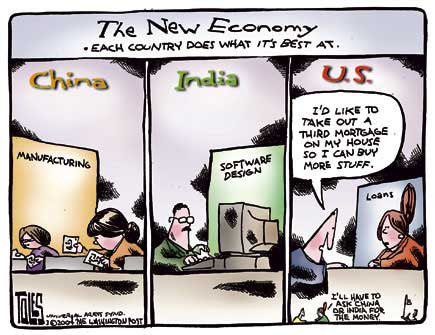
China-India Race


If China is Asia's hare, India is its tortoise in race that may surprise

By William Pesek


HONG KONG (Standard) 01 Feb. 2006 - If you want to shock an audience of business people, make this argument: Twenty years from now, India's rise will be more impressive than China's.

The conventional wisdom is that efficient and rigidly controlled China will leave unsteady, plodding India in the dust. That certainly was the buzz at last week's World Economic Forum in Davos, Switzerland.

Two decades from now, a very different outcome may befall Asia's two nascent superpowers - one that investors should consider carefully.

For an indication why, check out downtown Chennai. The southern city of 4.2 million is India's fourth largest and, like Mumbai and New Delhi, it is experiencing a retailing boom.

Chennai's proliferating malls are abuzz with fashionably dressed 20somethings showing off their growing affluence. They're sipping pricey espressos, buying Italian handbags and text-messaging each other on hyper-modern cellular phones.

It's scenes like these that have economists such as Stephen Roach at Morgan Stanley saying: "India is on the cusp of something big." As a share of gross domestic product, its burgeoning consumer sector is outpacing China, Europe and Japan. Economists are also noticing that India's economy is looking less like those in East Asia and more like those in the West.

True, even the most superficial look at Asia's second- and fourth-biggest economies - China and India, respectively - argues in China's favor. Its world-class infrastructure, glistening skyscrapers, massive supply of cheap labor and ability to direct huge resources anywhere they're needed make it a limber hare.

India is Asia's tortoise, plodding along as China races off with a leading chunk of the world's direct foreign investment. Its infrastructure is an embarrassment, its bureaucracy a major economic headwind and its crushing poverty a reminder of challenges facing the world's second-most populous nation.

Here, the Aesop fable about the tortoise and the hare may offer some insight. In it, the hare, the clear favorite in the race, shoots ahead only to lose steam before the finish line. The less athletic, but steadily progressing tortoise wins in the end.

But for all its warts, India boasts a level of ground-up entrepreneurship China's top-down model can't match. It's created world-class, globally competitive companies and a real stock market, unlike the financial casinos that pass for equity bourses in China. India also has a liquid bond market and its banking system isn't bogged down by bad loans.

Education policies, an ever- increasing pool of English speakers, demographic trends and political stability also are strengths. Democracy can be an inefficient, messy process and nowhere is that truer than in India.

Yet it is civil society, a free press and accountable government that offer stability. China's transition from a command economy to capitalism poses many risks, including social instability.

So seduced are investors and executives by what could go right in China, they often forget all that could go wrong, too.

Here are three reasons to wonder if China has the stuff to remain ahead of India by the year 2026.

The first is entrepreneurship. For all the stories about China churning out millions of engineers and scientists, innovation is not at the heart of an economy that grew 9.9 percent last year. Foreign investment and massive government spending drive China's boom.

India isn't exactly running on a single engine. Its economy is growing at an 8 percent rate with far less domestic and foreign investment than China. Simply put, it has done a more impressive job of creating a living, breathing economy.

The second big issue for China is piracy. While India has its challenges, it does a far better job of protecting intellectual property rights.

China must create technologies and products no one has thought of before. Its future as an innovative powerhouse - and its ability to create millions of new jobs as a result - depends on protecting the ownership of those advances. If Chinese innovators can't profit from their ideas because their fellow countrymen steal them, why should they bother?

Third, China's rise itself. Nothing has provided a more abrupt wakeup call to India than China's emergence as a global economic power. That may just be the catalyst needed to shake India out of its lethargy and kick the economy into higher gear.

If it can, India may prove true something else that Aesop wrote long ago: "Men often applaud an imitation and hiss the real thing."

Related Articles:

China e-Lobby: Communist China and India: They are not the same

Business Week: Crouching Tigers, Hidden Dragons

Reviving the China Threat


U.S. must forumulate policy regarding China

by Brad Vogel


WISCONSIN (Badger Herald) 30 Jan. 2006 - It is time to wake up and smell the cold war, America.

China is no longer simply the place where everything is made. Today, it is a nation poised to challenge the United States’ global leadership and radically reorder international standards if it manages to succeed. Economically, militarily and diplomatically, the Middle Kingdom that long ago turned inward upon itself is exploding outward, engaging the world with its newfound prowess. As it takes these steps, China inevitably butts up with Uncle Sam. The defunct U.S.S.R. no longer threatens Western civilization as it did when we were children. The emerging standoff features a new antagonist — a dragon instead of a bear.

As the United States remains transfixed by the global fight against Islamic terrorism, and as our nation graduates fewer math and science majors than India or China, it is time to wonder whether we missed our modern day Sputnik. We must wonder whether the significance of the Chinese spy plane incident of 2001 was overshadowed all too quickly by the events of Sept. 11, 2001. We missed our wake up call — and we did so at our own peril.

America should not hasten her own downfall with complacency in the face of a rising China. The U.S. economy grew at a rate of just less than 4 percent in 2005. In the same period, the Chinese economy grew at a rate of more than 9 percent — this coming after a decade of sizzling growth many thought impossible. The continuing Chinese military buildup financed by such economic vitality also surprised observers who had confined Chinese military aims to threatening Taiwan and bullying Japan.

The world’s most populous nation has confounded predictions on many fronts, however. Open democratic governance, long prophesied as an inevitable companion of Deng Xiaopeng’s economic reforms, has not emerged in the long shadow of Tiananmen Square. It should have by now.

Instead, the Chinese economy forges onward while political freedoms remain elusive. The Chinese Communist Party, its ideology bankrupt, resorts to fomenting radical anti-U.S. and anti-Japanese nationalism, as seen after the mistaken 1999 bombing of the Chinese embassy in Belgrade, to maintain its monopoly on political power. While distracting its populace and using economic freedoms as bread and circus, the CCP is free to crack down on spiritual organizations like Falun Gong and the Roman Catholic Church, repress knowledge (aided and abetted recently by Google) and enforce an inhumane one-child policy.

China’s regrettable actions are not restricted to the land behind the Great Wall, as seen in the nation’s foreign policy. China has been a consistent obstacle to U.N. action in the Darfur genocide, using the threat of its veto on the Security Council to defend its sizable oil and arms sales interests in Sudan. Sudan is certainly not the only rogue nation where China looks the other way with regard to human-rights abuses.

Support of pariah nations like Sudan in exchange for mineral resource wealth typifies contemporary Chinese actions abroad. China’s voracious appetite for energy resources, evidenced by a Chinese state oil company’s bid for Unocal petroleum in summer 2005, has drawn it outside and beyond its traditional sphere of influence.

In the vacuum left by U.S. disdain, Beijing built “a strategic alliance” with leftist stooge Hugo Chavez in Venezuela. It embraced dictators in Zimbabwe, Myanmar and Uzbekistan. China’s sheer economic clout, financed largely by U.S. direct foreign investment and consumer spending, is pulling nations like Australia, Bangladesh and even Chile into its orbit.

In 2004, Chinese troops landed in Haiti as part of a U.N. force — the first time Chinese military forces deployed in the western hemisphere. Chinese influence is not staying at home. The stage is being set, it seems; the battle lines are being drawn whether we like it or not. The pieces are subtly arranged on the board.

This chess game is a momentous one. China may not have a powerful carrier-based blue water navy, but its soft power — its economic weight, its cultural influence and its vast spy network in the United States (revealed in the past year by a number of defectors) — rivals America’s ability to arrange the players. It is this strategy that the Chinese employ to “put themselves beyond the possibility of defeat” without firing a shot, to quote Sun Tzu’s “The Art of War.” The question is this: given our present focus on the Middle East and our contentment with cheap Chinese goods, will we wake up? Will America recognize its possible successor for what it is or nonchalantly tip its king?

World powers wax and wane. China’s Ming Dynasty, with its massive treasure fleets, eclipsed all other powers in the world in the 1420s. Only with the rise of Mao Zedong in 1949 did the nation begin its reemergence in its quest to regain a leading role. This new cold war is not inevitable, but the United States, star of the global stage, should not content itself with a subtle demotion to understudy.

Hit the alarm, America. Peel back the sheets and rub your eyes. That’s no panda at the window. It’s a dragon.

Brad Vogel (bvogel@badgerherald.com) is a senior majoring in political science and journalism.

Related Article:

Asia Times Online: Reviving the China Threat