Search This Blog

Thursday, March 09, 2006

CCP Kills Falun Gong for Organ Harvesting in Secret Concentration Camp


“Nobody has yet come out,” Government Insider Reveals


Below is a related testimony on organ harvesting from Wang Guoqi, former PRC doctor. It is not intended to shock you but rather to put things into perspective while looking at the present situation at the Sujiatun Concentration Camp in Shenyang City. Once again the butchers of Beijing show how unscrupulous they are with emphasis on how the evil specter of the CCP goes against the law of heaven and earth.


Habeas Corpus

(...) Although I performed this procedure nearly a hundred times in the following years, one incident in October 1995 has tortured my conscience to no end. We were sent to Hebei Province to extract kidneys and skin. We arrived one day before the execution of a man sentenced to death for robbery and the murder of a witness. Before the execution, I administered a shot of heparin to the prisoner to prevent blood clotting. A policeman told him it was a tranquilizer to prevent unnecessary suffering during the execution. The criminal responded by giving thanks to the government.

At the site, the execution commander gave the order, "Go!" and the prisoner was shot to the ground. Either because the executioner was nervous, aimed poorly, or intentionally misfired to keep the organs intact, the prisoner had not yet died but instead lay convulsing on the ground. We were ordered to take him to the ambulance anyway, where urologists extracted his kidneys quickly and precisely. When they finished, the prisoner was still breathing and his heart continued to beat. The execution commander asked if they might fire a second shot to finish him off, to which the county court staff replied, "Save that shot. With both kidneys out, there is no way he can survive." The urologists rushed back to the hospital with the kidneys, the staff and executioner left the scene, and eventually the paramilitary policemen disappeared as well. The burn surgeons remained inside the ambulance to harvest the skin. We could hear people outside the ambulance, and fearing the victim's family might force their way inside, we left our job half-done, and the half-dead corpse was thrown in a plastic bag onto the flatbed of the crematorium truck. As we left in the ambulance, we were pelted by stones from behind. Read the full story.


Concentration Camp for Falun Gong Disclosed;
Prisoners Killed for Organ Harvesting

NEW YORK (FDI) 09 March 2006The Falun Dafa Information Center received shocking, detailed information on Wednesday from a Chinese Communist Party insider documenting a concentration camp set up in Shenyang city, Liaoning province, expressly for Falun Gong practitioners. The news comes on the heels of the Department of State’s 2005 Country Reports on Human Rights Practices, released Wednesday; the report documents continued, systematic abuses of the Falun Gong in China.

Information about the camp was relayed via audio recording from a former intelligence agent of the Chinese government. It is the first time news of the secret camp’s existence was disclosed to outsiders. The camp is said to hold over 6,000 Falun Gong adherents at any given time, and “nobody has yet to come out” from it alive. According to the source, it contains a crematorium, and an unusually large number of doctors work there—reflecting the camp’s practice of killing prisoners for their organs, which are then sold for profit.

The source tried to convey the horror of what is happening in the concentration camp: “Why was a crematorium built, and why are so many doctors housed there? … The answer is something unimaginable. You must be clear that a cremator for bodies is different than a burner used for sanitation purposes.”

Located in the Sujiatun district of Shenyang city, the camp, dubbed the Sujiatun Concentration Camp, is surrounded by walls three meters high topped with electrified barbed wire. It is heavily fortified and said to be highly secret; locals know close to nothing about it. Those held inside are Falun Gong adherents from China’s three northeastern provinces as well as central China; many are said to have been transferred there from various labor camps. CCP authorities involved with the camp have “learned many things from North Korea,” according to the source.

“This is deeply, terribly disturbing, and confirms our worst fears: that CCP authorities remain intent on ‘eradicating’ Falun Gong, and in their desperation will go to any lengths,” stated FDI spokesperson Mr. Erping Zhang. “We need to be clear that the persecution has not gone away—it has merely become darker and more hidden.”

The Chinese government source spoke at length about the unlawful “harvesting” of organs in the Sujiatun facility. “If Falun [Gong] practitioners are sent to Sujiatun,” he said, “they have no chance of coming out … The CCP won’t let a prisoner consume food forever. So what are they up to, then? … the Falun Dafa practitioners are killed for their organs, which are sent off to various medical facilities. Organ sales is now a highly profitable business in China.”

“They can’t find enough bodies through executions, and no bodies are more readily available for this business than those of the [Falun Dafa] practitioners,” he stated.

Warning signs have surfaced in recent months.

Last June CCP authorities reportedly held a “crisis meeting” in which China’s deputy minister of Public Security, Liu Jing, was assigned the job of “stamping out” Falun Gong “before the Olympic Games in 2008,” according to the Paris-based Intelligence Online. Several reports have stated that authorities wish to use the Olympics as a pretext to deepen their assault on the Falun Gong.

This past January Chinese officials similarly announced a “new campaign” that would supposedly “sabotage activities of cult organizations” as part of a “complex struggle against enemies,” according to a Reuters report. Past campaigns to “strike hard” have resulted in upwards of 10,000-plus executions in a single year, say human rights groups.

Word of concentration camps for Falun Gong practitioners has circulated for several years. An October 1, 2000, report by Agence France Presse told of two concentration camps having been recently built, both specifically for Falun Gong detainees. The camps were said to have been built in northwest and northeast China, and been capable of each holding up to 50,000 persons.

An October 6, 2000, report on Minghui.net stated that a concentration camp, expressly for the Falun Gong, had been built in the remote northwestern province of Xinjiang. Chinese sources report seeing Falun Gong adherents shipped off on trains to the Xinjiang camp. Little to no information on the secretive camp has emerged. No one to date is known to have come back from the camp.

Stated Mr. Zhang, “International media and governments around the world must pay attention to this and take active measures to investigate the concentration camp and put a stop to this barbarity and madness. We are calling for all possible support from international organizations. There must be accountability in China. If this is the price people are paying for our silence, it is chillingly tragic.”

Related Articles:

Epoch Times: Exposing the Shocking Horrors Behind Sujiatun Concentration Camp's Closed Gates

Epoch Times: Illegal organ business booms

Wednesday, March 08, 2006

The CCP cheats the peasants once and again


Best viewed in Mozilla

Clintonian Communism is an excellent review from WSJ on the National People’s Congress opening session. The author cuts through the glossy package and delivers nothing but the bare bones. Look here for some of my insights on this topic. It’s clear that China’s dictators make it sound like they are very concerned about the peasants and we know why that is. First let’s have a look at the Nine Commentaries on the Communist Party to see how the CCP really takes care of their peasants. It's no wonder that they are rebelling with over 84,000 riots a year.

The CCP Cheats the Peasants Once and Again

CCP relied on peasants to gain power. The rural residents in the CCP-controlled areas in the early stage of its buildup devoted all they had to the CCP. But since the CCP obtained control of the country, peasants have experienced severe discrimination.

After the CCP established the government, it set up a very unfair system – the residential registration system. The system forcefully classifies people into rural and non-rural populations, creating an unreasonable separation and opposition within the country. Peasants have no medical insurance, no unemployment welfare, no retirement pensions, and cannot take loans from banks. Peasants are the most impoverished class in China, but also the class carrying the heaviest tax burden. Peasants need to pay a mandatory provident fund, public welfare fund, administrative management fund, extra education fee, birth control fee, militia organization and training fee, country road construction fee and military service compensation fee. Besides all these fees, they also have to sell part of the grains they produce at a flat rate to the state as a mandatory requirement, and pay agriculture tax, land tax, special local produce tax, and butchery tax in addition to numerous other levies. In contrast, the non-rural population does not pay these fees and taxes.

In the beginning of 2004, China’s Premier Wen Jiabao issued the “No. 1 Document,” stating that rural China was facing the most difficult time since the beginning of the economic reform in 1978. Income for most peasants had stagnated or even declined. They had become poorer, and the income gap between urban and rural residents continued to widen.

In a tree farm in eastern Sichuan province, upper level authorities distributed 500,000 yuan (approximately US$ 60,500) for a reforestation project. The leaders of the tree farm first put 200,000 yuan in their own pockets, and then allocated the remaining 300,000 yuan to tree planting. But as the money was taken away when passing through each level of the government, very little was left in the end for local peasants who did the actual tree planting. The government did not need to worry that the peasants would refuse to work on the project because of inadequate funding. The peasants were so impoverished that they would work for very little money. This is one of the reasons that products made in China are so cheap.

Clintonian Communism

WSJ: 07 March 2006 - There's something for every common man in these legislative proposals: socialized health care, handouts to the agricultural lobby and welfare reform. No, we're not recalling Bill Clinton: we're talking about China's annual National People's Congress (NPC) that kicked off on Sunday. Like Mr. Clinton's last term in office, Beijing's priorities reveal just how uncertain the Communist Party has become -- in power and in ideas.

Premier Wen Jiabao delivered the requisite laudatory spiel to kick off the stolid affair, hailing China's "new progress" in "all social undertakings." Some of the achievements sounded, if you'll pardon us, almost French: Social security coverage "was expanded"; the party "launched in-depth, specialized environmental protection programs." Hong Kong's "elected" leaders, sitting in the Great Hall of the People to hear the address, looked distinctly uncomfortable.

Mr. Wen soon honed in on the party's newest New Ideas: narrowing the income gap between the urban rich and rural poor, and convincing citizens to spend more and save less. And as a thoroughgoing populist might do, he laid out the goodies: $42 billion in rural spending, $23 billion in welfare outlays, $584 million to health care projects, nine years of free compulsory education for rural youth, the elimination of agricultural taxes, and promises for more infrastructure projects in the countryside, among other things.

Clearly, Beijing's top brass are worried about pacifying the peasants, who are angry about property expropriation, corrupt local officialdom and a significant deterioration in social services. The oft-quoted 74,000 official violent incidents in 2004 probably understates the scale of the unrest.

We'll ask the obvious question: If China's leaders are so concerned about their rural poor, why are so much of the NPC's budget outlays devoted to the military? The party recently announced a 14.7% bump in the defense budget, now officially a $35.3 billion annual outlay and most likely much more in reality, at a time when saber rattling towards Taiwan is growing stronger. ("No one can stop" the reunification, Mr. Wen declared, to applause.)

As for the party's handouts, most probably won't reach intended recipients, thanks to local corruption. Shame. We're not quibbling with the need to bolster health care and education services in China's vast countryside, which lost most of its state-provided social welfare net when Deng Xiaoping's reforms started to truly take hold. We'd even admit that private market mechanisms may not sprout easily in China's more remote provinces.

But for the vast majority in China, now's the time to get economic incentives right. Contrary to popular belief, one of the primary reasons why China's health care reforms haven't worked is because the system wasn't truly privatized. Instead, China simply told hospitals to start charging for their services, without any reference to a true market price. Nor did Beijing allow robust foreign competition. The same goes for education: Beijing hasn't even considered letting a truly private market for schools get off the ground.

As for raising consumption -- a worthy goal, meant to rebalance China's growth away from exports and investment -- surely Beijing could loosen capital controls and let the Chinese invest in foreign stocks and bonds with a decent annual return. Critics argue this can't happen until the banking reform is completed, because domestic banks need the liquidity to keep afloat. But what about all those foreigners who are begging to own more of China's domestic banks? And what better way to encourage fast reform than to let banks compete for business?

The NPC will drag on until the end of next week in Beijing, but its ultimate message is already clear: parties without popular legitimacy have to find ways to buy their citizens' love. That is the rationale of machine politics wherever it's found. The problem is that the greed of the foot soldiers often overwhelms whatever benign instincts the leaders have.

Monday, March 06, 2006

Quick Take on Communist China and their 'new' slogans


by M.Makina


Best viewed in Mozilla

Looking at a piece from the National Post entitled 'China Economy Below Expectation' about the National People's Congress, it is indeed very nice for China's dictators to have put the peasants at the top of their do-good agenda. It sounds so credible that it’s sure to be a crowd pleaser particularly for the well off investors who just can't get enough of China--especially when they don't have to pay green fees when setting up their sweatshops. This lack of social responsibility results in frequent environmental disasters occurring in Mainland China--what is more worrisome is that there might not be any drinking water left for the next generation. Red alert...or should I say Green Alert?

But let's get back to this article that talks about easing tension and finding solutions. It is an open secret that whenever an eyesore surfaces in Communist China, such as the peasants' unrest, the dictators (CCP) put on a great show—they go out of their way to publicize the remedial action in a diplomatic fashion. People call this phenomena ‘sincere pretension’. A fraction of what is proposed might get done for the record, and if it involves money, the peasants might get next to nothing by the time it gets to them--the CCP will have shamelessly pocketed the bulk of it. Meanwhile the killing goes on full tilt in the backroom and this is how the Party sustains itself; by killing and robbing. Canada is a big culprit in directly and indirectly encouraging this corrupt behaviour. Throughout the years the Liberals have shamelessly provided $50 million annually in foreign aids to Communist China, a country that has its own space program, a strong military build-up, a prosperous (?) economy with an abysmal human rights record. Some third world country! I think there is a lesson to be learned here. For one thing with better budgeting, the dictators could spread the dough to the Northern part of China, thereby taking care of the poverty problem.

So how does Hu Jintao and Wen Jiabao care for peasants? Is it by opening fire on unarmed citizens who protest the loss of their land to construction projects and future Olympic sites, plus the fact that they only get a pittance for their agricultural land? With thousands of paramilitary police to contain the unrest—it is a do or die situation. Wasn’t this situation of unrest created by the CCP in the first place by bulldozing their homes down to the ground without prior consultation? Now the CCP is trying to look good by saying they want to fix things? What is wrong with this picture? Just read up on the Hanyuan, Shanwei, Taishi, Sanjio, Zhongshan massacres and see what the victims of the last CCP strike hard campaigns have to say—you might find it shocking. It seems that most massacres take place in Guangdong Province lately. It is clear that the CCP’s big dream of making this Province the center of China’s economy is in big trouble. It’s not surprising when the governor of Guangdong, Huang Huahua, is a notorious criminal throughout the Mainland. Because of his bloodlust he personally inspects the jails where Falun Gong practitioners are held to ensure that they get the worst inhumane treatment possible. Bearing that in mind it wasn’t difficult for me to serve him with legal papers when he was in Victoria last fall, on behalf of a Calgary practitioner. He had been persecuted under Huahua's jurisdiction for two long years in the harshest environment. Needless to say that Huahua cut his trip short after that episode and returned to China without Donald Tsang and the gang (600 of them). Nevertheless he left his mark behind by donating 2000 communist books to the Vancouver Library. Exporting their communist ideology through culture is where the CCP is at right now…how can people say no to culture. Well luckily some do!

Back to the Congress—the CCP has a lot more to worry about than just how poor the peasants are! Besides the fact that the Red Dragon is dying and that every attempt has to be made to keep it (the CCP) alive, their lack of free speech has been targeted heavily lately by the caving in of the web giants. The CCP's real corrupt nature has been widely published in the Dajiyuan/Epoch Times, New Tang Dynasty TV, and Sound of Hope and this alone is enough to keep the Party officials awake at night. And a few more things--

1) so far over 11 million have quit the Party after reading the shocking truth of the CCP's uncensored history of slaughtering their people in the Nine Commentaries on the Communist Party

2) the Party has never been able to eradicate the spiritual Falun Gong in three months like they first intented to—this is the 7th year of the persecution and the Falun Gong are still appealing for justice and going strong

3) defectors are speaking out against tortures conducted by the 610 Office (Chinese version of the Gestapo) breaking news with spy networks mostly prevailing in Canada, the US, and Australia

4) Christian human rights attorney Gao Zhisheng, known as the Martin Luther King of China, has been to the rescue of victims of the CCP's tyranny by defending them including Christians, Falun Gong and peasants. To protest the injustice and persecution by the vile Party, Gao went a step further and wrote a few open letters to Hu and Wen urging them to stop the persecution. Later on Gao, along with his colleagues, started the Relay Hunger Strike for human rights in China. Despite the arrests and recurring threats on their lives including failed assassination attempts, these lawyers have promoted this effort internationally and activists (in China) have signed up for the relay hunger strike for a whole year ahead of time. Overseas the hunger strike is in full swing especially in major cities. You can join in by posting your name here. When asked about the movement of quitting the CCP and the hunger strike, Gao said: “They are indeed quite similar in terms of ideology and methods adopted. They are both non-violent and non-cooperative movements that show no fear of the despotic rule.”

The other slogan that is transparent in the Congress’ agenda is the debacle about keeping Taiwan on a permanent leash which is the ongoing diversion that the CCP has been faithfully using for some time now to take the focus off the big fours that they fear the most.

Other than that the rest of the agenda is as glossy as can be!

China economy below expectations

National Post (AP) 05 March 2006 - Premier Wen Jiabao opened the annual session of China's legislature Sunday with promises of new social spending to placate the country's rural poor and said the economy is expected to slow but should still grow by eight per cent.

Wen warned Taiwan, which the Chinese government claims as its own territory, not to pursue formal independence.

The session of the National People's Congress is to focus on efforts to ease tensions over the gulf between China's rich and poor by spending more to help the countryside, home to 800 million people and others left behind by its economic boom.

"Building a `new socialist countryside' is a major historic task," Wen said in a nationally televised address to 2,927 NPC delegates.

The government is promising to spread prosperity to the countryside amid mounting rural anger over chronic poverty, corruption and the seizure of farmland for factories and other development projects.

This year, Beijing will spend the equivalent of $6 billion Cdn more on rural schools, hospitals, crop subsidies and other programs, raising spending on those areas by 15 per cent, Wen said.

There were no immediate signs of protests around the Great Hall of the People in central Beijing, where streets were closed and the government said 15,000 police officers were deployed. Protesters detained in previous years have included laid-off workers, farmers with land disputes and members of the banned Falun Gong movement.

The premier promised "fast yet steady" economic development but said growth is expected to fall to eight per cent this year -- down from 9.9 per cent last year and below a World Bank projection of 9.2 per cent for 2006.

Beijing has been trying to restrain sizzling growth in recent years, warning a prolonged annual rate above nine per cent could cause inflation and financial problems.

Wen said a key government priority will be increasing domestic consumption -- part of efforts to sustain growth, while easing reliance on exports amid pressure by the United States and other trading partners to cut China's huge trade surpluses.

The premier also warned Taiwan's leaders against pursuing formal independence -- a step Beijing has warned could lead to war with the island, which has been split from the mainland since 1949.

"We will uncompromisingly oppose secessionist activities aimed at Taiwan independence," Wen said.

Beijing has no official relations with Taipei and reacted angrily this week when Taiwanese President Chen Shui-bian abolished an agency dedicated to unifying the island with the mainland.

The premier's report included no mention of political change -- a taboo topic in a system where the Communist party rejects any challenge to its monopoly on power.

The government announced Saturday its military budget this year will rise by 14.7 per cent to the equivalent of $40 billion.

China has given its 2.5 million-member People's Liberation Army double-digit spending increases nearly every year since 1990.

A series of closed-door meetings during the session are expected to give delegates a chance to air grievances and propose their own ideas for change.

Political and health activists and some people with AIDS who have complained of poor medical treatment were detained by the government or ordered to stay at home ahead of the session in an apparent effort to prevent protests.

Sunday, March 05, 2006

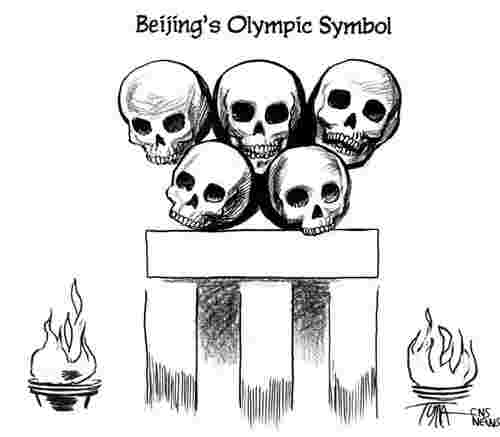
Say No to the Communist Olympics


Best viewed in Mozilla

Should Communist China, with their abysmal human rights record, deserve the honour of hosting the 2008 Olympics?

How will the world react to the host of the 2008 Communist Olympics once the true corrupt nature of the CCP is truly revealed? The defectors have spoken , the Falun Gong , Tibetan supporters and activists are clarifying the facts. China’s rights defenders have started the Global Relay Hunger Strike last month. This worldwide effort is exposing the evil deeds of the Party and is opening a door to free speech. The Epoch Times’ Nine Commentaries on the Communist Party is going a step further with spreading the horrific uncensored history of the CCP--like a sweeping force throughout Mainland China it has triggered over 8 million Chinese to quit the wicked Party so far. What if the Party dissolves before the 2008 Beijing Olympics? Looking at the past China e-Lobby weighs the situation and comes up with a few creative alternatives.

China e-Lobby: 02 March 2006 - Now that the Winter Olympics of Turin (or Torino) have ended, the eyes of Olympic watchers are turning to the next Olympic host city, which for now is still Beijing, the capital of Communist China. Not content with the Hitler Olympics of 1936 and the Brezhnev Games of 1980, the International Olympic Committee chose to fete a dangerous, anti-freedom, and murderous dictatorship yet again. However, we can still show our determination not to let freedom be slighted by either the IOC or the Chinese Communist Party. The democratic world can demand that the 2008 Games be moved, and that if they are not moved we (the U.S., Canada, and the rest of the democratic world) should not let our athletes step foot in Communist China for the Games, but instead will conduct an alternate sporting event on our own.

Why am I raising the issue now? For starters, it would take time to move the Olympics, or to establish the alternate event. An alternate city must be chosen and made ready in either scenario. Additionally, the Communists will soon begin a two-year propaganda warm-up for the Beijing Olympiad, so it would be best to make the case against it sooner rather than later.

The reasons for moving or boycotting the Games are clear. No regime has more blood on its hand than the Chinese Communist Party. It has murdered over 60 million people in just over a half-century. Moreover, its murderous ways (contrary to popular belief) have not let up one iota, as shown in the persecution of Falun Gong and the Hanyuan County massacre.

Additionally, Communist China is a menace to the democratic world. The regime is the largest benefactor of terrorism on earth. To this day, it has propped up the Stalinist regime of Kim Jong-il, who has himself starved millions to death in northern Korea. Just recently, the regime granted itself permission to conquer the island democracy of Taiwan, and recent reports reveal that the Communists will do just that by 2012 at the latest. The fact that the upcoming Olympics are a critical part of the pre-war propaganda campaign should be reason enough to move the Games .

Of course, not everyone is looking to move or boycott the games. In part, this is due to historical amnesia on the Berlin Games of 1936. While in America that Olympiad is best known for Jesse Owens four gold medals, in Europe it was seen as a Nazi organizational triumph and geopolitical bonanza. Moscow was headed for the same glory with the 1980 Olympics until President Carter pulled the U.S. out of those Games (easily one of the most admirable acts of his entire political career).

Another fallacy used to defend the Communist Olympiad is the theory that the 1988 Olympic games somehow pushed South Korea toward democracy. Nothing could be further from the truth. The protests against the South Korean regime took place in 1987, not 1988. The pressure to democratize came not from the prospect of the 1988 Games, but from the Reagan Administration and the South Korean regime’s hand-picked choice for President, who adopted the democratic reforms of the opposition as his own platform and threatened to refuse the Presidency if said reforms weren't enacted. The grateful people of South Korea elected him President, democratically, six months before the Olympics even began.

No such circumstances exist in Communist China. The Communists do not rely on the U.S. for its protection (as South Korea did), but in fact see America as an enemy. The cadres are focused exclusively on justifying their regime’s survival to an increasingly restive people. The proper historical model is not Seoul, but the aforementioned Moscow or Berlin.

There is still time for the democratic world to take a stand for freedom. Both of Beijing's major competitors for the 2008 Games (Toronto and Paris) missed out on 2012. Either could serve as an alternate site; while Canada may be skittish about this, given the 2010 Winter Olympics in Vancouver, France might be willing to step forward once Jacques Chirac’s successor is elected next year.

Yours truly has been pushing for a Beijing boycott from the moment the Communist capital was awarded the Games in 2001. At this point, with so many athletes' plans already in full swing, an alternate event is the only fair outcome should the IOC not be convinced to move the Olympics. Still, a "Democracy Games," as it were, would be an excellent alternative to the Beijing Olympiad.

Whatever option is taken - boycott, relocation, or an alternative event - the athletes of the democratic world should not be turned in tools for Communist propaganda. If the IOC members will not stand for freedom, the U.S., Canada, and its fellow democracies must do it for them.

China e-Lobby can be found here

Saturday, March 04, 2006

Canadians join worldwide hunger Strike to protest Communist China's recent attack on human rights defenders

Best viewed in Mozilla

Hunger Strike to coincide with the CCP's annual National People's Congress meeting

Courageous Gao was detained early this Saturday morning and released after a couple of hours according to lawyer in exile Guo Guoting. A few weeks ago, an Epoch Times reporter asked Gao, who launched the hunger strike one month ago, about the danger of being attacked by the CCP, and he replied:

I don't want to think about that; indeed a lot of people remind me that, "you are getting more and more in danger!" I asked them, "Why do you think so? What is the representation of danger?" Many friends have told me that the CCP is going to arrest and kill me."

If you take "arresting you and killing you" as danger, you are in danger all of the time, yet when we do not view that as a danger, the danger is not there, and there is no danger.

Since the Chinese communist regime seized power, how many millions of people have been killed? Every day, there are large numbers of people being arrested and killed; one more arrested, one more killed is something very normal.

I believe that it is against the will of heaven for the Chinese communist regime to arrest me. Although the Chinese communist regime often runs against the will of heaven, I have not done anything wrong. Who is doing wrong? Who should be arrested? The Chinese communist regime and its band of criminals should be arrested. "

You can join the rights defenders 24-hour hunger strike at home or in a public place by posting your name here--this effort highlights positive winds of change taking place in Communist China as we speak.

Canadian MP Rob Anders, who was once assaulted on Parliament Hill by Consulate officials for speaking up about China's repressive regime, said in a letter of support: "The rolling hunger strike...brings attention to this situation and puts the Communist Party of China on alert that no matter how ruthlessly they attempt to crush liberty, the will of the people is stronger than that of oppression."

It's time to pay attention to Communist China and hold the CCP responsible for their crimes against humanity. Let's take advantage of the momentum and give the Chinese people a chance to liberate themselves from this hopeless repressive regime.

Toronto/Vancouver 04 March 2006 - Starting March 5th, Sunday night at 8pm EST Torontonians and Vancouverites (5 pm) will join tens of thousands of people in Asia, North America and Europe for a symbolic 24-hour hunger strike to protest the Chinese communist regimes worsening human rights and their recent violent attacks to silence journalists and lawyers who strive to protect Human Rights in China. They also call on the international community to take action and to pay critical attention to China's human rights situation. The protest will coincide with the regimes annual National People's Congress and the Chinese People's Political Consultative Conference.

Recently over 51 human rights lawyers, writers and journalists were secretly kidnapped, beaten severely or illegally shut down and threatened by the Chinese regime for wanting to defend citizens wronged by the communist regime.

Ms. Sheng Xue renowned Human Rights Activist and winner of The Canadian Association for Journalists Award for Investigative Journalism is organizing the Canada protest. “We the people of the world who hold human respect and the ideal for the protection of human rights, have agreed to hold 24-hour hunger strikes to call on the international community, world democratic governments, human rights organizations, media and all kind-hearted people to strongly protest the Chinese Communist Party’s abuse of state power to persecute its citizens

“Our hunger strike protest is out of absolute necessity, as our compatriots in China are risking their very lives to protect the rights of fellow human beings by an evil, criminal regime. With one mind, we state our support for those Chinese human rights lawyers who have, in recent years, supported civil rights under extreme hardships.”

We strongly call for:

1. The immediate release of all illegally monitored or detained writers and journalists, and lawyers.

2. The immediate reinstatement of all human rights lawyers who have had their law offices closed.

3. The immediate release of all those illegally detained and sentenced to imprisonment and forced labor, including Christians, Catholics, Falun Gong practitioners and other believers.

Related Articles:

Canada Free Press: Christians, Catholics, Falun Gong--Hunger Strike calls for end to China Human Rights Atrocities

China e-Lobby New 24-Hour Hunger Strike Set to Start Sunday at 8pm EST

Thursday, March 02, 2006

Hong Kong: Epoch Times Break-in


Media group slams China's 'brutal vendetta' against Falungong-linked paper

This is just another example showing how the CCP shamelessly behaves like gangsters--inside and outside of China. It's downright outrageous and must be stopped! It is obvious that free speech is what the CCP fears the most. Meanwhile the Epoch Times has revealed the true barbaric nature of the CCP through the Nine Commentaries on 5 continents, 30 countries and in 12 languages.

Asia (AFP) 2 March 2006 - The International Federation of Journalists (IFJ) has accused China of a "brutal vendetta" against independent media following the ransacking of the offices of one of its leading critics.

The Hong Kong office of The Epoch Times, a newspaper linked to the Falungong spiritual group outlawed in China, was broken into by four unidentified men on Wednesday.

They smashed a glass door at the entrance of the building and wreaked havoc in the offices, including entering the computer room in the print shop and wrecking office machines and computers, IFJ said.

"China's authoritarian leaders are maintaining a systematic policy of intimidation and censorship directed against dissident voices and independent media, both inside and outside of the country," said Aidan White, IFJ General Secretary.

"This latest vandalism is part of a brutal vendetta that cannot be tolerated."

Wu Xueer, a spokesperson for the New York-headquartered newspaper said its print shop had recently printed the Nine Commentaries, a series of editorials criticising China's Communist Party.

Wu believed that the Chinese authorities were trying to stop the paper's ability to print the Nine Commentaries in Hong Kong.

IFJ said the newspaper's employees have been the target of a series of threats and harassment in recent weeks.

The paper's IT director Yuan Li was attacked last month in his home in Atlanta, Georgia in the United States. He was severely beaten by a gang of Chinese men who stole only his work-related computers.

The Epoch Times in Malaysia has been blocked from publication due to the Chinese regime's interference, while its Sydney and Toronto offices have received suspicious envelopes in the post that are suspected of containing toxic materials, the IFJ said.

White accused the Chinese authorities of "systematically confiscating newspapers, intimidating advertisers, and threatening the families of staff members."

"This is a vicious witch-hunt aimed at crushing the voice of dissent," White added.

The Epoch Times, which has Falungong members among its staff, often takes a strong stance against China and reports on the persecution of the Falungong, banned in China since 1999 as an "evil cult".

A free newspaper that publishes five days a week, the publication was founded in 2000. It began as a Chinese-language newspaper and later launched an English edition.

It now publishes in 28 countries worldwide including the US and Australia.

Related Article:


Epoch Times: Thugs Smash Epoch Times Office

Wednesday, March 01, 2006

How San Francisco Kowtows to Beijing


Red Star Over San Francisco

By Lloyd Billingsley


Fighting Beijing war against Falun Gong on American soil...quite the epic!

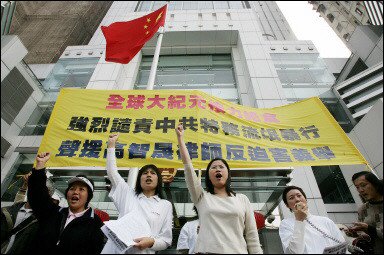
San Francisco (FrontPageMag.com) 01 March 2006 – San Francisco, California boasts its own Human Rights Commission and bills itself as a bastion of tolerance, diversity and inclusion. It didn't quite work out that way when members of Falun Gong wanted to showcase their heritage in the 2006 Chinese New Year parade. They found themselves branded as a “homophobic cult” in the San Francisco Chronicle and banned from the parade. That led some observers to compare the San Francisco experience to what happens in the People's Republic of China, where Falun Gong is persecuted to the point of death.

Falun Gong, literally, the “Law of the Wheel Breathing Exercise,” began in 1992 with Li Hongzhi, a Changchun grain clerk who based his spiritual teachings on the ancient practice of qigong exercises, coupled with meditation. In the spirit of Buddhism and Taoism, practitioners sought the cultivation of truthfulness, compassion, and forbearance. At the outset, Falun Gong, also known as Falun Dafa, provoked no reaction from the Communist regime. Problems began when the practice caught on with millions, including some Communist Party members. exercises, coupled with meditation. In the spirit of Buddhism and Taoism, practitioners sought the cultivation of truthfulness, compassion, and forbearance. At the outset, Falun Gong, also known as Falun Dafa, provoked no reaction from the Communist regime. Problems began when the practice caught on with millions, including some Communist Party members.

By the late 1990s, the ruling Communist Party estimated Falun Gong followers at between 70 and 100 million, more members then the Party itself. In April 1999, some 10,000 Falun Gong members sat in meditative poses near the Zhongnanhai security complex that houses Chinese leaders. It was the largest gathering since the Tiananmen Square protests in 1989. Though peaceful, the numbers alarmed the Party enough to begin harassing practitioners of Falun Gong. On July 22, 1999, the regime outlawed the group as an “evil cult” and accused it of “spreading fallacies, hoodwinking people, inciting and creating disturbances and jeopardizing social stability.

By then Li Hongzhi had decamped to the United States, where Falun Gong also caught on with some Chinese-Americans. By then, the Communist regime in Beijing then deployed its full repressive force, with arrests, imprisonment, re-education campaigns and agit-prop reminiscent of the Cultural Revolution.

Amnesty International has issued a report on the persecution of Falun Gong and Congress has passed a resolution criticizing Beijing's crackdown, which targets members in many countries. Paris-based Reporters Without Borders has documented attacks on Falun Gong members in South Africa, Hong Kong, and Australia, as well as the United States. Three Asian men recently broke into the suburban Atlanta home of Falun Gong follower Peter Yuan Li, for instance, bound him with duct tape, beat him up and stole two laptop computers. A lawsuit in the Supreme Court of British Columbia charges a “campaign of terror” against followers of Falun Gong. Five Canadian residents are suing Chen Zhili, China's former education minister, whom they claim made key decisions and had control over those who carried out torture and persecution.

In former times, the Chinese parade in San Francisco featured the flag of Taiwan, whose nationalist government commanded loyalty of many in Chinatown, along with business owners and politicians. That changed when Dianne Feinstein, now a U.S. Senator, became mayor in 1978. She wanted to encourage trade with China. That has come to pass, along with tolerance for its repressive policies.

In San Francisco, the only official concerned about the persecution campaign is Supervisor Chris Daly. In 2001, he authored a resolution condemning persecution of Falun Gong. It failed to pass, falling to opposition spearheaded by Rose Pak, a former journalist known as the “dragon lady of Chinatown” and reportedly San Francisco’s most powerful person outside of elected office. Pak accompanied then-mayor Willie Brown on junkets to Beijing, where Communist Party bosses accorded them red carpet treatment. Pak is on record that Falun Gong is “mostly gibberish” and “hocus pocus.”

Falun Gong marched in the Chinese New Year Parade in 2004 but San Francisco's Chinese Chamber of Commerce (CCC), which runs the event, excluded them in 2005 on the grounds that some members had handed out political tracts. By some accounts, the motive for exclusion was business interests in the PRC by some Chamber members. Supervisor Daly protested the exclusion by allowing two Falun Gong members to ride his car during the parade.

In the run-up to this year's parade, Daly floated another resolution condemning persecution of Falun Gong. The Chinese consulate issued a statement warning the Supervisors against any decision that would harm relations between China and the United States. The resolution passed 9-2 in a watered-down version that failed to mention the People's Republic of China and took no position on the parade dispute.

The city of San Francisco provides $77,000 in funding for the parade, along with police support and other services. Daly and a few others argued that Falun Gong members should be able to participate in an event their tax dollars supported. Falun Gong practitioners filed a lawsuit and lodged a complaint with San Francisco’s Human Rights Commission. Daly held a hearing on the matter, charging that the Chamber was playing along with a propaganda campaign of the Chinese government that sought to justify persecution of Falun Gong by demonizing the group. The Chamber did just that, in a way particularly suited for San Francisco, with a quarter-page ad in the San Francisco Chronicle blasting Falun Gong as a “homophobic cult” guilty of “hate speech.”

In San Francisco there can be no worse accusation than “homophobic.” Sherry Zhang, a Falun Gong spokeswoman and a chemist from Los Altos, told anybody who would listen that the group has teachings on homosexuality similar to those of Christian groups, but that Falun Gong has never spoken out expressly against homosexuality. It apparently escaped the notice of San Francisco's vocal Homintern that in the People's Republic of China, which has occupied Tibet since 1959, homosexuality is still considered a capitalist vice and that the Communist regime has imprisoned and even executed homosexuals. Chinese persecution of gays, or any of the regime's massive violations of human rights, has never been an issue in San Francisco, which is more agitated by U.S. military recruiters, Abu Ghraib, and even support for the war in Iraq by Nancy Pelosi.

When the Chinese Chamber of Commerce also ran a full-page ad in the Chronicle stating it rejected the Falun Gong’s assertion that “because they are Chinese, they have the right to be in the Chinese New Year Parade,” Chris Daly accused Rose Pak of pushing China’s political agenda. She accused him of tipping off the FBI about her longstanding ties to officials in Beijing. According to the Los Angeles Times, Pak called Daly a “jingoistic, superficial bully,” adding, “Chris Daly should join the John Birch Society. He sees Communists behind every rock and tree.” From Berkeley, Ling-chi Wang of UC-Berkeley's Asian-American studies program told reporters he didn't see any persecution of Falun Gong and said of the group: “They just want to crash somebody's party.”

San Francisco police agreed to let some Falun Gong supporters hold banners on the sidewalk along the parade route from Chinatown to Union Square. But some Falun Gong members said they were not allowed into the Chinatown district. The parade ushered in the Year of the Dog, but the way it played out was more like the Year of the Chicken.

This topic gained a certain amount of publicity in just about all the San Francisco papers a few weeks ago and below is one of my letters to the (editor) SF Examiner that was published.

letters@examiner.com

Board vote in favour of Falun Gong

I find it appalling that some people will distort the simple QiGong teachings of Falun Gong to fulfill personal achievement or please Beijing...Hmm! It is clear that some Chinese people hate Falun Gong so badly that they will not think twice about spreading lies about this meditation practice. This is not surprising as the whole persecution of Falun Gong in China is based on hate propaganda and fabricated stories by their notorious Central Propaganda Department. Over the years this has been the tactics of most dictators for stamping out the undesirables particularly religious groups. Genocide is the word that springs to mind. The discriminating remarks made by Luo is only one example showing how this persecution has been exported to America and how Chinese people nurture and shamelessly spread those lies. On the other hand Falun Gong makes no bones about telling the truth about how badly their families are tortured in China in an attempt to stop the persecution. THIS has ticked off the Red Barons of Chinatown in a big way. I am looking forward to a colourful and bright Lunar New Year parade, representative of the Chinese-Americans including Falun Gong as participants. Welcome to America!