Falun Dafa Association of Canada
Overview
Suppression of Falun Gong practitioners officially began on July 22, 1999 following years of escalating state abuses.
One basic explanation for the seemingly irrational campaign is the proclivities of China’s atheist Communist Party (the CCP), which fears all groups outside its control – particularly ones that subscribe to a different ideology.
The Party has tried several times to eradicate all expressions of religion from China (a country traditionally referred to as "the land of the divine"). To this day Roman Catholics, many Protestants, and Tibetan Buddhists cannot worship freely in China and are at constant risk of detention and torture. By 1999, Falun Gong became a natural target as it was the largest - and fastest growing - spiritual group in China with 100 million practitioners nation-wide, according to Chinese Government reports at the time.
The most prominent feature of the campaign has been its prevalent use of extreme torture. Torture of Falun Gong practitioners has been documented in each of China’s provinces, in jails, labor camps, brainwashing centers, and schools in China’s big cities, small towns, and villages.
Popular torture techniques include shocking with electric batons, burning with irons, tying the body in painful positions for days, force-feeding saline solutions through a plastic tube inserted up the nose, and prying out fingernails with bamboo shoots, to name a few; rape and sexual torture of the Falun Gong in detention are prevalent as well.
To date over 3,000 deaths have been documented, as well as over 63,000 accounts of torture. An estimate of the real figure puts the actual death toll in the tens of thousands Please see the section of ‘Physical Torture’ in this document for more info.
When the persecution was launched in 1999, tens of millions of Chinese who practiced the meditation discipline were faced with a choice. One option was to again surrender to the Communist Party and abandon a practice that had brought them better health, spiritual guidance, and, invariably, newfound hope. A second option seemed to be to continue practicing quietly at home – but as raids quickly showed, this was impossible even if one were able to turn a blind eye to the persecution of family and friends. A final option was to resist the persecution in spite of knowing full well what the painful consequences might be.
Indeed, those who chose the latter have most commonly faced forms of oppression that do not make headlines – dismissal from work, expulsion from universities, deprivation of health care and pensions, divorce, homelessness, and a range of other forms of discrimination.
For hundreds of thousands, the most basic reality of the campaign has been long periods of detention in "reform through labor" camps – China’s Gulag system. There they are forced to work up to 20 hours per day, producing – without pay – toys, Christmas tree lights, chopsticks, and soccer balls for export. Those who refuse are tortured.
Be it in labor camps, jails, or in special reeducation centers, all detained Falun Gong practitioners have been forced to undergo what can only be described as brainwashing. The Communist Party’s goal is to force these people to renounce their spiritual beliefs and come to view Falun Gong as dangerous, as well as to turn in others who are active in exposing the persecution.
The key ingredients of the brainwashing process, or what the Party calls "transformation," is sleep deprivation, hours on end of staring at videos vilifying Falun Gong, threats, and Cultural Revolution-style "struggle sessions". Some particularly "stubborn" individuals who refuse to transform are injected with psychotropic drugs in asylums as treatment for the mental disorder of incorrect political thinking.
But, as in every genocide of the twentieth century, extreme violence first required dehumanization of "the other" through propaganda. Indeed, one key measure in the Party’s suppression has been to limit, and distort, information about Falun Gong—both in China and elsewhere.
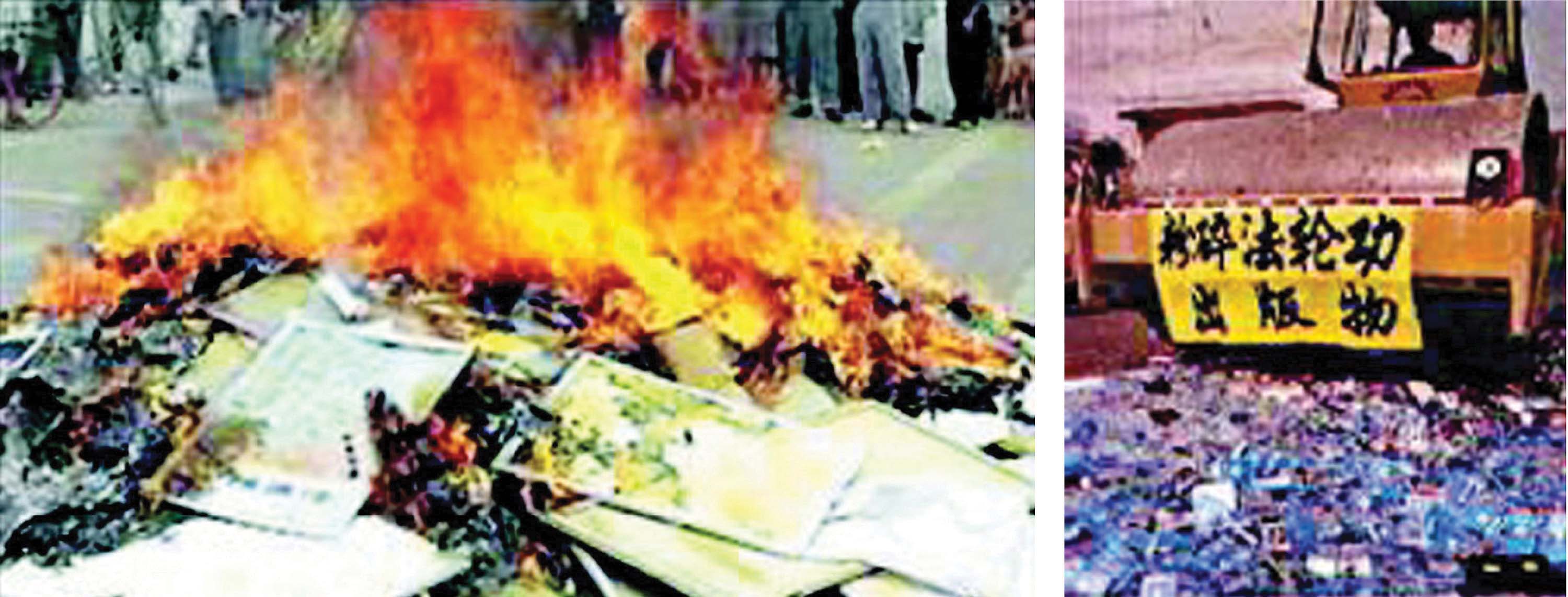
From day one of the suppression, the regime banned all books and informational media produced discussing Falun Gong positively. All websites relating to the practice were immediately blocked. Millions of Falun Gong books were forcibly seized and burned publicly. The regime feared people might learn, if they knew not already, that Falun Gong was a healthy, normal, and positive way of life embraced by millions.
These censorship efforts have, of course, extended to cyberspace, thanks in no small part to Western companies, such as Nortel, who have enthusiastically sold Internet surveillance technology to the Party’s security apparatuses. As a result, Chinese people are now in jail for posting evidence of torture online or even downloading articles about Falun Gong.
Alongside censorship, the Party has sought to scandalize Falun Gong through an aggressive propaganda blitz. The regime has been determined to paint Falun Gong as dangerous, deviant, and abnormal.
Former Party Chairman Jiang Zemin led the way, attaching onto Falun Gong the label of "cult" three months after his ban as means to further bend public opinion. The Ministry of Propaganda thus launched countless publications, radio and TV shows, and even plays, comic books, and exhibitions meant to criminalize Falun Gong.
Government officials around the world, meanwhile, report receiving defamatory materials from Party emissaries. These are often accompanied by attempts to pressure the elected officials to stay silent about abuses perpetrated against the Falun Gong, to rescind proclamations in recognition of Falun Gong’s contributions to the community, and to block local Falun Gong activities such as parades or conferences.
Business owners, journalists, and scholars have also been subjected to similar pressure tactics and threats, leading to a sometimes eerie silence in Western press and academia.
Beyond mere threats, Falun Gong practitioners overseas have been physically assaulted and spied on by agents directly connected to the Chinese Communist regime.The Falun Gong have responded to all of this with markedly peaceful means. Throughout nearly a decade of persecution, they have refused to adopt violence. Instead, practitioners first tried to reason with Communist Party rulers through letters and petitions. When these fell on deaf ears, the Falun Gong turned to Tiananmen Square where – through quietly meditating or displaying banners before being arrested - they sought to call upon the conscience of the Chinese people as well as world leaders. As the persecution continued, the Falun Gong began countering state propaganda by distributing information exposing the persecution through leaflets, VCDs, emails, and phone calls.
Collectively, this resistance movement - composed of bold individual acts in spite of great personal risks – constitutes what is probably today’s largest non-violent movement in the world.
Persecution: Killings
The Falun Dafa Information Center has confirmed the deaths of over 3,000 Falun Gong as a direct result of the persecution campaign that the Chinese Communist Party launched in 1999. It is feared that the actual number of Falun Gong deaths from torture, malnutrition, exhaustion, and neglect in detention and especially from organ harvesting in hospitals, however, is already in the tens of thousands.
While legal experts are increasingly referring to the persecution of Falun Gong as “genocide,” the form this genocide has taken is different from previous models. The Falun Gong are not hung in public like China’s landlords were when Mao Zedong took power, nor are they taken on a truck into an open field and shot as in Cambodia; they are not hacked dead with machetes as in Rwanda and they are certainly not gassed as in Auschwitz.
But the persecution of Falun Gong meets the Genocide Convention’s definitions of what constitutes genocide: “Causing serious bodily or mental harm to members of the group” and “deliberately inflicting on the group conditions of life calculated to bring about its physical destruction in whole or in part.”
Alongside mental harm, forced destitution, and economic persecution, the killing of the Falun Gong has primarily taken three forms.
Death from Torture
The first form is the killing of through beatings and various forms of torture. The vast majority of the torture takes place in prisons, temporary detention centers, and throughout the P.R.C.’s vast labor camp system. Police beatings leading to death from injuries have also taken place inside ’ homes or upon arrest on Tiananmen Square, often inside police vans.
Common methods of fatal torture include shock with multiple electric batons, hangings by the wrists or ankles - including upside down for many hours, burnings with irons or other objects, and injections of nerve-damaging drugs.
One torture method that has accounted for approximately ten percent of known deaths is forced-feeding. In order to protest their illegal detention and torture, Falun Gong often go on hunger strike. In response, police and inmates, with or without training, “feed” the hunger strikers by inserting a rubber tube into the nose and down through the trachea into the stomach. When the liquid pumped in – ranging from saline solutions to urine – goes directly into the lungs, it leads to a very painful death.
In order to avoid accountability, labor camps and prisons routinely release who are on the verge of death and ask their family members to pick them up. Hospitals frequently refuse to admit these people in such a condition, and they die at home within days or weeks of being released.
When an practitioner does die in detention, police claim he or she committed suicide. In fact, survivors have testified that their torturers threaten them by saying: “If we torture you to death it won’t count as anything - we’ll just say it was suicide and no one will ever know.” Witnesses have also reported bodies with black and blue marks being thrown limp out of high windows in order to frame a suicide.
Family members are only rarely allowed to see the body, which is often cremated in haste.
Death from Slavery
The second form of killing is a result of exhaustion, malnutrition, and neglect in labor camps. Political prisoners in China can be administratively sentenced to up to three years of detention in forced labor camps (laogai or laojiao) without ever facing a judge.
There they are forced to work up to 20 hours a day under the threat of violence. Many of the products they make, like toys, chopsticks, boxes, Christmas tree lights, and clothes are exported to the United States, Australia, and Europe. The prisoners are paid nothing and are, in effect, slaves.
In addition to exhaustion from the intense physical labor under pressure to produce, the slaves are given very little food – often just a pickle and a small, dry roll. Food infested with maggots is not a rare sight, while drinking water is scarce.
Fumes from glue and other chemicals associated with their work combine with poor sanitary conditions, the malnutrition and exhaustion to account for a currently unknown number of deaths.
What the slavery and torture have in common is that, from the Communist Party’s perspective, the goal is not necessarily to kill the ; rather, the death of the Falun Gong is a side effect.
The purpose of the campaign is not to execute the ’ body but to exterminate the Falun Gong’s spirit. The group is to be eliminated through “reeducation,” or “transformation,” using the above methods along with mental torture (link to mental persecution page), segregation, and nationwide propaganda. The idea is to force to give up their belief system and become obedient citizens, atheist-Marxists if possible. If they die in the process of “transformation,” so be it, it counts as suicide.
While the Falun Dafa Info Center has records of over 3,000 deaths from persecution, the number is likely many times higher. In 2002, sources inside China already estimated that at least 7,000 had been killed. Given the difficulty and risks involved in obtaining such sensitive information from China and the reports of tens of thousands of missing , a more realistic estimate places the death toll at 30,000.
Death from Organ Extraction
The above figure could be more than double, however, according to the Kilgour-Matas organ harvesting report. According to the pair of prominent Canadian lawyers, over 40,000 organs from Chinese people used in transplants have no other explained source other than the bodies of Falun Gong . These healthy prisoners of conscience, evidence shows, have been killed explicitly for their livers, hearts, and kidneys.
Hon. David Kilgour and Mr. David Matas concluded in their independent investigation report that “there has been and continues today to be large scale organ seizures from unwilling Falun Gong practitioners” by the “the government of China and its agencies in numerous parts of the country…” The widespread killing of Falun Gong practitioners for profit to provide organs for transplants is “so shocking that it represents a new form of evil on this planet.”
In a legally binding decision issued on Nov. 21, the United Nations Committee against Torture called for an investigation into illicit organ harvesting from Falun Gong practitioners. The statement was the latest in a long line of actions taken by writers, lawyers, doctors, and government representatives to research and condemn such abuses.
United Nations Conclusions
In concluding observations on China’s degree of adherence to the United Nations Convention against Torture, on Nov. 21 a U.N. committee of independent experts expressed concern over “information received that Falun Gong practitioners have been extensively subjected to torture and ill-treatment in prisons and that some of them have been used for organ transplants.”
The committee then made the following recommendation, the most legally binding demand to date for the Chinese authorities to investigate and punish those responsible for forced organ harvesting from Falun Gong:
“The State party should immediately conduct or commission an independent investigation of the claims that some Falun Gong practitioners have been subjected to torture and used for organ transplants and take measures, as appropriate, to ensure that those responsible for such abuses are prosecuted and punished.”
The committee’s conclusions follow on consistent inquiries transmitted to the Chinese government since August 2006 by Manfred Nowak, the U.N. Special Rapporteur on torture, and Ms. Asma Jahangir, the U.N. Special Rapporteur on religious freedom, which have received unsatisfactory replies.
International Steps Taken Thus Far
There a number of governments, international bodies, and members of the medical community who have found the allegations credible and in some instances, taken action to ensure their own citizens are not complicit in such abuses.
The following are a sample of the steps taken, initiatives which should further be expanded:
Conducting additional independent investigations and analysis
· Edward McMillan-Scott, Vice-President of the European Parliament and rapporteur for the EU's European Instrument for Democracy and Human Rights, traveled to China in May 2006 on a fact finding mission to personally investigate the allegations of organ harvesting, and he has several times condemned the organ harvesting from Falun Gong practitioners in China.
· In March 2007, Dr. Tom Treasure, writing in the Journal of the Royal Society of Medicine, found the allegations credible, particularly in the context of the role doctors played in the Holocaust.
· In July 2008, a special Israeli rabbinical council ruled that the Chinese regime has been responsible for the killing of Falun Gong practitioners, perhaps because of material benefits derived from organ harvesting.
· In November 2008, The Weekly Standard magazine featured a cover story on organ harvesting, authored by Ethan Gutmann, adjunct fellow at the Foundation for the Defense of Democracies. The article described systematic and suspicious medical testing of Falun Gong practitioners.
Taking measures to stem the flow of foreign recipients traveling to China for organs:
· In August 2006, the New York-based National Kidney Foundation issued a statement expressing deep concerns over allegations that large numbers of Falun Gong practitioners were being executed for the purposes of organ donation, as well as opposition to such aa scheme and to organ transplant tourism generally.
· In early 2007, Israeli health insurance carriers stopped sending patients to China for transplants. This was in part related to an investigation in which Israeli authorities arrested several men for tax evasion in connection with a company that mediated transplants of Chinese prisoners’ organs for Israelis. One of the men had stated in an undercover interview that the organs came from “people who oppose the regime, those sentenced to death and from prisoners of the Falun Gong.”
· In August 2007, Hou Sheng-mao, the Director of Taiwan’s Department of Health, reported requesting Taiwanese doctors not recommend to their patients to travel to mainland China for transplants.
· In December 2007, a petition signed by 140 Canadian physicians was presented to the House of Commons urging the government to issue travel advisories warning people that organ transplants in China include the use of organs harvested from non-consenting donors such as Falun Gong practitioners.
· In February 2008, Canadian Member of Parliament Borys Wrzesnewskyj introduced a bill to stop Canadians from participating in obtaining human organs and body parts from unwilling donors, including traveling to other countries to get such organs. He stated that the urgency of the matter was highlighted by the findings of the Kilgour-Matas report.
Ceasing academic training and cooperation with Chinese doctors on organ transplantation:
· In July 2006, Associate Director of the Program in Human Rights and Medicine in the University of Minnesota, Kirk C. Allison, PhD, MS released a statement reinforcing the findings of the Kilgour-Matas report and calling for academia and medical circles stop cooperation with China on organ transplantation.
· In December 2006, the Australian Health Ministry announced the abolition of training programs for Chinese doctors in organ transplant techniques at the Prince Charles and the Princess Alexandra Hospitals, as well as banning joint research programs with China on organ transplantation.
Conducting government hearings and raising the issue with the Chinese government
· In September 2006, the United States Congress held a hearing on organ harvesting from Falun Gong practitioners.
· In September 2006, The European Parliament adopted a resolution condemning the detention and torture of Falun Gong practitioners, and expressing concern over reports of organ harvesting; the issue was also raised by direction of the EU troika leadership through the Finnish Foreign Minister Tuomioja meeting bilaterally with China's Foreign Minister Li Zhaoxing at the EU-China summit in Helsinki.
· In November 2006, following a hearing on the topic, the Irish Parliament’s Joint Committee on Foreign Affairs wrote to the Minister of Foreign Affairs to request that he raise the issue with his Chinese counterparts and that it be included in the EU-China dialogue on human rights.
All above mentioned information can be found at: http://faluninfo.net/article/834/?cid=84
Mechanics of Persecution
Since the Chinese Communist Party banned Falun Gong in China in 1999, the Chinese authorities have utilized a wide variety of mechanisms in their efforts to force to renounce their faith and ultimately wipe out the spiritual group. These strategies have ranged from extreme use of torture and sexual abuse, to the intimidation and harassment of ' family members, to the establishment of a nationwide extralegal task force to implement the eradication policy.
In this section the following mechanics of persecution are covered:
Physical Torture

Figure 1: The face of 36-year-old Gao Rongrong after it was severely disfigured by torture with high-voltage electric shock batons. Ms. Gao died of torture in 2005.
Torture in custody has taken the lives of thousands of Falun Gong ’ since the Communist Party began persecuting followers of the spiritual discipline in 1999.
While cases of torture are annually documented in nearly every country around the world, the Falun Gong represent perhaps the largest tortured group. In the United Nations’ Special Rapporteur on Torture’s 2006 report,
Human rights organizations have documented over 38,000 cases of severe abuse or torture of Falun Gong . Of the more than 3,000 confirmed deaths of Falun Gong in China, the vast majority came from torture.
Used for decades by Chinese Communist Party police to extort confessions from suspects and targets of political campaigns, torture is now being used against the Falun Gong to force them to renounce their faith. Both physical and mental torture techniques are used (the latter is addressed in the brainwashing section), though the distinction between the two is not always clear.
This way mental and physical torture are combined can be seen in the brief excerpt below from the Washington Post, which describes the typical ordeal countless Falun Gong have faced:
At a police station in western Beijing, Ouyang was stripped and interrogated for five hours. "If I responded incorrectly, that is if I didn't say, 'Yes,' they shocked me with the electric truncheon," he said.
Then, he was transferred to a labor camp in Beijing's western suburbs. There, the guards ordered him to stand facing a wall. If he moved, they shocked him. If he fell down from fatigue, they shocked him.
Each morning, he had five minutes to eat and relieve himself. "If I didn't make it, I went in my pants," he said. "And they shocked me for that, too."
By the sixth day, Ouyang said, he couldn't see straight from staring at plaster three inches from his face. His knees buckled, prompting more shocks and beatings. He gave in to the guards' demands.
For the next three days, Ouyang denounced [Falun Gong's] teachings, shouting into the wall. Officers continued to shock him about the body and he soiled himself regularly. Finally, on the 10th day, Ouyang's repudiation of the group was deemed sufficiently sincere.
He was taken before a group of Falun Gong inmates and rejected the group one more time as a video camera rolled. Ouyang left jail and entered the brainwashing classes. Twenty days later after debating Falun Gong for 16 hours a day, he "graduated."
(John Pomfret and Philip P. Pan, August 5, 2001)
Human rights workers have also compiled over 100 methods of corporal torture methods used against the Falun Gong. Below are a few short examples of such methods. More detailed examples can be found through the index on the right.
Beatings
Falun Gong practitioners in police custody are often brutally beaten, sometimes to death. The use of the following items for beating have been documented among the known cases: wooden clubs, steel and iron bars, iron rods, whips made of twisted copper wire, bamboo sticks, rubber sticks, electric batons, wooden planks, steel wire locks, rattan, electric wire whips and rope whips.
Piercing
Fingertips are pierced with pins and bamboo nails, which are also hammered under the fingernails. In many cases, torturers pull out the practitioners’ fingernails by the root. Women’s breasts are also pierced with sharp wires.
Force-feeding
Force-feeding is a torture method often used on the Falun Gong, and it has been the cause of death in approximately 10 percent of all known death cases. The force-feeding is most often carried out by labor camp staff with no medical training, or by criminal inmates who are coerced to assist. Unsanitary rubber tubes are shoved into an practitioner’s nose and down the stomach, often rupturing or damaging tissue; sometimes the tube enters the lungs. Detainees are often fed irritants such as highly concentrated salt water, hot pepper oil, boiling water, detergent, or even human feces.

Figure 2: On June 2nd, 2001, three labor camp guards tried to force Tan Yongji (above) to sign a “repentance statement” renouncing Falun Gong. When he refused, the guards tied him to a post, heated an iron rod in a furnace until it glowed red, and began applying it to his legs. The pain was so excruciating that Tan lost control of his bowel and bladder functions. The guards pressed the rod on his legs 13 times, spacing them out at regular intervals on his flesh, asking him all the while if he would renounce his belief in Falun Gong.
Scorching with Hot Irons
Hundreds of practitioners have reported being burned with cigarettes, lighters, fire, irons, or hot iron bars.
“Water Dungeon”
In “Water Dungeons,” the detainee spends many days in total darkness while inside a small cage and immersed in chest deep water. Often the water is routed from sewage lines. Some detainees have died under such conditions, while others have been driven insane from this torture.
High-voltage Electric Shock Batons
Electric batons carrying high voltages are used to shock practitioners’ sensitive areas and private parts such as the inside of the mouth, top of the head, breasts, genitals, buttocks, thighs, etc. Several electric batons are often used simultaneously on different parts of the body. Victims have said that the smell of burning flesh permeates the air during the torture.
Psychiatric Torture
“'After traveling to Beijing on April 25th to protest for the ban on Falun Gong, he was arrested again; on May 23rd, his employer, a state-run petrochemical company, approved commitment papers that authorized the police to admit him to a mental hospital. According to Mr. Su’s father, the doctors injected Mr. Su twice a day with an unknown substance. When Mr. Su emerged a week later, he could not eat or move his limbs normally.' He died ten days later.”
- Washington Post, June 23, 2000
At least 1,000 have been subjected to psychiatric torture in Chinese mental hospitals, though the actual figure is likely many times higher, likely far exceeding the number of dissidents politically persecuted in mental asylums during the Stalinist era.
In the PRC’s psychiatric wards, the Falun Gong are injected with unknown psychotropic drugs in toxic doses. Some report having been used as guinea pigs and falling into prolonged periods of hallucinations after being injected. Others have suffered severe damage to their central nervous system from the injections. Yet others – mentally healthy when forced into the hospital for political reasons – became deranged after being “treated” there.
Much groundbreaking work in exposing this abuse of psychiatry has been carried out by Robin Munro. In his 2006 book, China’s Psychiatric Inquisition: Dissent, Psychiatry and the Law in Post-1949 China, Munro dedicates a chapter to the issue of psychiatric persecution of the Falun Gong in China.
The psychiatric abuses of the Falun Gong and others who have been branded insane for insisting on views not in accord with that of the Communist Party, are well documented and have been ongoing under the current regime for decades. Organizations such as the World Psychiatric Association (WPA), Human Rights Watch, and the Geneva Psychiatric Treatment Committee have reported on it; the WPA sought to investigate the abuses of Falun Gong in Chinese mental wards but has been repeatedly denied access.
Torture in mental hospitals serves two primary purposes for the Communist Party. First, it aims to discredit Falun Gong by making its appear demented. Second, it allows for severe forms of punishment and a potential solution for handling those viewed as hardcore who stubbornly refuse to transform.
The tools of psychiatry – including electric shock, sedatives, and other drugs – are turned on Falun Gong detainees as a means of torture and manipulation.
Beyond the asylum’s walls, these methods have found their way and into the hands of police and prison guards. Amnesty International has reported how one Beijing police spokesman connected to these hospitals, when questioned about these abuses, explained: “They are not patients, they are here to be re-educated… Most of them are Falun Gong extremists who have been to Beijing to protest.”
Below is one example of the experiences the Falun Gong practitioners have faced in psychiatric hospitals follows:
We were held in the Xuzhou City Mental Hospital for over three months. We were forcibly tied to a bed and the so-called medical staff gave us injections and forced “medicine” down our throats. They injected us with unknown drugs as well. We passed out and were unconscious shortly after receiving the injections.
When the injections were taking effect, we suffered from extreme pain. It was so severe that we writhed in pain, cried out miserably, and slammed ourselves against walls in a desperate attempt to knock ourselves unconscious in order to be rid of the pain.
After the injections’ affect wore off, we questioned the medical staff, “Why did you give injections and other harmful substances to us even though we are perfectly healthy?” They replied with shame, “We have no choice. It’s per instructions from above. We have to obey our leaders if we want to keep our jobs. We don’t want to treat you this way, but we don’t want to lose our job.”
-- Testimony of a Falun Gong practitioner from Xuzhou City (from “Investigative Report on Spiritual Persecution of Falun Gong Practitioners,” WOIPFG)
Psychological Abuse
The goal of forcing people who practice Falun Gong to renounce their beliefs and cooperate with the authorities has been, from the outset, a central part of the Chinese Communist Party’s campaign.
While every form of physical torture involves mental torture as well (whether being forced awake for over a week or being electrocuted in the genitalia), Falun Gong practitioners have also been specifically targeted for psychological persecution. This has come in two forms: brainwashing and psychiatric torture.
Brainwashing is the more widespread, with facilities across at least 21 of 22 provinces in mainland China, and four of the five “autonomous regions.” These brainwashing classes are also held at each administrative level: provincial, municipal, county, and township. According to one analysis, the density of brainwashing facilities is greater than that of prisons, labor camps, and mental hospitals.
Reeducation
Brainwashing often includes physical torture [see torture section], with the goal of “transforming,” or reprogramming practitioners to the point that they abandon their spiritual practice. Authorities promise that their ordeal will be over once they sign a three-fold “statement of guarantee” displaying the “correct” understanding about Falun Gong, promising not to protest ever again, and disclosing information about friends and family who practice Falun Gong.
The mental anguish does not stop there, as the transformed practitioner is then immediately required to not only stop believing in Falun Gong, but to turn against it. Once a transformation statement is signed, practitioners are then often taken in front of television cameras and asked to read the statement with their “new understanding” about Falun Gong for use in propaganda materials; if the statement is not satisfactorily repentant or insufficiently disparaging of Falun Gong and its founder, the process must be repeated.
Then the recently “transformed” are quickly obliged to take an active role in transforming other detained practitioners. Those who prove particularly capable are even taken on speaking tours to other prisons and labor camps to assist transformation efforts there.
How to break a practitioner
The accounts of Falun Gong who have emerged, often mentally scared, from prolonged brainwashing sessions reveal that the cadres’ methodology has become increasingly sophisticated over time. Still, the basic approach is consistently as follows:
- Isolate them and lock them up, either alone or with criminals.
- Strip them of clothes and personal dignity – drill into their mind that they are criminals who have committed a terrible crime - people with dangerous mental problems.
- Deprive them of sleep for days on end; if they fall asleep wake them up immediately with a blow or loud sound. Keep doing this until they can no longer keep track of time or remember basic details about their life.
- Force them to watch 10 hours a day of video vilifying Falun Gong and, especially, its founder Li Hongzhi. Play the tapes at full volume and do not allow them to look away.
- Convince them that the only way they will ever be able to leave again is if they sign the three-fold statement of guarantee and that everything will be over once they do.
- Bring in their parents, children, and siblings intervention-style to cry and even kneel in front of them, begging them to come home. Bring in their spouses to threaten with divorce.
- Threaten, and if necessarily, take away their jobs, pensions, or enrollment in university. Threaten that their family members will also lose their salaries and education opportunities.
- Bring in transformed former-Falun Gong practitioners (ideally someone the person was previously very close to) to help them see the light. Alternate one-on-one sessions with ones in which many people talk at the same time.
- Tell them Falun Gong is banned around the world, since there is an international consensus that it is just like the Branch Davidians, Aum Shinrykiyo and other “evil cults.” They may not accept this at first, so just repeat it hundreds of times daily for weeks or months.
- Replace Falun Gong by instilling in their minds a different ideology – try Marxism (make them read The Story of Lei Feng, Mao Zedong’s Selected Works, etc.) and, if that fails, give them the Bible, Buddhist Scriptures, etc.
- Beat them.
- Tell them this is all for their own good.
The above, of course, does not include the extreme physical violence and sexual assault detailed elsewhere in this site or the use of psychotropic drugs described below.
John Pomfret and Philip P. Pan of the Washington Post provide a vivid account of how mental and physical torture are combined in efforts to break the Falun Gong. Individuals who have gone through this process describe at “spiritual murder”.
Once released from brainwashing classes, practitioners and their families are then forced to retroactively pay tuition and room and board for their time there. (report)http://www.zhuichaguoji.org/en/index2.php?option=content&task=view&id=136&pop=1&page=0%29.
Hundreds, if not thousands of the Falun Gong have been tortured in mental asylum, where they are injected with unknown psychotropic drugs.
For many, however, these transformation efforts have proven a useless, if painful process. After returning home and collecting themselves from the traumatic experience, many resume practicing Falun Gong.
Some even post statements online nullifying any statement they made against Falun Gong under coercion. According to the Falun Gong website Clearwisdom.net, where such statements known as “solemn declarations” are posted, over 380,000 such declarations have been recorded as of March 2008.
Rape and Sexual Assault
Women of Falun Gong tell wrenching tales of physical and sexual abuse in captivity. They have been violated with brooms sticks or electric batons causing bleeding from the vagina. They have had their breasts pierced with barbwire, and they have been gang raped.
“Among the true accounts of unbelievable brutality,” writes prominent Chinese human rights attorney Gao Zhisheng following his investigation into the persecution of the Falun Gong, “the immoral acts that shocked my soul the most were the lewd yet routine practice of attacking women’s genitals by 6-10 Office staff and the police.”
“Almost every woman’s genitals and breasts or every man’s genitals have been sexually assaulted during the persecution in a most vulgar fashion,” Gao wrote in a December 2005 open letter to Communist Party leaders.

Figure 3: Torture technique known as “splitting legs.”
One group letter from Chinese women who practice Falun Gong summarizes what they have suffered as follows: “Iron wire has been used to pierce our nipples.” Police “have sexually violated our bodies with eggplants, toothbrushes, and plastic water bottles. In one female labor camp located in Jilin province, police inserted hot pepper powder into women’s vaginas in order to force them to give up their belief and practice of Falun Dafa.”
A report of the United Nations Special Rapporteur on violence against women cites an October 2000 case in which 18 women who practice Falun Gong were stripped naked and thrown into jail cells containing convicted male criminals (U.N. document number E/CN.4/2001/73/Add.1). The report also states that “electric batons are used to shock the breasts and genitals of the female practitioners.”
Policeman Rapes Woman on the Street

Figure 4: Female Falun Gong practitioner who was beaten and raped by Beijing police.
Excerpted from a Falun Gong Human Rights Working Group report:
On May 14, 2001, after 9 p.m., a Falun Gong practitioner was posting Falun Gong flyers alone along the street from Dabeiyao to the Yonganli city canal in the Chaoyang district. A plainclothes policeman who was on patrol duty stopped her. He viciously groped around this practitioner’s lower body under the excuse of conducting a body search. She struggled free and ran down the street. He chased after her on his bicycle, and beat her fiercely with a rubber baton. He told her, “My superior has said not to let go of any Falun Gong practitioner. Today, I will either kill you and throw your body into the city canal, or take you to the police station.”
She tried to run away but did not succeed. The policeman beat her for over an hour, bringing her to the verge of death. There were about a dozen passersby who came to watch during that time. He shouted to them, “She is a Falun Gong practitioner. She is an active counterrevolutionary. If I beat her to death, it will count as nothing.” All passersby hastily left.
Two of her front teeth were knocked out from the beating. This rogue police officer inflicted many wounds on her head, and left her whole body swollen and bruised.
The plainclothes policeman gave her a heavy blow with his baton on her right ear and temple. She then lost consciousness. After she lost consciousness, he dragged her under the bridge and ripped off her pants. He raped her. After that, he forced his rubber baton into her vagina using his full strength and sat on her. When this practitioner regained consciousness and a little strength, she shouted as loudly as she could; he then rode away on his bicycle.
Prison Guard Rapes 28-year-old University Student
One of the most prominent rape cases is that of Ms. Wei Xingyan. On the evening of May 13, 2003, the graduate student from Chongqing University was arrested for possessing balloons and banners printed with messages about Falun Gong.

Figure 5: A wooden block depicting moments before gang rape.
A policeman ordered two inmates to strip her naked. Then he forced her to the floor and raped her in front of them.
Once news of her story was exposed outside of China, her university and the local authorities attempted to erase her identity, denying that she exists. Her current whereabouts are unknown.
Men are not spared sexual torture either. Thirty-two year old Mr. Chu Hui, for example, was tortured with beatings and cattle prod shocks from 9 p.m. to 8 a.m. the next morning. The torturers used the cattle prods all over his body, including inserting them into his anus. Chu passed out several times during the torture.
- Thirty-two-year-old Ms. Zhu Xia cries, laughs, and often bangs on doors and windows madly. She soils her clothing uncontrollably, and has frequent hallucinations, tossing and turning restlessly amidst unseen enemies. At night she throws her arms around her head defensively, screaming “Are you going to rape me?”
- After being beaten and electrocuted in the genitalia, woman dies after three days’ detention.
- Women hung spread-eagle from ceiling, sexually assaulted with sticks in attempt to meet “transformation” quota
- Falun Dafa Information Center report: Women of ConscienceThough dated, this report contains photos and other easily accessible information about how women who practice Falun Gong have been specifically targeted.
Arbitrary Imprisonment and Slavery
In today’s China, any Chinese person can be picked off the street, say, on the way to the supermarket, and be immediately turned into a slave for up to three years without legal procedure. This has happened to hundreds of thousands of people who practice Falun Gong and vanished into China’s vast system of labor camps.
There are between 200,000 and 2 million Falun Gong held in China’s vast system of detention centers and labor “re-education” camps. Outdoors in Siberia-like weather of northeastern China winters or in the suffocating heat of unventilated rooms filled with fumes of glue and feces, detainees work up to 20 hours of labor a day. Those who refuse are beaten, tortured, or starved.
Many of the products they make – Christmas tree lights, toys, chopsticks - are sold to us in America, Europe, and Australia.
Making toys amidst torture in a Beijing labor camp
Especially since late 2007, consumers of low-priced “Made in China” products now recognize the long-term costs of such goods - dangerous lead toys, Chinese food product scares, related rising unemployment rates at home and trade deficits have all made headlines.
But perhaps the most severe price of all is often ignored - modern slavery is alive and well in China.
Slavery is not limited to the well-documented sweatshops in which teenagers work under horrible conditions and physical abuse in gated communities while getting paid close to nothing. This is a different kind of slavery that involves people who are prisoners of conscience – they were arrested for their beliefs or for speaking their minds and turned into slaves.
They get paid nothing for laboring in Chinese gulags. If they leave the camp alive, they are among the more fortunate.
When Jennifer Zeng was imprisoned in Beijing’s Xin’an Labor Camp, she and worked long hours making toy rabbits for Beijing’s Mickey Toys Co. Ltd, a project reportedly subcontracted from Nestle. After she was released and returned home to Australia, she was shocked to find the toys she had made being sold on store shelves there.
“The processing fees went to the labor camp. We didn't get anything,” Zeng said. “Usually we began work at 5 o'clock in the morning and worked until 2 or 3 o'clock in the morning the next day. Sometimes, we had to work overtime; otherwise we could not finish the job. I was so exhausted that I could not count clearly from 1 to 9. Long hours of intensive work and severe lack of sleep made me feel for a long period of time, that the only thing I needed in my life was sleep.”
Canadian Mr. Lin Shenli was forced to make soccer balls by hand in a Jiangsu province labor camp. A large section of his chest and buttocks began to bleed and ulcerate from other intensive manual labor. Throughout, labor camp staff tried to force Lin to renounce his beliefs. There are literally thousands of known cases like these.
‘Sanitary chopsticks’
The Clearwisdom website has compiled a collection of vivid, first-hand accounts of life in these labor camps and the range of products Falun Gong detainees are forced to make there.
The full report can be read here. One testimony tells of the “sanitary chopsticks” produced at this Daxing County labor camp in Beijing:
The chopsticks to be packed were piled on the floor arbitrarily and often stepped on by workers. The inmates’ job was to put the chopsticks into paper coverings labeled by the Department of Sanitary and Epidemic Prevention, though the inmates had not gone through any measures of epidemic prevention or sanitary conditions themselves. Many of them had skin diseases, scabies outbreaks, and some were drug addicts or diagnosed with sexually transmitted diseases. The payment for the contracted forced labor became income for the policemen at the labor camps.
For general information about China’s system of reeducation through labor, see Human Rights Watch’s report: http://www.hrw.org/campaigns/china-98/laojiao.htm
Destitution
Alongside the most brutal forms of violence, such as torture and organ harvesting, a quiet, systemic form of violence being perpetrated against the Falun Gong on a large scale is destitution and internal displacement.
Although the number of Falun Gong forced into homelessness and living as fugitives is currently unknown, countless testimonies, and reports of tens of thousands of missing in mainland China suggest destitution is pervasive. There are several reasons for this phenomenon.
First, the Falun Gong have been expelled from schools and dormitories, fired from their workplaces, and denied opportunities for re-employment because of their beliefs or open resistance to persecution. This situation, moreover, has persisted for over eight years. Without any remaining financial means, those who can no longer rely on the support of family and friends are being driven into homelessness.
Second, have been forced into bankruptcy due to robbery and extortion. Police, the 610 Office, and local officials have all been known to pillage the houses of after arresting them. In other cases, police have forced family members to pay large extortion fees to secure the release of their relatives and spare them from torture.
Third, many have become homeless fugitives in order to avoid further persecution. After being repeatedly jailed and tortured, and knowing the arbitrariness of such arrests that can take place whenever local officials receive new orders or whenever a major anniversary approaches, have chosen to leave their homes and wander from place to place to escape their pursuers.
In addition to the 610 Office and local police forces, the Chinese Communist Party also employs a system of neighborhood and street committees. Much like the system employed in East Germany, this PRC version of neighborhood watch employs retirees who spend their days spying and reporting on their neighbors - not for stealing but for hanging posters, distributing leaflets, or meditating. With such a system in place, the Falun Gong cannot feel safe living in any single location for a prolonged period and roam like vagabonds from place to place.
Fourth, some have left their homes in order to ease their family members’ suffering from police pressure. Harassment does not end when the Falun Gong are released from detention. After they return home face frequent, sometimes daily, visits from local officials and police. The visitors try to find the whereabouts of other Falun Gong as well as make sure the newly released practitioner is maintaining “correct views.” Such visits are not always cordial.
Finally, children of Falun Gong have not been spared either. With both parents either jailed, fleeing persecution or killed, children as young as three-year-old Kaixin have had to fend for themselves. While some have gone to live with relatives or who knew their parents, others have become homeless.
Some Falun Gong practitioners have been able to escape to Southeast Asia or other countries and find asylum thanks to their host nations. A much larger number, however, have become internally displaced or, as Chinese put it, gone into exile in their own country to escape persecution.
In addition to requiring their identification for renting an apartment or receiving a salary, Chinese citizens may be required to present their ID to police on whim at any moment. Afraid of being recognized as Falun Gong, and in some cases already on a public wanted list for the crime of distributing leaflets, cannot establish a new life or feel secure anywhere in China.
The 6-10 Office

Diagram of the 6-10 Office structure, from the Communist Party's seat of power -- the Politburo -- down to neighborhood committees and village offices.
The 6-10 Office—named after the date of its creation on June 10, 1999—is a plainclothes police task force responsible for carrying out the mission of eliminating Falun Gong.
Established by former Communist Party leader Jiang Zemin and announced in a speech to elite cadres a month before Falun Gong was banned, the organization exists outside China’s legal framework.
Jiang granted it wide-ranging powers and the authority to use “every means necessary” to wipe out Falun Gong. Operating in an atmosphere of impunity even after Jiang was replaced by Hu Jintao, the 6-10 Office has become notorious for its regular use of extreme torture.
In his book A China More Just , human rights lawyer Gao Zhisheng describes being shocked by the extent of the 6-10’s operations.
“The immoral act that has shaken my soul most is the 6-10 Office and policeman’s regular practice of assaulting women’s genitals,” Gao wrote after his 2005 investigation. “Of those persecuted, almost every woman’s genitals and breasts and every man’s private parts have been sexually assaulted in a most vulgar fashion.” (full letter)
In addition to torture and sexual abuse, 6-10 Office agents also administratively sentence the Falun Gong to labor camps and abduct straight from their homes to brainwashing classes.
But its real power lies in its ability to direct the campaign against Falun Gong from behind the scenes. By employing quotas and incentive systems, as well as latching onto the Party’s existing and pervasive bureaucracy, the 6-10 office is responsible for overseeing all aspects of the campaign against the Falun Gong: from controlling the criminal justice system to gathering overseas intelligence through the Ministry of Foreign Affairs to infiltrating top Chinese universities.
Though Party officials have externally denied the 6-10 Office’s existence, a broad range of public statements, internal documents, and testimonies refute such claims. Instead, available evidence paints a disturbing picture of a shadowy yet powerful entity that operates like the mafia but is officially sanctioned; an excessively violent organization that permeates Chinese society but is well-known only to those who control it or work for it as well as, of course, those who dread it.
Family and Loved Ones
Spouses, parents, children, and siblings of those who practice Falun Gong have suffered various degrees of persecution, ranging from loss of employment to torture. Meanwhile, some relatives have directly taken part in persecuting their loved ones, often under extreme levels of pressure/duress from the communist state.
Persecution of Relatives
When tens of millions of Chinese who practice Falun Gong began being targeted in 1999, even their relatives who did not follow the spiritual discipline were implicated at once. Immediately, the number of people directly hit by the campaign rose into the hundreds of millions.
Relatives were given a painful choice between supporting their loved ones at great risk or following the Party and thus wrecking their families and betraying their kin. The comprehensive campaign left little room for ambiguities.
The Party had three main reasons for targeting the Falun Gong’s relatives.
- First, it sought to deter Chinese people from supporting their family members by opposing the campaign; at minimum the Party demanded quiet acquiescence, though it preferred the kind of proactive support described below.
- Second, the Party feared family members would publicly expose the torture and other abuses their loved ones faced.
- Third, police and jail wardens learned that one way of breaking the determination of jailed Falun Gong is by showing them how miserable their children, spouses, or elderly parents are.
Persecution of relatives has taken many forms, including:
- Spouses are pressured to divorce and threatened with repercussions such as an end to their careers if they do not.
- Relatives are dismissed from their workplaces after their family members petition the government to end the persecution or distribute informational material.
- Sons and daughters are expelled from schools if one of their parents remains an active Falun Gong practitioner.
- Young children have become orphaned or parentless because their mother and father have been killed, arrested, or forced to run from place to place to avoid arrest and torture (See the story of one 11-year-old). Some children live with their grandparents or other relatives, while others have been left to fend for themselves.
Several short examples of such cases include...
- Young children have been arrested with their parents and some have even been tortured in custody. Some were thus witness to their parents being tortured (report).
- In some cases, family members were brought into detention centers explicitly for the purpose of witnessing their loves ones being tortured. Wang Yuzhi recalls witnessing how one man was forced to watch his wife being hung from the ceiling and tortured. Although Wang herself was tortured blind and nearly killed, she says hearing the man’s heart wrenching cries was one of her most traumatic experience in detention.
- Relatives are followed, interrogated, and threatened as the 610 Office tries to find the whereabouts of those fleeing persecution.
- Police and 610 Office staff search and plunder Falun Gong ’ homes and extort money from relatives for early release or as a “detention fee” (that is, family members are forced to cover the expenses of their loved ones’ torture).
- With a collapsed healthcare system in China, and their family members have struggled to pay enormous fees for the hospitalization of those recovering from torture. Those whose relatives died of torture also often have to deal with enormous fees on top of their grief, while others have to bribe the detention centers to reclaim their relative’s body or ashes.
- Relatives who stand up to support their spouses, siblings, children, or parents have faced the same persecution that do.
- When working-age Falun Gong are arrested, the Party leaves behind their elderly parents with no pension and no other means to cover basic needs.
- Elderly parents have suffered heart attacks or collapsed under the pressure of seeing their children arrested and beaten; others, like Charles Lee’s mother, passed away while worrying about their children and not being able to see them one last time.
In part of a story that won the Pulitzer Prize for International Reporting, Ian Johnson describes how Zhang Xueling was jailed after trying to seek justice for her mother who was beaten to death by Chinese police. (news)
Reminiscent of rescuers of Jews during the Holocaust is the story Ms. Li Weixun’s brother.
Finally, the number of broken families this persecution continues to create is staggering. Almost every Chinese Falun Gong practitioner one meets outside of China has such a story. At the very least, practitioner overseas cannot safely return to China. Most have been away from their relatives for over eight years. They have missed their children’s marriages and, often enough, their elderly parents’ passing as they are forced to remain in exile.
Persecution by Relatives
Because they internalized the Party’s propaganda portraying Falun Gong as a "dangerous organization," because they feared repercussions, or because of naiveté about the regime’s intensions, family members have taken part in persecuting their relatives who practice Falun Gong.
Below are several examples:
- Very common is family members agreeing to accompany police officers to detention centers and labor camps in order to try to talk their relatives into signing a statement slandering Falun Gong, and cooperating to provide police with information about other practitioners. Labor camp survivors describe emotional scenes in which teary spouses, parents, and children kneel in front of them and beg them to betray their conscience and give in so that they can return home to their loving family.
- Spouses have threatened to divorce or divorced their partner because they refused to abandon their belief system.
- Others have had divorced while their partner was jailed or moved in with another person while their legal partner was being tortured or forced to work hard labor.
- Husbands have beat their wives after catching them distributing Falun Gong literature in secret or practicing the Falun Gong meditation exercises.
- Some have locked their wives, children, or elderly parents in a room, forbidding them to go outside.
- Some have turned their relatives in to the local “brainwashing classes” (xinao ban), not knowing they would be deprived of sleep, beaten, and forced to blankly stare at videos, and “struggled against” Cultural Revolution style for days on end. When the loved ones “graduated” and returned home, the severe mental trauma they had experienced made them no longer recognizable as being the same person.
Persecution at Work and School
Schools and workplaces are among the institutions that the Communist Party immediately mobilized when it launched the campaign against Falun Gong in 1999. It is in these micro units of Chinese society that the persecution was able to reach the masses.
In the People’s Republic every school and work unit (dan wei) has a Communist Party official responsible for carrying out Party directives and reporting back to superiors. Chinese bureaucracy under decades of Communist Party rule has reached unprecedented depth and ability to quickly mobilize campaigns throughout the vast country.
Though a little rusty, this system was readily available for Party head Jiang Zemin to employ in 1999.
Before the 1999 ban, students and teachers could often be seen practicing Falun Gong together, as they currently do in Taiwan. “China’s MIT,” the prestigious Qinghua University, featured 11 different Falun Gong practice locations on campus with over 500 dedicated Falun Gong practitioners, including 100-200 professors.
In many a workplace Falun Gong quickly spread from one individual to the other as employees became intrigued and excited by the new exercise regimen and the discipline’s moral code. In some factories, workers gathered in the factory yard to practice Falun Gong’s slow-movement exercises in the early morning before work; some managers even praised the practice for boasting employees’ morale and work ethic.
But once the persecution, with its accompanying propaganda campaign, was launched, millions of colleagues, teachers, and classmates were suddenly ostracized. “Model workers” and honorary students who were Falun Gong practitioners were now reprimanded and even jailed. Friends who had only weeks earlier asked to borrow a Falun Gong book now urged practitioners to stop practicing in order to stay out of trouble.
Employers and school principals immediately came under pressure if one of their workers or students publicly petitioned the government to end the persecution. One after another, practitioners were fired and students were expelled for their belief system.
Meanwhile, workplaces and schools were forced to implement Cultural Revolution-style study sessions. These included public denunciations of Falun Gong based on People’s Daily editorials and other Party materials, which delineated the “correct view” Chinese people should have about Falun Gong.
Elementary school students are forced to line up and sign huge banners attacking Falun Gong and “superstition” more broadly while swearing allegiance to the progressive nature of Marxism and science.
High school students have to answer according to the official Party line on national standardized matriculation tests. Failure to provide the official answer means expulsion or denial of college education to otherwise qualified students. An answer that challenges the Party’s reasoning means jail, or worse.
Jailed practitioners who refuse to “transform” are threatened that their resistance will cost their loved ones their jobs and education opportunities.
Survivors report that, in many cases, the threats are carried out.
Classrooms, offices, and dormitories have also been used as ad hoc detention centers for Falun Gong practitioners who submitted petition letters to official petition offices. One woman from Shanghai describes she was locked in the school in which she taught, as policemen took turns around the clock carrying out “thought work” (sixiang gongzuo).
Finally, students of all ages have not been spared the persecution’s most brutal methods. Ms. Wei Xingyan, a graduate student from Chongqing University who practiced Falun Gong, for instance, was raped by a policeman in front of onlookers. When her case was exposed online she disappeared and the university went on to deny the woman ever existed.
Because of the deliberate way in which persecution of the Falun Gong has been carried out throughout China’s education system, former education minister Chen Zhili has been sued for crimes against humanity.
Law and Disorder Overview
While most readers recognize that under China’s one-party system, the judiciary functions differently than in a democratic society, few realize the extent to which China’s legal system remains subject to the whims of the Chinese Communist Party (CCP). With China's hundreds of thousands of lawyers, thousands of judges and brand new court buildings, do Falun Gong practitioners who are wrongfully imprisoned have a place to appeal? Are those who are abused able to press charges against their torturers?
The answer is that, despite rhetorical references to the “rule of law,” obtaining justice through the Chinese legal system remains an impossibility for Falun Gong practitioners.
Indeed, as the articles in this section vividly illustrate, the campaign against Falun Gong is a continuing reminder of the CCP’s ability to override the constitution, to tightly control the judiciary, and to blatantly disregard commitments made under international human rights treaties:
Violations of China's Laws
“The PRC government acted outside of its constitutional authority, violated citizens’ basic rights, and overstepped its own boundaries in its war against Falun Gong and its practitioners.”
Edelman and Richardson
It is not uncommon for Chinese Communist Party (CCP) officials to rebuff censure of its human rights record by claiming that critical remarks unfairly judge Chinese policies by foreign standards. While this argument is itself problematic, as the above quotation indicates it is also irrelevant to the case of Falun Gong. This is because in its persecution of the group, the CCP has not only breached its international obligations, but has systematically violated China’s own laws.
Besides the much-touted recent addition of a provision stating that “the state respects and upholds human rights,” (Article 33) the P.R.C Constitution contains 16 other provisions outlining specific rights and freedoms. These include the right to freedom of religion (Article 36), the right to freedom of expression (Article 35), and the right to education (Article 46). There are also articles prohibiting unlawful detention (Article 37) and violence against women, children, and the elderly (Article 49).
Nonetheless, as evidence presented on this site’s accompanying pages suggest, in the persecution of Falun Gong each of the above articles has been breached.
The violations have not been limited to the constitution either. As Chinese human rights lawyer Gao Zhisheng points out, in its treatment of Falun Gong, the CCP has ignored provisions of the Chinese penal code, as well as general principles of law, like the prohibition on retroactive legislation. In its report, Human Rights Watch similarly pointed to what it termed a “rule of law veneer,” highlighting that the legislation cited by Chinese officials as the legal basis for the ban was in fact passed in October 1999, a full three months after the persecution was launched.
In other words, when Jiang Zemin wanted to take action against Falun Gong, it did not matter to him that relevant provisions were non-existent or that the measures he called for were unconstitutional – if there were no laws to support his actions, he would do what he wanted first and create the laws later.
Indeed, the campaign against Falun Gong is a continuing reminder of the CCP’s ability to override the constitution, a core feature of the PRC legal system. As Chinese law expert Daniel Chow says, “the real power structure in China is not to be found anywhere in the constitution. Real power lies in the hands of the Communist Party.”
For a detailed list of the specific articles in the Chinese constitution and criminal law violated in the persecution of Falun Gong, see http://www.faluninfo.net/article/582/?cid=48The Legal System of the People’s Republic of China by D. Chow (St. Paul, 2003), p114.
---
References and additional resources:
B. Edelman and J.T. Richardson, “Falun Gong and the Law: Development of Legal Social Control in China,” Nova Religio, Vol. 6, No. 2, April 2003, pp. 312-331, 312.
R. Berring, Prof. of Law, University of California (Boalt Hall), affadavit to U.S. District Court, Northern District of California in the case of Jane Doe I, et al. v. Liu Qi on provisions of Chinese law relevant to the persecution against Falun Gong and Liu's role in it as former mayor of Beijing.
Falun Gong Human Rights Working Group, "The Chinese Government's State Violence against Women," 2002 submission to the United Nations Special Rapporteur on Violence against Women.
Violations of International Treaties
For those familiar with China’s human rights record, it may come as a surprise that in recent decades the Chinese Communist Party (CCP) has signed or ratified the vast majority of all key international human rights treaties. Indeed, the regime proudly cites being a “member of 21 international conventions on human rights” on the website of its permanent mission to the United Nations in Geneva.
In the face of these legal obligations, the campaign against Falun Gong raises serious questions about whether the CCP has acceded to these instruments in good faith or whether it has done so mostly in order to deflect international criticism with little intent to effect real positive change.
Among the major instruments the CCP has ratified are the 1948 Genocide Convention, the 1966 International Covenant on Economic, Social and Cultural Rights (ICESCR), the 1984 Convention against Torture, and the 1989 Convention on the Rights of the Child. In ratifying these treaties, the CCP has voluntarily undertaken to protect the rights enshrined in them.
Since 1999, however, the regime has systematically breached a broad range of the international provisions in its efforts to wipe out Falun Gong. This includes violating rights that immediately come to mind such as freedom of religion, freedom of expression, and the right to be free from torture.
But the persecution has also extended to the day-to-day realm of economic and social rights, areas that the CCP has traditionally cited as its primary spheres of accomplishment and legitimacy. That is, as practitioners have been fired from their jobs, expelled from school, and denied the right to practice a discipline known to improve physical well-being, their rights to work, to education, and to health have also been violated.
Besides ratifications, the CCP has also signed other human rights instruments, most notably the International Covenant on Civil and Political Rights (ICCPR) in 1998. Under international law, signing a treaty does not entail a commitment to implement all its provisions, but it does oblige the signing state not to take action that would violate the document’s object and purpose.
Despite this pledge and CCP claims to be reforming its legal system towards ratification of the covenant, Falun Gong practitioners continue to be systematically denied most of the rights listed in the ICCPR. These include freedom of belief (Article 18), the right to life (Article 6), and due process rights (Articles 9, 14, 15, and 16), just to name a few.
Beyond promising to protect the rights enshrined in the above treaties, the CCP has also made international commitments to investigating violations and punishing those found responsible. This requirement is a particular feature of the Genocide Convention and the Convention against Torture.
But while China’s criminal code does allow for prosecutions over such crimes, one notorious feature of the campaign against the Falun Gong has been an atmosphere of total impunity. Officials who are the most effective at “transforming” practitioners through torture are not only spared punishment, but are often promoted and even given awards at state-sponsored ceremonies. Luo Gan, one of the campaign’s main architects, was for example promoted to the Politburo Standing Committee.
A complete list of international treaties the CCP has acceded to and the ways in which these have been mocked in the persecution of Falun Gong is available: http://faluninfo.net/article/815/?cid=49
Complicity of China's Judicary
As a 2002 report by the International Commission on Jurists states, the Chinese judiciary is not independent, but rather “subject to the control of the leadership of the Chinese Communist Party (CCP)” .
This subordinate relationship stems from a number of factors, the most evident being that all judges are Party members bound by Party discipline. Judges are appointed and removed by a Party committee at the corresponding level and the “political-legal committee” underneath it. The judges’ job security, therefore, often depends on their compliance with Party instructions, certainly when it comes to sensitive cases.
It is for these reasons that once CCP leader Jiang Zemin banned Falun Gong, the Chinese court system emerged not as a bulwark against injustice, but as a tool of repression.
In October 1999, three months after the overt persecution campaign was launched, the Supreme People’s Court began issuing directives to lower courts with instructions as to how they must collaborate in the campaign against Falun Gong.
The following month the Supreme People’s Court ordered judges to fulfill their role by “resolutely imposing severe punishment.” Indeed, one week later the first “trial” of Falun Gong practitioners took place in Hainan province. At the end of a hearing that lasted less than one day, all four practitioners were sentenced to periods of up to 12 years in prison on the vague charges of “using a heretical organization to undermine the implementation of the law.” Hundreds of others have since been jailed for to up to 18 years (for a chart of charges and sentences, see Amnesty International’s report.
The vast majority of the Falun Gong who are jailed, however, are never even walked through the pretense of appearing before a judge. Instead, they are sentenced to up to three years of administrative detention in “re-education through labor” camps. In these cases the courts’ complicity is more subtle – here it takes the form of refusing to judicially review practitioners’ cases or punish the torture and slavery inflicted upon them.
Prominent human rights attorney Gao Zhisheng discovered the depth of collusion first-hand when attempted to file a complaint with the Shijiazhaung Intermediate Court on behalf of a practitioner detained in a local labor camp. The presiding judge took one look at the file and said, according to Gao:
Are you aware that lawyers aren’t allowed to take cases like this? The court belongs to the Chinese Communist Party, and so do the laws. There are currently orders from above to reject these cases, and that’s the end of it. Go talk to whoever you like and go file your case wherever you like. We don’t care. (Gao’s open letter to the National People’s Congress: http://en.epochtimes.com/news/6-3-25/39696.html) .
Falun Gong practitioners who work as judges have also not been spared severe persecution, losing their jobs and even their lives.
In most countries that operate under rule of law the grounds for dismissing a judge are very limited. But China’s Judges Law has “a list of prohibited acts that would trigger removal,” including a “catch-all clause” that allows judges to be dismissed over anything the Party finds problematic, according to a International Commission on Jurists report.
In one case widely reported by the Associated Press and Reuters, a former High Court judge from Jiangxi province was imprisoned and later died of Leukemia, a disease he had recovered from after he began practicing Falun Gong, read the judge’s open letter, written before his death.
Lawyers and Rights Defenders
When the Communist Party launched the campaign against Falun Gong, among the first measures taken was to instruct lawyers not to defend practitioners. Indeed, in the early years of the persecution, it was incredibly difficult, if not impossible, for practitioners to find genuine legal representation. This has changed in recent years, however, as a generation of lawyers and rights defenders have defied Party directives and taken the cases of Falun Gong practitioners, offering advice, representing them in court, and publishing accounts of abuse.
More broadly and at great risk, the lawyers have called into question the fundamental basis of the entire policy against Falun Gong, protesting it as a violation of Chinese citizens’ freedom of belief. The most prominent and outspoken among them has been Gao Zhisheng, who in October 2005 wrote an open letter to Hu Jintao and Wen Jiabao detailing torture suffered by practitioners and calling for an end to the persecution. Over the following months he conducted fact-finding investigations and published his findings, making public the existence of mountainside torture chambers and widespread sexual violence used against practitioners.
Over a dozen other lawyers have since followed in his footsteps, representing Falun Gong practitioners in court, appealing to judges to uphold the constitutional right to freedom of belief, and educating fellow Chinese as to the illegality and brutality of the persecution.
In response to their efforts, Gao and other rights defenders have themselves faced persecution at the hands of the authorities – disbarment, detention, beatings, torture and in at least one case, exile. Despite such risks, many have continued to defend Falun Gong, working on a daily basis to uphold justice and seek a timely end to a brutal campaign being carried out against an innocent group of people.
The following are short descriptions and references for several of these lawyers and rights defenders:
Gao Zhisheng
A human rights lawyer with an amazing personal story, Gao Zhisheng became famous after setting precedents in nationally-prominent cases in China. He was named one of China’s top-ten lawyers in 2001 and has worked for the gamut of China’s vulnerable groups—coal miners, home-demolition victims, and house church members.
But it was when Gao, a Christian, started tackling the persecution of Falun Gong that he ran afoul of the regime. In a series of open letters to Party leaders, Gao expressed outrage at the illegality of the campaign against the group and the ghastly torture of its practitioners--abuses he discovered when investigating in China's northeastern region. Gao had hoped that once the top leaders discovered what was happening at local levels, they too would be outraged and act to stop it. What he found instead was that the persecution ran through the entire system and that this machinery would later retaliate against him.
Since 2005, he and his family have been under constant surveillance and in 2008, such tight house arrest that his children have been unable to attend school. In December 2006, Gao was sentenced to three years in prison for "inciting subversion," but the sentence was subsequently suspended due to international pressure and he was released into house arrest. In late 2007, he was abducted again and reportedly suffered extreme torture in custody.
He has been featured on the cover of the New York Times, was nominated for the Nobel Peace Prize, and is beginning to garner honors such as the American Board of Trial Advocates’ Courageous Advocacy Award.
As Gao remains under house arrest in China, an English translation of his book "A China More Just" —which describes his story, his cases, and the range of social issues China faces— was published in the United States in 2007.
For more information:
Guo Guoting
Guo was a well-known international maritime lawyer who began to take civil rights cases in 2003. Among his clients were Shi Tao (a journalist sentenced to 10 years in prison after Yahoo turned over personal e-mail communications to the Chinese authorities) and Zheng Enchong (a fellow Shanghai attorney and former classmate sentenced to three years in prison).
Guo was among the first Chinese lawyers to take Falun Gong cases, unsuccessfully scouring Shanghai’s various law enforcement organs in search of Huang Xiong who had gone missing. He later sought to represent Qu Yanlai, a graduate student sentenced to five years in prison for practicing Falun Gong. When Guo was unable to even meet with his client after multiple attempts, he posted an article on the internet about the case in February 2005.
Later that month, the Shanghai authorities searched his offices, seizing his license to practice law and his computer. On March 4, Shanghai’s Judicial Bureau banned him from practicing law for one year for "anti-constitutional speeches and acts" and then placed him under house arrest. In May 2005, he managed to flee China for Canada, where he remains in exile.
For more information:
Li Heping
Li Heping is a partner at Beijing Global Law Firm and has worked as a defense lawyer in a large number of politically sensitive cases—including representing underground Christians, victims of forced eviction, and Falun Gong practitioners.
In March 2008, Li and five other lawyers—Li Xiongbing, Zhang Lihui, Li Shunzhang, Teng Biao, and Wu Hongwei—filed a landmark brief in defense of Falun Gong practitioner Wang Bo and her parents in which they laid out a detailed defense of freedom of religion and an analysis of the illegality of the persecution against Falun Gong. More recently, he has represented Beijing practitioner Zhang Lianying and Liu Fengmei from Liaoning.
In September 2007, Li was abducted by plainclothes security officers, taken to an unknown location and tortured with electric batons for a period of several hours before being released. The security agents also confiscated some of his legal files and his license to practice law.
For more information:
- "Chinese lawyers’ motion defends Falun Gong in Court for first time," Human Rights Law Foundation, October 25, 2007: http://en.epochtimes.com/news/7-10-25/61180.html
- "Chinese lawyer recounts abduction," New York Times, October 3, 2007, http://www.nytimes.com/2007/10/03/world/asia/03china.html
- "Lawyer Li and the goon squad," Evening Standard, August 19, 2008, http://www.thisislondon.co.uk/standard/article-23541200-details/Lawyer+Li+and+the+goon+squad/article.do
- Transcript of defense in court of Liu Fengmei, August 2008 (Chinese)
Propaganda Inside China
The Xinhua News Agency – official mouthpiece of the Chinese Communist Party (CCP) government – had a rare, if not startling, moment of candor in July of 1999, four days into the suppression of Falun Gong.
“In fact, the so-called ‘truth, kindness and tolerance’ principle preached by Li Hongzhi [Falun Gong’s founder],” Xinhua proudly declared, “has nothing in common with the socialist ethical and cultural progress we are striving to achieve.” Especially the “truth” part.
As in every genocide of the twentieth century, central to the persecution of Falun Gong has been a hate propaganda campaign of enormous proportions. “Beijing has ratcheted up the campaign to a fever pitch, bombarding citizens with an old, communist-style propaganda war,” The Wall Street Journal reported (Ian Johnson, "China's War against Falun Dafa Enters New Battleground: Primary Schools," February 13, 2001).
The bombardment, which has continued in various modified forms for nearly a decade, began on July 22 of 1999, the day Falun Gong was officially banned in China. Under the direction of the aptly named Ministry of Propaganda, state-run television immediately launched disinformation marathons, broadcasting alleged “exposés” on the meditation group 24 hours a day.
Not to be outdone, radio stations flooded the airwaves with the government’s official rhetoric denouncing the group. State-run newspapers condemned the Falun Gong with unchecked bravado, led by the CCP’s People’s Daily, which ran a staggering 347 “articles” on the group - in one month.
Over time the CCP would extend the scope and reach of its propaganda, erecting billboards, issuing comic books, printing posters, and producing movies, a TV series, and even plays.
Clive Ansley, Esq., a renowned Canadian lawyer who has practiced and taught in China for 14 years, was residing there at the time. He has described the media barrage as “the most extreme, and totally unjustified, campaign of unmitigated hatred I have ever witnessed.”
One feature common to this propaganda is its caustic nature, breeding distrust, discrimination, and hatred, ultimately creating an environment in which otherwise inconceivable violence could be justified. Through a combination of name-calling, gross misrepresentations, and scare tactics, Party rhetoric seeks to dehumanize those who practice Falun Gong. The most common label for the Falun Gong is “evil cult members.”
For instance, on July 2, 2002, Xinhua published a story entitled “16 Beggars Poisoned: the Suspect is a Falun Gong Member.” At the same time, more detailed reports from the local newspaper in Zhejiang, where the incident took place, did not mention Falun Gong at all, and said the case had not yet been solved. Nonetheless, the Xinhua version of the story was circulated in newspapers throughout China and even picked up by overseas wire services. (http://www.faluninfo.net/Compassion5/ratpoison.htm).
Falun Gong has been scapegoated for all of China’s ills - from poverty to “superstition.” A number of government-authored pieces have made appeals to nationalism while trying to link, however clumsily, Falun Gong to “foreign anti-China forces.”
The propaganda campaign is a supplement to the violence detailed elsewhere on this site. “Pure violence doesn’t work. Just [compulsory] ‘studying’ doesn’t work either,” one CCP adviser explained to the Washington Post. “And none of it would be working if the propaganda hadn’t started to change the way the general public thinks. You need all three.”.
The propaganda campaign has not been limited to the PRC’s state-run media, but has spread overseas, to the point that non-Chinese have been echoing the Party’s label of Falun Gong without knowing its origins. CCP propaganda, too, has slipped into Western media coverage of Falun Gong and some academic scholarship without ever being questioned.
The most prominent example of a single propaganda piece that succeeded in generating much hatred against Falun Gong inside China and skepticism about it overseas is that of the purported “self-immolation.” This in spite the fact that the incident has been exposed as most likely being staged by the CCP.
Meanwhile, the major conduits for this propaganda both in China and abroad – Xinhua News Agency and China Central Television – are now more prominent internationally than ever before, thanks to media conglomerates contracts with the Party’s self-proclaimed mouthpieces.
Censorship
In order for the Chinese regime's anti-Falun Gong propaganda to saturate society, the Party has sought to silence alternative views. This effort has been carried out through both explicit and implicit censorship.
Explicit censorship has meant banning all books, articles, audiotapes, videos, flyers, and items that cast Falun Gong in a positive light.
Over the first three months after the campaign against Falun Gong was launched in July 1999, over 21,000,000 Falun Gong related books were confiscated. Large-scale citywide destruction activities were destroyed in the street in large book-burning drives (photos [link to http://hqphoto.minghui.org/photo_high/allimages/destroybook.jpg]).
Police and neighborhood committee members’ (community spies) ransacking of homes has resulted in the confiscation of over 10 million Falun Gong books since 1999.
All Falun Gong websites, including those based overseas, have been blocked since the campaigns onslaught; a mere visit to one can land a person in jail. Even mainstream foreign media websites have been blocked whenever they carried items about the persecution of Falun Gong. As many as 100,000 Internet police are in place to monitor online activity, according to CNN (see Internet Section).
Usually, however, the Chinese regime needs not revert to explicit censorship to silence dissenting views. It relies heavily on implicit censorship; in other words, journalists and editors within Chinese media organizations exercise a high degree of self-censorship because they are under the watchful eye of the Party.
As a result of the censorship policies, for nearly a decade it has been impossible to find any public expression in defense of Falun Gong – be it in government, media, or academic discourse.
Those who have spoken out in disagreement have done so at great risk and often paid a high price. Merely posting a notice can land a person in jail – new laws brand such acts “subversive.” Individuals have been sentenced to years in prison just for visiting banned Falun Gong web sites and printing their contents. In December 2004, a round of arrests landed 11 more people in jail for posting evidence of torture online (See Reporters Without Borders press releasehttp://www.rsf.org/article.php3?id_article=12179]).
After human rights attorney Gao Zhisheng, for instance, wrote to Party leaders calling upon them to end the campaign of torture against the Falun Gong, he and his family came under surveillance, attempts on his life, and eventual arrest and reportedly torture (Gao describes these ordeals in a book he wrote before he disappeared in 2007: A China More Just. [http://www.broadbook.com/english/1product.asp?id=216]).
What has been left for Chinese people is an underground discourse in which information about the most sensitive topics like Falun Gong is obtained through illicit leaflets, private conversations, and – for those with the technical ability –forbidden websites.
Persecution Abroad
In October 2000, top Chinese Communist Party leader Jiang Zemin ordered to “intensify the struggle” against Falun Gong overseas, according to a leaked Party document. Since then, practitioners of the Falun Gong outside China have seen their tires slashed, their homes vandalized, their e-mail accounts hacked and their phones tapped; they have received death threats, have been beaten and even shot.
In addition to blatant hate crimes, at the documented instigation of Chinese embassies and consulates they have also been barred from joining community cultural events, have been denied restaurant services, and have been spied on by colleagues and classmates.
Here are a few examples of incidents that took place in the United States. These were cited in a House of Representatives resolution (HCR 304) condemning the extension of the persecution overseas, which was passed in 2003:
- Five Falun Gong practitioners were assaulted while distributing leaflets outside the Chicago Chinese Consulate. The two assailants, who were convicted of battery, were members of a Chinese-American organization with close ties to the consulate.
- The Chinese Consulate in San Francisco wrote to the mayor of Saratoga, urging him to retract a proclamation honoring the contributions of the Falun Gong to his community.
- Between 1999 and 2003, the apartment of Falun Gong spokeswoman Gail Rachlin was broken into five times. The only items taken were her address book, tax records, and Falun Gong-related materials.
(for more on Resolution 304, including the full text, see http://faluninfo.net/displayAnArticle.asp?ID=8962)
Until he defected in 2005, Mr. Chen Yonglin worked as a diplomat in the Sydney Chinese Consulate. But his disgust at what he was required to do on a daily basis – monitor and sabotage the activities of Australians who practice Falun Gong or support other persecuted groups in China – led him to walk out of the consulate and seek asylum.
Secret documents that Chen smuggled out with him show how oppression of the Falun Gong outside of China has not been limited to the United States.
Documents in over 30 countries, the persecution is felt worldwide in several other ways:
(1) Propaganda attacking Falun Gong that originates from the Communist Party has been spread seemingly everywhere, leading to bigotry and suspicion toward the Falun Gong internationally. While much of this situation has been rectified as people have gotten to know those who practice Falun Gong and what the discipline stands for, the effects of this smear campaign, which began in 1999, can still be felt today.
For instance, practitioners of Falun Gong living in the U.S., Australia, and Europe - including many who are not Chinese – report being denied jobs or academic opportunities because of their religious beliefs.
Of course, another reason for international discrimination against the Falun Gong is that some fear that if they are seen as associating with Falun Gong they might lose business opportunities in China or collaborative programs with the Chinese regime.
(2) Chinese people living in the diaspora have felt discriminated in their own communities because of their spiritual discipline and their choice to openly speak out for human rights in China. In addition to receiving death threats, they have also been barred from community activities.
Ms. Wang Xiaodan, for instance, told of how she was singled out at her University of Minnesota Chinese student club (http://en.epochtimes.com/news/7-6-26/56872.html). The elderly Ms. Huang Daiming won a lawsuit after an Ottawa Chinese seniors club revoked her license because she practices Falun Gong (http://www.ohrc.on.ca/en/resources/news/e_bg_falun-gong/view).
(3) Chinese practitioners of Falun Gong living outside of China can rarely return to mainland China to visit their family, including elderly parents. Often they cannot even communicate freely over the phone as these are tapped either in China or abroad and the family in China fear punishment.
International Pressure
In its campaign against the Falun Gong, the Chinese Communist Party (CCP) has attempted to manipulate Chinese public opinion through information and message control. In order to protect its international image and mute criticism of rights abuses, the CCP has been zeroing in on foreign governments, businesses, and media, often through under-the-table pressure tactics.
As a result, throughout the democratic world elected officials, entrepreneurs, professors, and journalists can be found who have been complicit in maintaining silence over what some legal experts have termed the “genocide of Falun Gong.” At the same time, many individuals have been infuriated by the pressure tactics and become even more outspoken in support of Falun Gong as a result.
The CCP has carried out these pressure tactics primarily through diplomatic channels, the Chinese diaspora, sister city relationships, as well as Western China scholars and businessmen who have vested interested in access to the mainland.
Western politicians who express any form of support for Falun Gong are the main targets of Communist Party maneuvers. Former-Party head Jiang Zemin, largely seen as responsible for launching the campaign, has personally handed out comic books vilifying Falun Gong to heads of state like Bill Clinton.
Members of Parliament have similarly been on the receiving end of a barrage of propaganda. Even small towns officials have not been spared.
Along with the standard phone calls, letters, and personal visits aimed at vilifying Falun Gong, documented pressure tactics include threats of action on trade, cultural or academic exchange programs, or a break off of sister-city relations if CCP demands are not met. Writing in the Wall Street Journal, Claudia Rosett gives a sense of how many arms have been twisted over Falun Gong.
In order to keep the persecution away from public attention, the CCP also works to directly preclude Falun Gong protests. In June 2002, for example, Jiang Zemin was set to make an official visit to Iceland as part of a four-state European tour. Jiang was able to pressure the Icelandic government (the world’s oldest continuous democracy) into using a blacklist the CCP provided to bar all Falun Gong practitioners from entering the country to protest during the visit (http://www.faluninfo.net/displayAnArticle.asp?ID=5756). As a result, over 3,000 Icelandic citizens, who originally knew nothing about Falun Gong, took to the street wearing muzzles to protest both the persecution in China and their own government’s servility.
In another example, under pressure from the CCP, Australian Foreign Minister Alexander Downer tried (ultimately without success) to bar the Falun Gong from displaying protest banners outside the Chinese embassy (http://www.faluncanada.net/infocentre/reports/CanberraTimes_102306_downer.htmhttp://www.faluninfo.net/django_media/js/tinymce/jscripts/tiny_mce/blank.htm - _msocom_1, http://www.abc.net.au/pm/content/2005/s1389732.htm ; http://clearharmony.net/articles/200506/27084.html).
These efforts to make the Falun Gong issue go away have reached what would otherwise seem to be a ridiculously petty degree. CCP officials have worked feverishly to block Falun Gong from participating in 4th of July or St. Patrick’s Day parades, and to close art exhibits displaying paintings by Falun Gong practitioners (link to http://en.epochtimes.com/news/8-3-7/67189.html).
Another prominent target have been media enterprises that employ Falun Gong practitioners and report extensively about the persecution in China, primarily New Tang Dynasty Television (NTDTV) and The Epoch Times.
Indeed, Chinese student and scholar associations (CSSAs) have been among the groups traditionally loyal to the Party now being used to conduct PR battles against the Falun Gong overseas.
In 2002, the United States House of Representatives unanimously passed House Resolution 304, urging the CCP to “immediately stop interfering in the exercise of religious and political freedoms within the United States, such as the right to practice Falun Gong.” (for more on Resolution 304, including the full text, see http://faluninfo.net/displayAnArticle.asp?ID=8962)
Why is the Chinese Communist Party so invested in waging a public relations campaign against Falun Gong in countries it surely must know will never ban the practice? Unlike the 1960s under Mao, when the Party seemingly could not care less about how its massacres were viewed overseas, the post-Tiananmen CCP is now much more image-savvy. The CCP’s main foreign policy slogan in recent years has been the “peaceful rise,” a phrase intended to convey the regime’s benign nature. The brutal suppression of the Falun Gong is not helpful to building that image.http://www.faluninfo.net/django_media/js/tinymce/jscripts/tiny_mce/blank.htm - _msocom_2
For more examples on CCP attempts to interfere with Falun Gong activities in over 20 countries, see article http://faluninfo.net/article/531/?cid=107
More Third Party Report-
U.S. State Department: 2007 Country Report on Human Rights Practices (on Falun Gong)
The following are excerpts from the 2007 U.S. Department of State’s Annual Human Rights Report on China.
“Arbitrary or Unlawful Deprivation of Life
During the year the government and its agents reportedly committed arbitrary or unlawful killings. On February 27, Xu Hongmei and Shen Zili, two women who were arrested in January for Falun Gong activities, died after they were reportedly tortured by security forces.”
“Torture and Other Cruel, Inhuman, or Degrading Treatment or Punishment
…
In March 2006 UN Special Rapporteur Nowak reaffirmed earlier findings that torture, although on a decline--particularly in urban areas--remained widespread, and that procedural and substantive measures were inadequate to prevent torture. Nowak reported that beatings with fists, sticks, and electric batons continued to be the most common forms of torture. He also found that prisoners continued to suffer cigarette burns, prolonged periods of solitary confinement, and submersion in water or sewage, and that they were made to hold extreme positions for long periods, were denied medical treatment, and were forced to do hard labor.”
“According to Nowak, officials specifically targeted for abuse house church groups, Falun Gong practitioners, Tibetans, and Uighur prisoners. Nowak reported that Falun Gong practitioners accounted for 66 percent of victims of alleged torture while in government custody. Since the crackdown on Falun Gong began in 1999, estimates of the number of Falun Gong practitioners who died in custody due to torture, abuse, and neglect ranged from several hundred to a few thousand.”
[Sexual abuse]
“Sexual and physical abuse and extortion occurred in some detention centers. Falun Gong activists reported that police raped female practitioners, including in 2005 at the Dongchengfang police station in Tunzhou City, Hebei Province, where two women were allegedly raped while in detention.”
[Psychiatric abuse]
“According to foreign researchers, the country had 20 ankang institutions (high-security psychiatric hospitals for the criminally insane) directly administered by the Ministry of Public Security. Persons committed to these institutions had no mechanism for objecting to public security officials' determinations of mental illness. Some dissidents, persistent petitioners, and others were housed with mentally ill patients in these institutions. Patients in these hospitals were reportedly given medicine against their will and forcibly subjected to electric shock treatment. The regulations for committing a person to an ankang facility were not clear.”
“Political activists, underground religious believers, persons who repeatedly petitioned the government, members of the banned China Democratic Party (CDP), and Falun Gong practitioners reportedly were incarcerated in such facilities during the year. Activists sentenced to administrative detention also reported they were strapped to beds or other devices for days at a time, beaten, forcibly injected or fed medications, and denied food and use of toilet facilities.”
“Arbitrary Arrest and Detention
The law permits nonjudicial panels, called labor reeducation panels, to sentence persons without trial to three years in reeducation-through-labor camps or other administrative detention programs. The labor reeducation committee is authorized to extend a sentence up to one year. Defendants could challenge reeducation-through-labor sentences under the administrative litigation law and appeal for a reduction in, or suspension of, their sentences. However, appeals rarely succeeded. […] Administrative detention was used to intimidate political activists and prevent public demonstrations.”
“Special reeducation centers were used to detain Falun Gong practitioners who had completed terms in reeducation-through-labor but whom authorities decided to continue detaining.”
“During the year human rights activists and defenders, Falun Gong practitioners, domestic and foreign journalists, unregistered religious figures, and former political prisoners and their family members were among those targeted for arbitrary detention or arrest.”
“Freedom of Religion
[…P]ractitioners based abroad reported that the government's crackdown against the group continued. In the past, the mere belief in the discipline (even without any public practice of its tenets) sometimes was sufficient grounds for practitioners to receive punishments ranging from loss of employment to imprisonment. Falun Gong sources estimated that since 1999 at least 6,000 Falun Gong practitioners have been sentenced to prison, more than 100,000 practitioners sentenced to reeducation-through-labor, and almost 3,000 died from torture while in custody.”
“Some foreign observers estimated that Falun Gong practitioners constituted at least half of the 250,000 officially recorded inmates in reeducation-through-labor camps, while Falun Gong sources overseas placed the number even higher. In the past, many practitioners were detained multiple times.”
“Over the past several years, Falun Gong members identified by the government as "core leaders" were singled out for particularly harsh treatment. More than a dozen Falun Gong members were sentenced to prison for the crime of "endangering state security," but the great majority of Falun Gong members convicted by the courts since 1999 were sentenced to prison for ‘organizing or using a sect to undermine the implementation of the law,’ a less serious offense.”
“Most practitioners, however, were punished administratively. Some practitioners were sentenced to reeducation-through-labor. Among them, Yuan Yuju and Liang Jinhui, relatives of a Hong Kong journalist working for a television station supportive of Falun Gong, were sentenced to reeducation-through-labor for distributing Falun Gong materials. Some Falun Gong members were sent to "legal education" centers specifically established to "rehabilitate" practitioners who refused to recant their belief voluntarily after their release from reeducation-through-labor camps. Government officials denied the existence of such "legal education" centers. In addition hundreds of Falun Gong practitioners were confined to mental hospitals, according to overseas groups.”
“Police continued to detain current and former Falun Gong practitioners and used possession of Falun Gong material as a pretext for arresting political activists. In March Chi Jianwei, a member of the CDP, was sentenced to three years in prison for using a cult to undermine implementation of the law, reportedly after authorities found Falun Gong material at his house.”
“Early in the year, authorities sentenced Cui Xin, an elderly resident of Harbin, to seven years' imprisonment for her involvement with Falun Gong. Police confiscated Falun Gong materials from Cui's home following her arrest in December 2006.”
“The government continued its use of high-pressure tactics and mandatory anti-Falun Gong study sessions to force practitioners to renounce Falun Gong. Even practitioners who had not protested or made other public demonstrations of belief reportedly were forced to attend anti-Falun Gong classes or were sent directly to reeducation-through-labor camps.”
“Freedom of Movement
There were instances in which the authorities refused to issue passports or visas on apparent political grounds. Members of underground churches, Falun Gong members, and other politically sensitive individuals sometimes were refused passports or otherwise prevented from traveling overseas.”
“The law neither provides for a citizen's right to repatriate nor otherwise addresses exile. The government continued to refuse reentry to numerous citizens who were considered dissidents, Falun Gong activists, or troublemakers.”
Full report: http://www.state.gov/g/drl/rls/hrrpt/2007/100518.htm
United Nations’ Report on Human Rights Abuses on Falun Gong in China
United Nations
United Nations Special Rapporteurs and Working Groups first began conveying communications and urgent appeals about Falun Gong practitioners to the Chinese authorities in 2000. Since then, they have issued urgent appeals for dozens of practitioners, transmitted hundreds of cases of concern to the Chinese government, and determined in formal opinions that Falun Gong practitioners were detained arbitrarily. After a 2005 mission to China, the Special Rapporteur on Torture reported evidence that practitioners had been tortured to death and held in solitary confinement in labor camps in Shanghai and Beijing, respectively.
Background
Unlike many United Nations’ positions which are held by government representatives, the individuals who serve on these bodies are independent experts, often professors of international law, who are appointed by the UN Human Rights Council (previously the Human Rights Commission - UNHRC). Their mandates are defined by the UNHRC and their work includes receiving complaints of abuse from victims and civil society groups, transmitting concerns over reliable allegations to governments, investigating allegations, and for working groups, issuing formal opinions on particular cases. During the regular meetings of the UNHRC these experts also present their findings to the plenary and in several instances have mentioned abuse of Falun Gong practitioners as an issue of particular concern, as referred to in the 2007 report by the Special Rapporteur on Freedom of Religion and Belief, Ms. Asma Jahangir:
“The Special Rapporteur continues to be very concerned by the continued violations of freedom of religion or belief suffered by members of the Falun Gong. In her previous reports to the Commission on Human Rights, she explicitly mentioned members of the Falun Gong as targets of various human rights violations because of their beliefs and she strongly condemns the continued lack of freedom of belief of members of Falun Gong.” (A/HRC/4/21/Add.1, Pg 25)
Since 2000, the following UN Special Procedures experts have raised Falun Gong cases with the Chinese authorities: Special Rapporteur (SR) on Torture, SR on Extrajudicial Executions, SR on Freedom of Religion or Belief, SR on Violence against Women, SR on the Independence of Judges and Lawyers, SR on Freedom of Expression, SR on the Right to Health, the Working Group on Arbitrary Detention, and the Working Group on Disappearances.
Sample Reports
What follows is a small sample of their reports and comments. For a more complete account of U.N. Special Procedures experts’ mentions of Falun Gong, see: http://www.falunhr.org/index.php?option=content&task=category&id=111§ionid=8&Itemid=
- 2008 Report by the SR on Torture – includes three joint appeals issued with other Special Procedures experts: two regarding particular practitioners and one regarding organ harvesting
- Mr. Cao Dong
- Organ harvesting
- Ms. Liang Wenjian and others
This addendum to the report of the Special Rapporteur contains, on a country-by-country basis, summaries of reliable and credible allegations of torture and other cruel, inhuman or degrading treatment or punishment that were brought to the attention of the Special Rapporteur, and were transmitted to the Governments concerned.
During the period under review, i.e. from 16 December 2006 to 14 December 2007, the Special Rapporteur sent 79 letters of allegations of torture to 51 Governments and 187 urgent appeals to 59 Governments on behalf of persons who might be at risk of torture or other forms of ill-treatment.
22/12/2006 / JUA [Joint Urgent Appeal] / WGAD [Working Group on Arbitrary Detention], RINT [Special Rapporteur on Freedom of Religion or Belief], TOR [Special Rapporteur on Torture] / Allegations transmitted:
Cao Dong, a Falun Gong practitioner. On 21 May 2006, Mr. Cao Dong met with the vice-president of the European Parliament in Beijing. Following this meeting, he was arrested and transferred to Gansu Province State Security Bureau Detention Centre. On 29 September 2006, Mr. Cao Dong was charged with “producing Falun Gong material”. His current whereabouts are unclear and his family has not been allowed to visit him since the arrest. Gansu local authorities informed Mr. Cao Dong's family that he will be on trial soon. He has previously been placed in administrative custody for being a Falun Gong practitioner.
25/01/2007 / JAL [Joint Allegation Letter] / RINT [Special Rapporteur on Freedom of Religion or Belief], TOR [Special Rapporteur on Torture] / Allegations transmitted:
Organ harvesting (see also A/HRC/4/33/Add.1, para. 40). A critical issue was not addressed in the Government’s previous responses, in particular: It is reported that there are many more organ transplants than identifiable sources of organs, even taking into account figures for identifiable sources, namely: annual estimates of executed prisoners by whom a high percentage of organs are donated, according to the statement in 2005 of the Vice Minister of HLTH, Mr. Huang Jiefu; willing donor family members, who for cultural reasons, are often reluctant to donate their organs after death; and brain-dead donors. Moreover, the short waiting times that have been advertised for perfectly-matched organs would suggest the existence of a computerized matching system for transplants and a large bank of live prospective donors. It is alleged that the discrepancy between available organs and numbers from identifiable sources is explained by organs harvested from Falun Gong practitioners, and that the rise in transplants from 2000 coincides and correlates with the beginning of the persecution of these persons.
The Special Rapporteurs note reports that on 15 November 2006, Vice-Minister Huang reiterated at a conference of surgeons in Guangzhou that most organs harvested come from executed prisoners. And notwithstanding the reported stringent criteria in place for donors, including for those sentenced to death, the Government informed in its response of 28 November, that voluntary donations, and donations between relatives are the two other legitimate sources of transplant organs. According to the allegations, based on data from the China Medical Organ Transplant Association, between the years 2000 and 2005 there were 60,000 transplantations performed, or approximately 10,000 per year for six years. This period coincides with the alleged rise in the persecution of Falun Gong practitioners. In 2005, it is reported that only 0.5% of total transplants were accounted for by donations by relatives; non-relative brain dead donors were around nine in 2006; and estimates—given that the Government does not make public statistics on executions—for 2005 indicate 1770 executions were carried out, and 3900 persons sentenced to death. It is alleged that the discrepancy between the number of transplants carried out and the number of available sources is made up from the harvesting of organs from Falun Gong practitioners. However, it is also reported that the true number of executions is estimated to be around 8,000 to 10,000 per year, rather than the figure of 1770 executions referred above.
As the Special Rapporteur on torture recommended in his report on his visit to China, he reiterates that the Government (E/CN.4/2006/6/para. 82, recommendation q) should use the opportunity of the restoration of the power of review of all death sentences by the Supreme People’s Court to publish national statistics on the death penalty. A full explanation of the source of organ transplants would disprove the allegation of organ harvesting of Falun Gong practitioners, particularly if they could be traced to willing donors or executed prisoners. The request for an explanation for the discrepancy in the number of transplants between the years 2000 to 2005 and the numbers from identifiable sources of organs is reiterated.
29/3/2007 / JUA [Joint Urgent Appeal] / WGAD [Working Group on Arbitrary Detention], TOR [Special Rapporteur on Torture] / Allegations transmitted
Ms. Liang Wenjian, aged 39, her husband, Lin Zhiyong, aged 40, Ms. Li Dongmei, Wang He, Wu Jiangyan, and three other persons whose identities have yet to be established. All eight individuals were arrested on 10 February 2007 by around ten plain-clothed police officers for participating in an illegal gathering at the residence of Liang Wenjian. The police also searched their home and confiscated Falun Gong literature and a computer. About one month later seven of the eight individuals mentioned above were assigned to two years of “Re-education through Labour” (RTL) in connection with their Falun Gong activities without formal charges, trial or any other judicial process. One person, an elderly woman whose identity has yet to be established, was assigned to one and a half years of “RTL”. All eight persons are currently being detained at Panyu detention centre in Guangzhou city, Guangdong province, awaiting transfer to an “RTL” camp. Their families have not been notified of their orders of detention and have not been allowed to visit them. Liang Wenjian had previously been assigned to “RTL” at Guangzhou Chaitou Xiaodao from February 2000 to April 2001. During this period she was subjected to ill-treatment. She was hung up by her wrists so that her feet could barely touch the ground for two hours for practicing Falun Gong in detention. Liang Wenjian was also required to work for up to 14 hours per day to make artificial flowers.
A full copy of the report is available at the following link, under the title “2008 Human Rights Council – Communications - A/HRC/7/3/Add.1
http://www2.ohchr.org/english/issues/torture/rapporteur/
· 2005 Mission to China of the SR on Torture – At the end of November 2005, the SR and a team of experts conducted a mission to China. The following are several of the conclusions reached in the reports published after the visit:
- Torture remains widespread in China and “many of the torture methods alleged to have been practiced on ethnic minorities…political dissidents, human rights defenders, Falun Gong practitioners, and members of house-church groups have been used in China.” (view excerpt)
- A table indicating that 66 percent of alleged cases of torture in China had Falun Gong practitioners as victims. (view excerpt)
- Falun Gong practitioners detained in Beijing Women’s labor camp were placed in solitary confinement for extended periods of time, far beyond the legally permitted length: “Detainees …stated that Falun Gong practitioners who had not renounced their beliefs after six months in detention were placed in the Intensive Training section until they were ‘reformed’. Falun Gong practitioners formerly detained at this facility mentioned that they would refer to this section as the ‘Intensive Torture Section’.” (view excerpt)
- Human rights activist Mao Hengfeng described conditions in Qingpo Women’s labor camp in Shanghai and reported having witnessed the torture to death in custody of Falun Gong practitioner Li Limao: “Ms. Li Limao, who was a Falun Gong practitioner, died one month after the Chinese New Year in 2005 following a punishment for disobedience. She was hung from a window from her hands tied behind her back, and with her toes just touching the floor.” (view excerpt)
· Joint communication from the SR on Violence against Women and the SR on Freedom of Religion or Belief regarding the torture of two female Falun Gong practitioners — including resultant miscarriages for one of the victims (September 13, 2005). (view excerpt)
· 2005 Opinion by the Working Group on Arbitrary Detention determining that Falun Gong practitioner Ms. Qiu Minghua had been arbitrarily detained (Adopted September 2, 2005) (view excerpt)
In the case under review, the Government failed to adduce any argument explaining why and how Ms. Qiu’s affiliation with, or profession of, the ideas or principles of Falun Gong was or could have been detrimental to the society as a whole, or to other individuals […] In the light of the foregoing, the Working Group renders the following opinion: The deprivation of liberty of Ms. Qiu Minghua is arbitrary, being in contravention of article 9 and article 18 of the Universal Declaration of Human Rights […] Consequent upon the opinion rendered, the Working Group requests the Government to take the necessary steps to remedy the situation of Ms. Qiu.”
· Report of the Special Rapporteur on Extrajudicial Executions to the 60th Session of the UN Commission on Human Rights (22 December 2003), listing 23 cases submitted to the Chinese government and stating:
The Special Rapporteur continues to be alarmed by deaths in custody in China. Reports describe harrowing scenes in which detainees, many of whom are followers of the Falun Gong movement, die as a result of severe ill-treatment, neglect or medical attention. The cruelty and brutality of these alleged acts of torture defy description.” (view excerpt)
Amnesty International: 2008 Annual Report (excerpts on Falun Gong)
“Growing numbers of human rights activists were imprisoned, put under house arrest or surveillance, or harassed.[...] Falun Gong practitioners were at particularly high risk of torture and other ill-treatment in detention. […] Women and girls continued to suffer violence and discrimination. Preparations for the 2008 Olympic Games in Beijing were marked by repression of human rights activists. Censorship of the internet and other media intensified.”
Repression of spiritual and religious groups
“illions of people were impeded from freely practising their religion. Thousands remained in detention or serving prison sentences, at high risk of torture, for practising their religion outside of state-sanctioned channels. Falun Gong practitioners, Uighur Muslims, Tibetan Buddhists and underground Christian groups were among those most harshly persecuted.
During the year over 100 Falun Gong practitioners were reported to have died in detention or shortly after release as a result of torture, denial of food or medical treatment, and other forms of ill-treatment.”
Hong Kong Special Administrative Region
“Tens of thousands of people demonstrated for political and human rights reforms on the 10th anniversary of Hong Kong’s return to Chinese sovereignty in July. Hundreds of overseas Falun Gong practitioners were denied entry to Hong Kong in the run-up to the anniversary. “
For the full text of the report, see: http://www.amnestyusa.org/annualreport.php?id=ar&yr=2008&c=CHN
Human Rights Watch: http://faluninfo.net/topic/83/
Victims with Canadian Ties
At least 120 practitioners of Falun Gong persecuted in China for their belief currently reside Canada, and 44 of them have family members who were or still are jailed in China for practising Falun Gong, with terms up to 12 years. Many more of our relatives have been subjected to other forms of persecution, including arbitrary arrests and short-term detentions.
Former prisoner of conscience of Amnesty International and Canadian Professor Kunlun Zhang was tortured with electric batons while detained back in 2000. Yet more painfully etched in his memory is the mental torture that forced him to denounce his faith and even to express gratitude to his torturers. His “transformation” continues to be used to deceive and “transform” others, part of the massive propaganda campaign perpetuated to demonize and incite hatred against Falun Gong nationwide. At the same time it is used to justify the persecution and cover up gross human rights atrocities.
Canadian citizen Tianxiao Zhang grieves for her brother-in-law who was killed by torture for his belief in Falun Gong. Zhang’s sister, also a Falun Gong practitioner, was abducted by police in 2002. Her condition and whereabouts are unknown for the past more than 6 years, and her then 3-year-old daughter has been orphaned as a result. Yue Yao, wife of Canadian resident Wenyu Liu in Calgary, is one of 10 jailed practitioners with Canadian tie. In 2001 she was sentenced to 12 years in prison for downloading information from Falun Gong websites and printing leaflets for distribution.
Ms. Xiaoli Huang and Mr. Yiming Zhang, daughter and son-in-law of Toronto resident Ms. Xiulian Huang, were in the process of obtaining their immigration visa to Canada when Yiming was sentenced to 10 years imprisonment for being a Falun Gong practitioner. Xiaoli is in hiding and living under extreme danger.
Attached is a list of family members of Canadians incarcerated for practicing Falun Gong in China.
Summary
Since 1999, People’s Republic of China (PRC) has carried on a violent and systematic persecution against Falun Gong practitioners across all 32 provinces and autonomous regions, impacting a large population. According to official Chinese government estimates, there were 70 to 100 million practitioners across the country just prior to the start of the persecution.
The persecution of Falun Gong is a crucial aspect of the overall issue of human right abuses in China. Information from Falun Gong practitioners and their sympathizers from China, and from human rights organizations indicate that millions have been subjected to arbitrary detention, hundreds of thousands have been sent to labor camps; thousand have been sent to psychiatric hospitals and injected with harmful chemicals; almost all who have been arrested were tortured, and most women who have been arrested have suffered violence, including sexual violations; thousands have been tortured to death; large numbers of live Falun Gong practitioners have systematically had their vital organs harvested, leading to their deaths. Lawyers lost licenses to practice for defending practitioners as “not guilty”.
Information from other sources, including inquiries and interventions by Special Rapporteurs of the United Nations Human Rights Council (UNHRC), also point to a severe and extensive persecution.
UN Special Rapporteur Nowak reaffirmed in his 2006 report that Falun Gong practitioners accounted for 66 percent of victims of alleged torture while in government custody. The US State Department’s annual reports indicate that Falun Gong practitioners may constitute half of the 250,000 officially recorded inmates in reeducation-through-labour camps, while the real number could be even higher.
According to Falun Dafa Information Center more than 3,200 practitioners have been tortured to death to date. Many more cases of detention and death remain unreported, as the Chinese regime imposes an information blockade, and reporting these cases to outside authorities constitutes a severe crime of “leaking state secrets.”
In the concluding observations of its report on PRC on November 21, 2008 the United Nations Committee against Torture showed concern over “information received that Falun Gong practitioners have been extensively subjected to torture and ill-treatment in prisons and that some of them have been used for organ transplants (arts. 12 and 16).” And called for for investigation and prosecution of the individuals involved in the organ harvesting of Falun Gong practitioners:
“The State party [China] should immediately conduct or commission an independent investigation of the claims that some Falun Gong practitioners have been subjected to torture and used for organ transplants and take measures, as appropriate, to ensure that those responsible for such abuses are prosecuted and punished."
Given the information blockage by the PRC government, the real situation is feared to be much worse. The long duration of this persecution and the number of people affected makes the PRC government’s persecution of Falun Gong the most severe human rights violation in the world.
The PRC government’s severe and extensive violations against Falun Gong practitioners are precisely what the Universal Declaration of Human Rights (UDHR) calls “barbarous acts which have outraged the conscience of mankind.” Such acts go against the letter and spirit of the UN Charter, and violate every article of the UDHR and all international human rights treaties and laws that are based on the UDHR.
Recommendations:
1. There have been over three thousand documented torture-to-death cases of the Falun Gong practitioners.
Some torture to death cases were also document in UN Report of the Special Rapporteur on and torture and other cruel, inhuman or degrading treatment ; UN Report of the Special Rapporteur on violence against women [2005], etc
Canada should urge the Chinese government to investigate these cases and prosecute the perpetrators, including the torturers, complicit, and who are responsible in the chain of command.
2. For all the well documented torture cases, especially women who have suffered violence, including sexual assault, as documented in the Report of the Special Rapporteur on torture and other cruel, inhuman or degrading treatment or punishment in recent years, [e.g.: A/HRC/7/3/Add.1, 19 February 2008, Voilence Against Women (2006), etc.] and Falun Gong practitioners are subject to psychiatric abuse in mental hospitals for their beliefs [2007 U.S. Department of State’s Annual Human Rights Report on China.] etc.,
Canada should urge the Chinese government to stop such cruel and inhuman practice immediately and investigate reported cases and prosecute the perpetrators, including the torturers, complicit, and who are responsible in the chain of command.
3. There are many more organ transplants than identifiable sources of organs. David Matas and David Kilgour in their report "Bloody Harvest", http://organharvestinvestigation.net/, have concluded that the discrepancy between the number of transplants carried out and the number of available sources is made up from the harvesting of organs from Falun Gong practitioners. Same concerns expressed by the Special Rapporteur on torture and other cruel, inhuman or degrading treatment or punishment, Manfred Nowak, Addendum UN Document A/HRC/7/3/Add.1 , 19 February 2008 and he Special Rapporteur on freedom of religion or belief Addendum, Asma Jahangir, UN Document A/HRC/4/21/Add.1, 8 March 2007.
Canada should urge Chinese government to explain the discrepancy in the number of transplants between the years 2000 to 2005 and the numbers from identifiable sources of organs.
4. The Government of China should conduct and commission an independent investigation by international agencies and investigators of the claims that some Falun Gong practitioners have been subjected to torture and used for organ transplants and take measures, as appropriate, to ensure that those responsible for such abuses are prosecuted and punished.
Reference: Concluding observations of the UN Committee against Torture on China UN Document number CAT/C/CHN/CO/4, 21 November 2008 and
5. Canada should urge the Chinese government to stop the persecution of friends and supporters and defense lawyers of Falun Gong practitioners, such as Mr. Gao Zhisheng. Release Mr. Gao Zhisheng and other human rights defenders from prison.
6. Canada should urge the Chinese government to opening up of labour camps, prisons, hospitals and related custody facilities for inspection by international agencies and investigators
7. Canada should urge the Chinese government to end the persecution of Falun Gong immediately and release all practitioners incarcerated for their faith, including those practitioners who have family ties in Canada.
http://www2.ohchr.org/english/bodies/cat/docs/CAT.C.CHN.CO.4.pdf


 Facebook
 Digg
Digg del.icio.us
 StumbleUpon