Search This Blog

Thursday, November 16, 2006

China could find congress a chillier place

Pelosi is at the right place at the right time. IF she keeps on shining the light on Communist China, there is still hope for religious freedom, human rights and trading with a conscience among other things.

WSJ Excerpt: When Democratic Rep. Nancy Pelosi becomes House speaker in January, her views on China could set the tone for a new Congress looking to get tough on Beijing. Mrs. Pelosi's criticisms include human-rights abuses and unfair trade practices, as well as allegations that China is manipulating its currency and seeking technologies to undermine U.S. national security. (more)

Wednesday, November 15, 2006

China angry at Falun Gong?

The BC Premier is currently visiting China these days looking for gold--and no doubt to get the approved tourism destination status (ADS) on track. Will BC kowtow to Beijing in order to get the ADS – ask Sam the man. Saying that China is angry at Falun Gong is putting it mildly since they are harvesting their organs as if there was no tomorrow.

Excerpt: There are lots of explanations for what's gone wrong. China is reported to be angry about Falun Gong protests in Canada and criticism of its record on human rights.

Campbell's visit won't solve all the problems, or even produce immediate benefits. But what's needed is a range of relationship-building efforts, from university exchanges to provincial trade missions to a stronger federal government push. (full report)

World-Class 2007 Chinese New Year Global Spectacular Tour Launches from Vancouver

MEDIA ADVISORY - FOR IMMEDIATE RELEASE

PRESS CONFERENCE

Monday, November 20, 2006 at 10:30 a.m.
Vancouver Convention and Exhibition Center
Room 200 - 900 Canada Place

The behind-the-scenes people who have used their artistic talent to re-introduce to the world the true ancient cultural, traditional and spiritual heritage of China are travelling to Vancouver for this conference. Come and meet the key players who are here to introduce this spectacular event to our city.

Yu Zhou - Director of the Spectacular (New York)

Zhiping Chen - Artistic Program Advisor (Seattle)

Joe Wang, President of NTDTV Canada (Toronto)

Patrick Dong - Vancouver Director

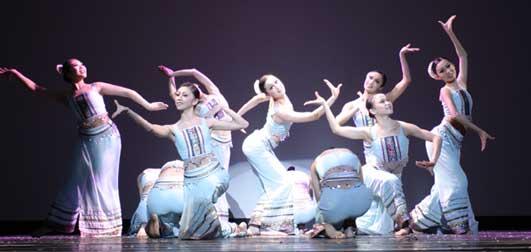
A world-class production of performing artists of excellence, the Spectacular features outstanding vocalists and instrumentalists while showcasing grad stage designs, sceneries and costumes. Classical Chinese dance along with traditional dances of various ethnic styles help weave a talke that touches on the themes of love, compassion and virtue -- and the never-ending battle between good and evil. To usher in the Chinese Year of the Pig, the 2007 Spectacular will play in 26 cities across four continents, including 15 major cities in North America. In Canada, from Jan 3 to Jan 20, the show will play in Vancouver, Ottawa, Montreal, and Toronto.

Last year's production at New York's world-famous Radio City Music Hall ranked the top 7th show internationally on Billboard magazine's Boxscore in February 2006.

In Vancouver for the second year in a row, the Spectacular will play two shows at the Queen Elizabeth Theatre on January 3rd 2007, at 2 pm and 8 pm, featuring all new performances by world-class artists from New York. Don't miss this unique experience!

NTDTV is an independent, non-profit Chinese language TV network established by overseas Chinese. One of our missions is to foster mutual understanding between Chinese and Western societies and advance multiculturalism, peace and compassion. To watch programs 24/7, go to http://www.ntdtv.com

Hu and Harper - to meet or not to meet at APEC

Is Hu Jintao showing resentment towards Harper’s frank attitude on Beijing's communist policy and their lack of human rights? Nevertheless, Foreign Minister MacKay remains optimistic that a meeting will take place to convey their concerns. May they awaken soon! Update: It is confirmed that they will be meeting after all.

Excerpt: Since the Conservatives took power last January, a number of irritants have emerged, including the awarding of honourary Canadian citizenship to Tibet's exiled Dalai Lama, the Celil case, and public accusations by Ottawa of commercial espionage by the Chinese.

And before the Conservatives took power, Tory MPs were among the most vocal critics of religious persecution in China, particularly the treatment of members of the Falun Gong faith.

"I think Canadians want us to promote our trade relations worldwide, and we do that, but I don't think Canadians want us to sell out important Canadian values -- our belief in democracy, freedom, human rights,'' Harper told reporters during a Wednesday stopover in Anchorage, Alaska. "They don't want us to sell that out to the almighty dollar, said Harper.'' (more)

It has only been in the last month that ministerial outreach has been ramped up with Beijing, including a visit this week by Natural Resources Minister Gary Lunn. Foreign Affairs Minister Peter MacKay has been participating in a number of events with embassy officials.

Still, Canadian business leaders have been pressing the Conservative government to reach out to China in order not to hurt future trade ties with the economic powerhouse. At the same time, human rights groups such as Amnesty International and Human Rights Watch have been trying to remind western countries of the continuing abuses in China and the region. (full story)

Wednesday, November 08, 2006

Letter: Good to Pause Over China's Rights Record

Embassy, November 8th, 2006 - I disagree with John Manley's criticism of the Harper government's coolness towards China ("Over Half of Canadians Dislike Tories' Foreign Policy Direction: Poll" Nov. 1). It is actually quite refreshing to see a government pause in front of China's abysmal human rights record. The recent shooting of Tibetans, the news of organ harvesting of living Falun Gong members, the ongoing persecution of Uyghurs and Christians, not to mention the crackdown on rights lawyers' should be more than enough to impose economic sanctions on Beijing. In the run-up to the 2008 Olympics, it is deplorable to see human rights violations are on the rise in China. Did we think that the brutal dictatorship was going to change overnight because they said so? I hope that human rights will play an active role in our government's foreign affairs policy.

Marie Beaulieu
Victoria B.C.

Letter: A response to claims against Falun Gong group

Molokai Times: 11/8/2006 11:03:00 AM

RE: Response to Falun Gong group By Charles Liu 11/4/2006 1:33:46 PM

I strongly disagree with Charles Liu's views about Falun Gong undermining China's rights record. Let's shine the light on Beijing for a moment, shall we?

The news of organ harvesting targeting the Falun Gong only surfaced recently but investigation reports highlight that it has been going on since 2000. Before that, the persecution of Falun Gong (in China) by the Chinese regime was already well documented at the UN with collected evidence amounting to genocide.

The world response toward stopping what Kilgour-Matas call "a new form of evil on the planet" has been encouraging with a recent hearing held by the US Congressional sub-committee and support from Amnesty International New Zealand. So far, the Finnish, Taiwanese and Australian governments, as well as the European Parliament, have backed up the allegations.

For such an abhorrent practice to be allowed to take place in the 21st century is unacceptable. By all means, China should be held accountable for such crimes against humanity. In the run-up to the 2008 Olympics it would be in China's best interest to live up to the promises they made-that is-to improve their rights record before the Games.

With the shooting of the Tibetans at the border, intensified crackdown on human rights lawyers along with tightening up internet and press censorship, not to mention widespread corruption, one can only attest to the contrary. It is clear that this long list of violations, including organ harvesting, has put Beijing apologists on the spot leaving them with a bunch of nothing to talk about.

Tuesday, November 07, 2006

Vancouver: Illicit Organ Harvesting and Transplant Tourism Forum

The BC Friends of Falun Gong cordially invite you to attend a public forum entitled:


Illicit Organ Harvesting and Transplant Tourism in China
Monday Nov.20th, 7:00 pm
Simon Fraser University515 W. Hastings, Vancouver
Room: 1900, Fletcher Challenge Theater

The keynote speakers are:

  • Mr. David Matas, a noted international human rights lawyer from Winnipeg. A former President of the Canadian Council of Refugees, Mr. Matas is active in such organizations as Amnesty International, Helsinki Watch and the International Commission of Jurists. He is also Honourary Legal Counsel for B'nai Brith Canada;

  • acclaimed scholar and author Rabbi Dr. Reuven P. Bulka of Toronto Congregation Machzikei Hadas. He is a member of the Canadian Council for Donation and Transplantation;

  • prominent human rights attorney Clive Ansley, a well-known specialist on China who has been actively involved with China and Sino-Canadian relations for more than forty years. He is the China Country Monitor for Lawyers’ Right Watch Canada (LRWC). Now a resident of Courtenay, Mr. Ansley worked and taught in China as a Canadian law specialist for 14 years.

Mr. Matas’ recent report on human organ trafficking, “Report into Allegations of Organ Harvesting of Falun Gong practitioners in China,” co-authored by former MP David Kilgour, came to the shocking conclusion that Falun Gong practitioners’ vital organs are being extracted while they are still alive. The organs are then sold to the highest bidder while the practitioners’ bodies are subsequently burned in a crematory to destroy all evidence. In order to halt this macabre practice, Mr. Matas has suggested that such a complex matter must be approached from both the justice side and the demand side.

If you are concerned about these allegations regarding the procurement of organs and tissues through coercive or exploitative practices in China, or practices that violate worldwide human rights standards, then this forum is for you. An organ transplant can save a life, but removing an organ from a living person for transplant and killing them in the process - such as in the case of the Falun Gong - is manslaughter.

We hope you will join us for this important forum regarding the booming and lucrative organ trade in China and its repercussions. Let us explore together how we can stop such an abhorrent practice in the 21st century. Your participation is sure to make this forum a success. Please note that members of the Vancouver media will be invited to attend.


Mary Woo Sims & Sadie Kuehn
Co-Chairs, BC Friends of Falun Gong

BC Friends of Falun Gong is a non-for-profit organization composed of human rights advocates and activists who are appalled by the discriminatory treatment of individuals solely because of their beliefs. BCFOFG is dedicated to actively support the efforts of Falun Gong practitioners by bringing the illegal and inhumane persecution of practitioners by the Chinese Government to the attention of the Canadian people and the Canadian government. Falun Gong, a.k.a Falun Dafa, is a practice of mind and body based on the universal principles of truthfulness, compassion and tolerance. Many people worldwide are practitioners of Falun Dafa.

Canadian pressure attracts growing international attention to Chinese Government's organ seizure from Falun Gong prisoners


News Release - For Immediate Release

Ottawa - Following the July release of their ‘Report into Allegations of Organ Harvesting of Falun Gong Practitioners in China’, David Kilgour, former Secretary of State (Asia-Pacific), and David Matas, international human rights lawyer, visited approximately 20 capitals in Europe, Asia, North America and Australia/New Zealand to raise awareness of the “new form of evil on this planet” among legislators, governments, media and the public, including the European Parliament in Brussels and the United Nations Human Rights Council in Geneva.

“Our aim is to raise enough pressure on the government of China that it will stop the unacceptable practice of killing Falun Gong practitioners for their vital organs long before the Olympic Games open in 2008 -- and hopefully immediately”, said Kilgour.

The efforts of the two Canadians appear already to have produced consequences, including:

  • The European Parliament adopted a resolution condemning the persecution of Falun Gong, and expressing concern over reports of organ harvesting; the issue was also raised under the direction of the EU troika leadership through the Finnish Foreign Minister Tuomioja meeting bilaterally with China's Foreign Minister Li Zhaoxing at the EU-China summit in Helsinki in September.

  • The Australian government and main opposition party reportedly asked the Chinese government to allow an independent investigation of the matter within the country.

  • The vice-president of Taiwan, Annette Lu, proposed taking measures to prevent Taiwanese nationals from going to China to receive illegally obtained organs, while condemning China’s government for the practice, after a visit from Kilgour and Matas to Taipei in October.

“As international attention on this issue grows, it is imperative that our government also take action and contribute to the stopping of such crimes”, said Matas.

Background

Kilgour and Matas were asked to investigate an allegation that organs were being harvested in China from unwilling Falun Gong practitioners in early May.

“The allegations were so shocking that they were almost impossible to believe, “ but that disbelief does not mean that the allegations are untrue”. As skeptical lawyers, they investigated. “When one of the first in camera witnesses said that her surgeon husband personally removed the corneas from approximately 2,000 anaesthetized Falun Gong prisoners, we were shaken ", wrote Kilgour.

Kilgour and Matas concluded regrettably that the allegations are true. They further concluded that the government of China and its agencies in numerous parts of the country, have put to death a large but unknown number of Falun Gong prisoners of conscience. Their vital organs, including hearts, kidneys, livers and corneas, were virtually simultaneously seized involuntarily for sale at high prices. Their report is available on line http://organharvestinvestigation.net/

The report was prepared after a systematic examination and marshalling of the evidence. It demands a reply based on facts. So far, there has not been one from the Chinese government, nor does it allow anyone to gather evidence in China.

For more information, contact: David Kilgour: (613) 747-7854; David Matas: (204) 944-1831; Organ Harvest Investigation Team: investigation.team@gmail.com

Friday, November 03, 2006

NTDTV: Myths and Legends Spectacular


Last year's show was absolutely magnificent--la creme de la creme!

"NTDTV Brings the Divine Beauty of the Ancient East to Life With its Now Legendary Chinese New Year Spectacular!

To see previews click here , here, and here.

Join us for a journey across oceans and centuries to the world of China's legendary golden age - the Tang Dynasty. Experience a world of mythical dragons, heavenly maidens, and exhilarating drummers as they evoke the beauty and grandeur of ancient traditional Chinese culture.

Now in its fourth year, the 2007 Chinese New Year Spectacular is going to be grander than ever, touring 26 cities worldwide.

Our celebration in Vancouver has also grown, and this year we will return to the magnificent Queen Elizabeth Theatre on January 3, 2007 for a run of two shows at 2pm and 8pm, with all new performances by world-class artists from New York. From the soulful poignancy of the two-stringed erhu to the stirring rhythms of a Mongolian plains dance, NTDTV's Chinese New Year Spectacular are truly events not to be missed. So this year, step out of the ordinary and into a realm of ancient pageantry with the leader in genuine Chinese cultural entertainment, New Tang Dynasty Television.

Vancouver website is here and email: van_gala@ntdtv.ca

More Spectacular venues can be found here, i.e., Atlanta, Australia, Berlin, Boston, Chicago, Dallas, Houston, Japan, Korea, L.A., Montreal, New York, Ottawa, Paris, Philly, San Francisco, Taiwan, Toronto, Vancouver, Washington DC

Amnesty International and Falun Gong


AI is certainly doing their homework considering that their methodology, a long and arduous process, requires that they cross-check information from two sources before it becomes facts.

AMNESTY INTERNATIONAL HAS APPEALED TO THE CHINESE AUTHORITIES TO STOP THE CAMPAIGN OF PERSECUTION OF FALUN GONG, INCLUDING BY RELEASING ALL THOSE DETAINED SOLELY ON ACCOUNT OF THEIR PEACEFUL RELIGIOUS OR SPIRITUAL BELIEFS AND PRACTICES.

Repression of Spiritual and Religious Groups in China

Religious observance outside official channels in China remains tightly circumscribed. In March 2005, the Chinese authorities promulgated a new 'Regulation on Religious Affairs' aimed at strengthening official controls on religious activities.

Unregistered Catholics and Protestants associated with unofficial house churches were also harassed, arbitrarily detained and imprisoned.

Persecution of Falun Gong

The Falun Gong spiritual movement is banned. When the movement was first banned in July 1999, police rounded up thousands of practitioners in a Beijing stadium.

The crackdown on the Falun Gong spiritual movement was renewed in April 2005. A Beijing official clarified that since the group had been banned as a "heretical organization", any activities linked to Falun Gong were illegal.

Amnesty International has raised concerns that the official campaign of public vilification of Falun Gong in the official Chinese press has created a climate of hatred against Falun Gong practitioners in China which may be encouraging acts of violence against them.

A large but unknown number of Falun Gong practitioners remain in detention where they are at high risk of torture.

More than 250,000 people in China are being detained in camps known as 'Reeducation through Labour', on vaguely defined charges having never seen a lawyer, never been to a court, and with no form of judicial supervision. It is unknown how many Falun Gong members are detained in these camps.

Torture and ill-treatment is endemic and widespread in a wide variety of state institutions. It is frequently used as a punishment against those deemed to be "subversive" or "resisting reform".

Common methods of torture include kicking, beating, electric shocks, suspension by the arms, shackling in painful positions, and sleep and food deprivation. Gender-specific forms of torture, including rape and sexual abuse, have also been reported.

Trade in Organs of Executed Prisoners

Chinese authorities conceal national statistics on the death penalty as a "state secret". Based on public reports available, AI has estimated that at least 1,770 people were executed and 3,900 people were sentenced to death during 2005, although the true figures are believed to be much higher. In March 2004, a senior member of the National People's Congress announced that China executes around 10,000 people per year.

There is a widely documented practice of the buying and selling of organs of death penalty prisoners in China. The lack of transparency surrounding such practices makes it impossible to determine whether written consent was obtained. Amnesty International also remains deeply concerned that those faced with imminent execution are not in a position to provide 'free and informed consent' to having their organs extracted.

Amnesty International notes the introduction, in China, of new regulations on organ transplants on 1 July 2006 banning the buying and selling of organs. However, questions remain about how well the regulations will be enforced, particularly in view of the high commercial value of organ sales in China. Amnesty International also notes that the regulations fail to address the basic issue of the source of organs for transplantation.

Report on alleged live organ harvesting of Falun Gong practitioners

A report published by independent researchers David Matas and David Kilgour on 6th July 2006, concludes that large numbers of Falun Gong practitioners are victims of 'systematic' organ harvesting, whilst still alive, throughout China.

Amnesty International is continuing to analyse sources of information about the Falun Gong organ harvesting allegations, including the report published by Canadians David Matas and David Kilgour.

Amnesty International is carrying out its own investigation on this issue. These investigations are being hampered by the particular difficulty of collecting reliable evidence in China, including official restrictions on access for international human rights organizations.

Amnesty International has noted the response of the Chinese authorities to the Canadian report, which states among other things that China has 'consistently abided by the relevant guiding principles of the World Health Organization endorsed in 1991, prohibiting the sale of human organs and stipulating that donors' written consent must be obtained beforehand'. Amnesty International considers this statement to be at odds with the facts in view of the widely documented practice of the buying and selling of organs of death penalty prisoners in China.

Lai Changxing, Falungong are 'relationship issues' between Canada and China: Emerson

Note to Mr. Emerson: Communist China thus far doesn't understand that Canada cares for 'these things' called human rights and will they ever? Canada has to stand firm on those rights issues that represent the values of our democracy. Surely Mr. Emerson you can try a bit harder to get that message across.

"I'm not saying these things (Falungong and Lai) are hard facts relating to the Canada-China relation, but definitely are part of the constellation of relationship issues that China needs to understand... that in a Canadian legal and constitutional context, there are things we can do and things we can't do," Emerson said.

Chinese in Vancouver Blog: Falungong protests and the extended stay of China's most wanted fugitive Lai Changxing in Canada are "the issues" in shaping the China-Canada relationship, said international trade minister David Emerson in the Asia Pacific summit in Vancouver.


This is the first time a Canadian minister admits that Falungong and Lai Changxing may hinder relationship between the two countries.

"I'm not saying these things (Falungong and Lai) are hard facts relating to the Canada-China relation, but definitely are part of the constellation of relationship issues that China needs to understand... that in a Canadian legal and constitutional context, there are things we can do and things we can't do," Emerson said.

However, he denied there was tension between China and Canada. He said, for example, he and foreign minister Peter Mackay will visit China next January. He said the new Tory gov needed time to understand issues at stake between China and Canada and that's why they weren't able to pay a visit to China sooner.

Emerson said, "My goal is to start to push for the trade and commercial files." Talks around ADS (approved destination status) has been stalled for some time.


"People are saying Canada needs to understand China, but we need to look at the other side too."

Emerson also said that prime minister Stephen Harper has requested to meet with Chinese president Hu Jintao one-on-one during the APEC summit in Vietnam next month, though he emphasized he could not speak on behalf of the prime minister.


"But scheduling has been difficult, especially from the Chinese side."


"All of this spinning that is going on that the government is not prepared to deal with China is not true," Emerson stressed.

Among the agreements he hinted was tied up by the "constellation" was one that would have Beijing grant approved destination status to Canada and make it easier for Chinese tourists to visit.

Emerson said issues such human rights would be prominent in the policy still being developed by the Conservatives, but he suggested they were still grappling with the "nitty gritty as to tactics."


"How do you pursue your human rights objectives, your democracy objectives, environmental objectives and so on, in a practical way that doesn't limit and hurt Canada's economic prospects?"

Towards the end of the scrum with reporters, Emerson was asked: "Are you going to run in the next election?"


Emerson's answer was: "Ha Ha Ha Ha Ha!"

Then he left.

Epoch Times: Chinese Tourism Deal Frozen

Rally in support of the 15 Million Chinese who quit the CCP

Sunday November 5, 2006 @ the Art Gallery on Robson

Rally and Speeches at 12:30 p.m.

March Begins at 1:30 p.m.

Members of the Vancouver Chinese and non-Chinese Community will march in support and recognition of the courageous Chinese citizens who are resigning from the Communist Party despite being heavily persecuted for this action.

Just fifteen years after the Berlin Wall was dismantled, a massive movement for freedom has emerged in China, the largest communist regime in the world. To date, over 15 million Chinese people have publicly renounced their affiliation with the Chinese Communist Party, with the number growing by up to 40,000 more people each day. This could be the single largest non-violent civil disobedience movement in China’s history, and indeed the world.

This phenomenon was spotlighted in the international community last week when Professor Jia Jia, Secretary General of the Science and Technology Experts Association of Shanxi Province defected from China. Mr. Jia is the highest-ranking Chinese official to openly support the movement to quit the Chinese Communist Party (CCP) while still at his post. According to the Global Service Center for Quitting the CCP, Mr. Jia's defection has triggered a chain reaction of members quitting the CCP in China.

What does this movement have to do with Canadians? As one of our major trading partners, what happens in China’s economic powerhouse directly impacts us. Susan Fang spokesperson from the Vancouver Chapter of Global Service Center for Quitting CCP said: “ When the Berlin Wall came down, we thought it happened overnight when in actuality the movement to end communism in Russia had been going on for many years. How will the fall of the Red Wall impact us? Canadians need to be aware of this.”

The massive wave of 15 million people withdrawing from the Chinese communist party was triggered by the book "Nine Commentaries on the Communist Party" http://www.ninecommentaries.com/ , which has revealed, for the first time a comprehensive account of the CCP's formation, its advocacy of violence and deception, its destruction of traditional beliefs, and the disaster it has brought upon the Chinese nation for the past 60 years. The 9 Commentaries is now the #1 banned publication in China. Outside China, the value of the Nine Commentaries on the Communist Party was highlighted when it was honored with a National Journalism Award in the category of Asian American Issues - Online by the Asian American Journalists Association (AAJA) on August, 18, 2005.

At this crucial historial time, millions of ex-Communists are watching to see if the democratic world will protect and aid Jia. By granting Jia asylum and protection, Canada will show that the nations of the democratic world are eager to see China join them. Conversely, continuing to deny him asylum sends the unintended signal that the free world is more worried about the Chinese Communist Party than the Chinese people. This is not the signal we want to send. Jia Jia can be more than just a leader in the China democracy movement; he can be a symbol to all who have rejected the Communist regime that they have been noticed by the democratic world, and a symbol of encouragement to those considering leaving the Party to do the right thing. That is the main reason why the Communist Party is so eager to ensure Jia is not granted asylum. It is also the main reason asylum should be granted.

Jia is safe and sound in Thailand for the time being.

Vancouver: A mayor's journey from hero to zero

It's not too late for Mayor Sullivan to show some compassion in the case of the Falun Gong protest site although the court date is fast approaching. That would be one way to regain some respect from Vancouverites.


Globe and Mail by GARY MASON: (VANCOUVER) October 29 - Nine months ago he was the toast of the world. Now it's hard to find anyone saying nice things about Mayor Sam Sullivan.

Reviews of the mayor's first year in office are starting to come in and they're not kind. He's being called feckless, wishy-washy, a non-item.

In one recent magazine profile he was compared to Howdy Doody, Uriah Heep, Columbo and Karl Rove in a wheelchair.

It's not looking so good for the little guy.

While there may not have been an expectation that Mr. Sullivan would accomplish a lot in year one, there was the hope he'd at least articulate a vision, demonstrate in some meaningful way the direction in which he planned to take the city.

So what has been the mayor's most talked-about policy decision so far? Probably the move to force Falun Gong protesters to take down a shack and signs in front of the Chinese consulate.

His shining moment, to this point, came at the 2006 Winter Games in Italy in February when he accepted the Olympic flag from the mayor of Turin, the first quadriplegic mayor to ever do so. The international media coverage of the event was saturating.

It's been downhill since.

The mayor would insist his most important policy initiative is something called eco-density. It's all he talks about. The problem is that no one knows what he's talking about. Apparently, it's a plan to jam more people into Vancouver by building up but no one is quite sure what that is going to mean for them or their neighbourhood.

Probably the biggest problem facing the mayor is homelessness. Given that you would have thought he'd turn to one of the few experienced members of his young Non-Partisan Association council team to grapple with the issue. Instead, he gave the file to a council rookie, Kim Capri.

Earnest and well-meaning, Ms. Capri made all the wrong headlines recently when she talked about having the homeless live in social housing units smaller than the 400 square feet mandated under city bylaws. Ms. Capri said she envisioned units perhaps half that size, ones she described as "cruise-ship style."

Many found the comment insulting and insensitive. Around city hall they're now calling her Kim Antoinette.

The people you would expect to be supporters of a mayor representing a right-of-centre party -- developers, business types -- are among his harshest critics. Influential developer Peter Wall recently said Mr. Sullivan has been a non-entity to this point.

And then there's condo king Bob Rennie. A supporter of Mr. Sullivan in the past, Mr. Rennie, who has amassed a large fortune selling real estate in the city and who is regularly referred to by cronies as The Mayor because of his wide circle of influence, is not a fan of the real mayor.

Mr. Rennie is one of the few to utter publicly what many have been saying in private: Sam Sullivan should be judged by what he's done as mayor, not by what he's done as a mayor in a wheelchair.

While that might sound harsh, there is definite constituency out there who believe Mr. Sullivan has made his wheelchair part of his arsenal. That it has helped him create this image of a guileless innocent, not one to be considered a threat of any sort.

If people are reluctant to really go after him because of his handicap, or better yet, if they underestimate him because of it, all the better. His weakness becomes his strength.

While Mr. Sullivan's "act," as some have called it, frustrates his political opponents there are few who are willing to challenge him about it on the record. Except Mr. Rennie.

"I think the wheelchair thing is belittling to Sam," Mr. Rennie said.

"He needs to start being the mayor rather than the wheelchair mayor. So far from him it's been complete mediocrity."

Kennedy Stewart, a political science professor at Simon Fraser University and one of the keenest observers of civic politics in Vancouver, also believes Mr. Sullivan's first year on the job has been a bust.

"It's been inauspicious to say the least," he said in an interview from London, England. "There's been a lot of wheel spinning in the first year. And then some of the things he's done like saying he's going to legalize heroin without consulting anyone makes him a laughing stock."

Prof. Stewart believes Mr. Sullivan needs to turn things around quickly if he wants to avoid further problems.

"If he continues down the road he's on you might see a push from inside his party to have someone else stand for the job next time around," Prof. Stewart said. "There wouldn't be a shortage of people interested in being the Olympic mayor."

Poor Sam. Where have all his friends gone?

Internet Governance Forum takes on China, US

Global net issues were discussed this week at the IG Forum in Athens with some Monty Python-like comments from the Chinese participants. Look here for more on the US tracking technology used to capture dissidents especially the Falun Gong.

It was a surreal moment, especially when the Chinese diplomat was asked to elaborate on the restrictions that were in place in China. His response: "We do not have restrictions at all." To which someone in the audience shouted out,"Come on!"

Day two: China doesn't censor the Internet. At all.

The IGF meeting has four main foci: openness, security, diversity, and access. The first major session on day two was the openness panel, and it was headed by BBC News presenter Nik Gowing. After the panelists introduced themselves, Gowing asked the crowd what they wanted to talk about for the next few hours, and it didn't take long for the topic to turn to China.

Steve Ballinger of Amnesty International took the microphone second and wanted to talk about IT companies "that have colluded with repressive countries, particularly in China." An Agence France reporter was "very interested in the Cisco participation in this panel because I would like to ask him what happened with the software material they've sold to the Chinese police." And with that, the panel was off and running.

With members of the BBC, Microsoft, Cisco, human rights organizations, social justice NGOs, and the European Court of Human Rights on the panel, there was plenty to talk about�and participants did so, for quite some time. This was apparently too much for Yang Xiaokun, a Chinese diplomat to the UN in Geneva, who stood up and defended his country. "In China, we don't have software blocking Internet sites. Sometimes we have trouble accessing them. But that's a different problem," he said.

This, of course, is a bizarre claim to make, and no one on the panel bought it. Xiaokun went on to add, "I've heard people say that the BBC is not available in China or that it's blocked. I'm sure I don't know why people say this kind of thing." Richard Sambrook of the BBC then let him know exactly why people say this kind of thing, saying, "If he was in China he would not be able to listen to our Mandarin service on short wave radio and not be able to read our Mandarin news site on the website."

It was a surreal moment, especially when the Chinese diplomat was asked to elaborate on the restrictions that were in place in China. His response: "We do not have restrictions at all." To which someone in the audience shouted out, "Come on!"

The discussion hit on several other topics, of course, including the WIPO broadcasting treaty. Jamie Love of the Consumer Project on Technology garnered applause from the audience by arguing that intellectual property laws are divorced from the ways in which people actually use digital content, and that the two approaches need to be reconciled. "WIPO has to sort of get the message that, you know, the people are right and the lawyers are wrong on some of this stuff and kind of move things back in the other direction."

Ottawa weighs shelving Chinese rights dialogue

Amnesty International Alex Neve, along with other NGOs, submitted concrete recommendations on the China bilateral dialogue policy to the Federal Human Rights Committee last week suggesting that a “whole of government” approach be adopted when dealing with China putting human rights at the center. Geoffrey York analyzed the situation.

The Globe and Mail: Ottawa weighs shelving Chinese rights dialogue

BEIJING, OTTAWA, October 27, 2006 — The federal government, under heavy criticism for its ineffective talks with China over human rights, is debating whether to proceed with the "human-rights dialogue" as planned this fall.

The annual event was a centrepiece of the previous Liberal government's policy of engagement with China. But many members of the new Conservative government are sharply critical of China's human-rights record and are seeking a tougher approach.

The dialogue was launched in 1997 as part of an agreement between the two countries when Canada decided not to co-sponsor a resolution about Chinese rights violations at the United Nations human-rights commission in Geneva. It is an annual event, usually lasting one or two days, in which Canadian and Chinese officials discuss an agenda of human-rights issues.

It has been assailed by a coalition of Canadian human-rights groups, which is calling for its temporary suspension and reassessment. And a study by a Canadian professor found that the dialogue is largely a propaganda exercise, intended by China to defuse foreign criticism.

While federal officials did begin preparations for the talks about six weeks ago, there is still no date set, and the normal consultations over the agenda have not yet begun. The delay is seen as a hint that the Tories are reconsidering the event.

A senior government source confirmed yesterday that the government is looking for a stronger mechanism. The source said the dialogue might still be held this year, but could be replaced in future.

A parliamentary subcommittee, headed by Conservative MP Jason Kenney, will also hold a hearing Tuesday to review the annual talks. Mr. Kenney, who acts as Prime Minister Stephen Harper's parliamentary secretary, is a strong advocate of more actively advancing the human-rights cause in China.

The coalition of human-rights groups had sought the review for five years, but were snubbed until the Conservatives took power.

A popular Chinese newspaper warned this month that Canada would face a "serious diplomatic problem" in its relations with China if it cancelled the dialogue. The Beijing-based Global Times newspaper told readers there were "cold winds blowing" from a "behind-the-times" government in Canada.

The Harper government has been badly divided on its China policy, with its caucus and cabinet split between those who want to emphasize human rights and those who want to give priority to trade.

At a closed-door consultation with key groups on Oct. 19, Foreign Affairs Minister Peter MacKay and International Trade Minister David Emerson heard criticism from Canadian business leaders and academics who warned that Canada's relationship with China is suffering neglect and damage because China is increasingly unhappy with the policy vacuum and the negative signals from Conservative MPs who seem to favour Taiwan over Beijing.

Mr. MacKay, however, gave no indication that the Conservatives would announce a new policy as long as they remain in minority.

In a letter to the government this month, a coalition of a dozen human-rights groups and other China-related organizations said the human-rights dialogue should be "temporarily suspended" because of China's recent crackdown on human-rights defenders and because the Tory government has failed to develop a new China policy.

The coalition, citing a detailed study by Brock University political scientist Charles Burton, said there are "substantial shortcomings and failings" in the dialogue, launched by the previous Liberal government in 1997, and argued that it should be delayed until the government responds to the Burton report.

Mr. Burton, who has been invited to testify to Mr. Kenney's parliamentary subcommittee, concluded that the dialogue is plagued by "pervasive cynicism" and "dialogue fatigue." Most of it is scripted in advance and has "little connection" to realities on the ground, he found.

The event has gradually been downgraded by Beijing and does not even involve the right officials, because the Chinese side is represented by Foreign Ministry officials who have no involvement in human rights, Mr. Burton found.

Carole Samdup of Rights & Democracy, part of the rights coalition, said a suspension would be "good news" if it means a serious rethinking. "The dialogue, in its current form, does not serve human-rights interests," she said.


Sunday, October 29, 2006

Rally in support of Jia Jia

Speech to the Rally

Jia Jia First Chinese Official to Publicly Quit the Communist Party Seeks Asylum

Vancouver BC Chinatown

Sunday October 29, 2006

Mr. Jia Jia is the general secretary of China Shanxi Science and Technology Experts's Association and legal representative. He is also a member of the board directors of Gold Experts's Services Co. Ltd, the director of National Experts Network Centre, the leader of the Strategy Team for the Chinese Experts Committee.

Jia is a dedicated activist for freedom and democracy in China. That is the reason why he has never joined the Chinese Communist Party (CCP) or any of its organizations. For the last couple of years, he has distributed the book Nine Commentaries of the Chinese Communist Party and told the true nature of the CCP to the Chinese people.

Jia defected October 23 during a trip to Taiwan, but due to intense CCP pressure on the Taiwanese government and other unknown reasons, the Taiwan government did not grant him asylum. At the press conference held on Friday in Hong Kong, where he was deported, Jia stated he would consider going to any country willing to provide a safe environment for him, and that he wishes to continue his work overseas to help China move forward to democracy.

He sought to leave China to publicly urge all CCP members to abandon and withdraw from the party. He also said he wished to confirm for the public the reality of the great current of withdrawals from the CCP, with 14 million people having renounced the party and its related organizations.

"The fact that 14 million people have renounced the CCP makes me feel compelled to step out," Jia said. "Because I have seen that the 'Quitting the CCP' website has been repeatedly telling the same story. What story? The website has been explaining to the public that the number of people posted on the website who have quit the CCP is real.

"I am doing this because many countries and many governments have refused to believe the reality behind the number and refuse to believe that such a campaign is indeed going on."

Chinese history proves that it is impossible for the CCP to realize democracy in China. The essence of the CCP determines its character of dictatorship, use of violence, cheating, suppression and terrorism.

Jia is resolute to promote democracy in China no matter what the cost and encourages people to take action. He stated that many communist party members want to have democracy in China and he is confident that it can be realized--the CCP is nearing its end.

As we all know, the famous Chinese human rights attorney Gao Zhi Sheng who promoted freedom in China has been widely supported by the righteous people of the world. Nevertheless, he was still arrested by the CCP recently. From his case, we can see that CCP has reached its extreme, as it turns a blind eye to international attention and human rights.

However, Jia’s situation is very critical. He can only stay in Hong Kong for 7 days until his transit visa expires on November 2nd at which time he will be returned to China. If he is deported back to China, his life will be at risk--he may be sent to prison with a life sentence or even receive the death penalty.

Last year, in Shi Jia Zhuang, Ms. Sun Li was sentenced to 5 years in prison for merely owning a copy of the Nine Commentaries. On January 24th the Public Security Bureau launched the "National Public Security Persecutes Falun Gong for distributing Nine Commentaries Act," making ownership of the book a crime.

Jia has already become one of the key players in the Chinese democracy movement. If he is persecuted by the CCP, then the democracy movement in China will be impacted. Other democracy activists will lose their confidence.

We appeal to the governments of the world to rescue Jia Jia-- for the sake of humanity, freedom and democracy. For the people who love freedom and democracy please support Jia immediately. We appeal especially to the Hong Kong government to protect Jia and support his democratic agenda so that democracy can be achieved in China.

You may call/fax/email to:

UNHCR Field Office in Hong Kong and China
UNHCR-Hong Kong
Tel: (852) 2770-5504
Email: chiho@unhcr.ch

Web-mail to UNHCR-Hong Kong [In the pull-down menu "- choose a country -", please select Hong Kong and click "Go"]

UNHCR-China (Assumes responsibilities for UNHCR activities in Mongolia and supervises the activities of UNHCR's office in Hong Kong)
Email: chibe@unhcr.ch; unhcr@unhcr.ch
Tel: +86 10 6532 6806
Fax: +86 10 6532 1647

U.S. Consulate General in Hong Kong
Address: 26 Garden Road, Hong Kong
Tel: (852) 2523-9011
Fax: (852) 2845-1598
Email: uscghk@pacific.net.hk

A list of foreign embassies/consulates in Hong Kong can be found here.

Friday, October 27, 2006

Stop Russia from banning Falun Gong

Russia’s close ties to Communist China is causing Falun Gong practitioners to bear the brunt of their strategic partnership these days. Once again, Putin has chosen to roll back democracy and back up China on Falun Gong issues. Recently the head of the Russian Branch of the Falun Dafa Association was asked to leave the country within a few days. He is now safe in the US. Meanwhile a wave of harassment has hit the community of practitioners especially since the G-8 meeting. Practitioners have had their visa renewals refused, their phones tapped, along with email messages screened, and the National Security Bureau has interrogated coordinators. The buzz is that Russia is preparing to outlaw Falun Gong completely if the practitioners do not stop their peaceful protests and activities exposing the brutal persecution of Falun Gong by the Chinese Communist Party (CCP).

This is not the first time that Russian authorities pick on Falun Gong. Epoch Times reporter and practitioner Anton Kolyada was beaten by the police on his way to the G-8 meetings last July. At that time they also arrested 12 Russian practitioners planning to go to St. Petersburg "to ask President Putin that he urge Hu Jintao to stop persecuting Falun Gong and end the [illicit] organ harvesting in China." (more)

Lyudmila Alexeyeva, head of the Moscow Helsinki Group and a respected human rights champion, said that totalitarian regimes always suppressed spirituality and said the banning of Falungong "reminds me of the USSR in the 1960s when they banned yoga." (more)

As Putin is getting closer to retirement, one can only wonder whom he will assign to take the post. This has pro-democracy activists quite worried. Let’s hope for Russia that they will not choose to regress by banning the peace-loving Falun Gong spirituality.

Let's stop them in their tracks by voicing our concerns to the Russian Government. Falun Gong practitioners are not criminals and shouldn't be treated as such.

Send a short and firm letter to President Vladimir Putin here and/or to the
Presidential Executive Office here. Many thanks for your support.

Thursday, October 26, 2006

Coalition to Investigate the Persecution of Falun Gong in China (CIPFG) Plans to Investigate in China

On October 20, 2006, the Coalition to Investigate the Persecution of Falun Gong (CIPFG) issued a notice that announced the organization of a team in preparation to conduct an unrestrained open investigation in Mainland China on the persecution of Falun Gong, especially on the harvesting of living Falun Gong practitioners' organs and to visit investigation team members Gao Zhisheng and Li Hong and urge the CCP authorities to release them unconditionally. (more) Following is the entire notice:

Notice of Plan to Investigate in China (1)

Whereas, former Canadian Member of Parliament and the Secretary of State for Asia-Pacific David Kilgour and International human rights lawyer David Matas' independent investigation report has established that the Chinese communist party (CCP) is murdering a large but unknown number of Falun Gong practitioners by removing their organs and selling their organs for profit.

Whereas, various Chinese organizations including the CCP military and judicial/hospital systems have participated in taking by force organs from living Falun Gong practitioners' since the year 2000, and are still continuing unabated today. A large number of Falun Gong practitioners are being covertly detained at many secret concentration camps with their lives in imminent danger;

Whereas, the CCP's persecution of Falun Gong has lasted over seven years, and 2,973 Falun Gong practitioners have been confirmed to have been persecuted to death. The Falun Gong practitioners, who are being illegally detained in various labor camps, prisons, hospitals, and associated facilities across China, are being brainwashed, enslaved, tortured, sexually abused, and murdered ;

Whereas, people in Mainland China, who have joined CIPFG, including human rights lawyer Gao Zhisheng, Yang Zaixin, Zhang Jiankang, and Internet writer Li Hong, have been harassed, beaten, and arrested by the CCP. Among them, Gao Zhisheng and Li Hong have been detained for over 60 and 30 days respectively. Both of them have been formally arrested for the so-called "crime of inciting subversion of state power" and are facing unfair punishment and heavy sentence;

Whereas, the CCP authority has denied the allegations of harvesting organs from living Falun Gong practitioners and have welcomed the international community to investigate in China;

Whereas, the act of taking innocent people's organs alive and in the process killing them is a crime against humanity, the international society has a justified responsibility to immediately investigate and stop it;

Therefore, the CIPFG has organized a team to conduct an unrestrained, open investigation in Mainland China on the persecution of Falun Gong, especially on the harvesting Falun Gong practitioners' organs, and to visit investigation team members Gao Zhisheng and Li Hong and urge the CCP authorities to release them unconditionally.

Since the formation of the CIPFG, many hundreds of humanitarians from all walks of life have joined the CIPFG. They are willing to go to China to do a thorough independent investigation. Because there are so many people, we are planning to organize sub-teams from different continents to investigate in China, i.e., an investigation team from Australia, an investigation team from Asia, an investigation team from Europe, and an investigation team from North America.

Each investigation sub-team has about 30 members, and is made up of (current and former) members of parliament and senators, attorneys, reporters, VIP's and doctors. Like Hon. David Kilgour and Mr. David Matas, all members are volunteers, and they will conduct the independent investigation voluntarily without payment.

Each sub-team will decide the length of its on site investigation in China. Generally, it will be from one week to one month. The investigation priority includes forced labor camps, prisons, hospitals, and all relevant detention facilities in Mainland China.

We sincerely hope that the Chinese government will fulfill its promise to the international community and assist us with an unfettered and open investigation.

We will update the media and our Governments with the progress of our visa applications and our on site investigation reports from for the sub-teams. We sincerely hope that the international community will pay attention to and support the investigation.

CIPFG

2006-10-20

United Nations to Investigate CCP Organ Trade

The UN Rapporteur on Torture Manfred Nowak will go ahead with investigating organ harvesting in Communist China. It's time for China to open the door to those VIPs who are willing to get at the bottom of this macabre operation.

Excerpt: On September 26, 2006, Agence Telegraphique Suisse (ATS, Switzerland) via CW published an article entitled "The United Nations to Investigate China’s Organ Trade."

The article said that China was not able to stop the discussion at the UN Human Rights Commission about the allegation that it harvested organs from Falun Gong practitioners. The current meeting of commission members ended on October 6. The UN rapporteur will look into the allegation and report back to the UN.

Canadian Human Rights lawyer David Matas and former Canadian [Secretary of State] responsible for the Asian Pacific region, David Kilgour, wrote an investigative report on the Chinese regime’s organ harvesting from Falun Gong practitioners. On Tuesday, Matas said in Geneva that the response from the Chinese regime was disappointing and empty. The regime did not reject the facts in the report, but instead chose to attack its authors. This made us very concerned about the events occurring there.

In the name of the International Multi Belief organization, Mr. Kilgour demanded of the Chinese Ambassador at the meeting that before the Beijing Olympics, China should answer to the allegations of deprivation of freedom, torture and disappearance of Falun Gong practitioners.

Mr. Matas said that a report into the problems of torture, arbitrary sentencing, religious freedom and disappearance had been passed to the UN rapporteur. The UN rapporteur of torture Mr. Manfred Nowak visited China last year. He agreed to join the current investigation.

Kilgour's Speech on Overcoming Violence: Abroad and at Home

Overcoming Violence: Abroad and at Home
Address by Hon. David Kilgour
Conference on Building World Peace
The Role of Religions and Human Rights
Shaw Conference Centre, Edmonton

October 21st, 2006: Before suggesting ways to reduce one kind of violence in neighborhoods within Canada, permit me to look beyond our borders. Some spills into our own country, but most, of course, results from a range of home-grown causes.

First the important concept developed by Benjamin Barber in his book, Jihad vs McWorld, stressing first, as the author does, that Islam as one of the world’s great religions is not the issue. Indeed Barber’s introduction to the most current edition of his book criticizes Rev. Jerry Falwell for interpreting the 9/11 attacks on New York and Washington as the wrath of God, noting that Falwell no more defines Protestantism than the Taliban defines Islam. Barber is also correct in taking issue with Samuel Huntington for echoing Osama bin Laden since both appear to call for a cultural war between “the West and the rest”.

The book uses the term “McWorld’ to refer to the forces of aggressive economic and cultural globalization. “Jihad’ refers to “disintegrative tribalism and reactionary fundamentalism”. It concludes that only the globalization of democratic institutions is likely to offer a way out of a global war between modernity and its critics because it responds best to both sides of the conflict.

Barber continues: “By extending the compass of democracy to the global market sector, civic globalization can promise opportunities for accountability, participation and governance to those wishing to join the modern world and take advantage of it’s economic blessings; by securing cultural diversity and a place for worship and faith insulated from the shallow orthodoxies of McWorld’s cultural monism, it can address the anxieties of those who fear secular materialism and are fiercely committed to preserving their cultural and religious distinctiveness. The outcome of the cruel battle between Jihad and McWorld will depend on the capacity of moderns to make the world safe for women and men in search of both justice and faith, and can be won only if democracy is the victor.”

Democracy Building

In my view, Canadians and our governments should be working much harder and more effectively towards achieving a fully democratic world as early as possible in the new century. The 45 or so dictatorships left around the planet, which do so much damage internationally as well as domestically, should know always that Canada stands always with their respective populations and their human rights and well-being, never with tyrants of any political hue.

I share fully a number of the points on democracy promotion which Tom Axworthy of the Queen’s University Centre for the Study of Democracy recently made to the House of Commons Committee on Foreign Affairs and International Development, including these three:

1. The British, Germans, Swedes and Americans are already directly promoting democratic practices around the world, including free elections with universal adult suffrage, freedom of expression, association, political organization and dissent, alternative sources of information and genuine political choice and the accountability of government to voters. Independent courts, equality before the law and protection for minorities, including religious ones, are essential to functioning democracies.

2. There must be a functioning state before there can be a functioning democracy. In the case of Afghanistan, the holding of a Loya Jirga traditional assembly to give Afghans ‘ownership’ of their democratic process was a good start, but more troops are unfortunately needed to ensure public security. In the successful case of Bosnia, the ratio of soldiers to inhabitants was about 1 to 50, but this level has never been reached in Afghanistan. (Lest there be any ambiguity, I do not think Canada should abandon the Afghans to the Taliban despite the loss there already of some of our noblest sons and daughters in battle.)

3 A Canada-based democracy institution- Democracy Canada – rooted in our federal, culturally diverse, multicultural and bilingual country would be warmly welcomed by the international democracy promoting community. We must stand with the world’s democrats and make a serious effort to promote the concept, (knowing full well that government of, by and for the people will differ everywhere).

Twentieth Century Violence

The century we recently left was undoubtedly the worst in all recorded history in terms of brutality directed at believers. One estimate of the number of human beings of all nationalities who died prematurely for their faiths between 1900 and 2000 is an appalling 169 million, including: 70 million Muslims; 35 million Christians; 11 million Hindus; 9 million Jews; 4 million Buddhists; 2 million Sikhs; 1 million Baha’is.

Too many of these victims died in inter or intra-faith violence, but most by far perished at the hands of totalitarian regimes, which, demanding that all authority be vested in themselves, detest religion mostly because its practitioners’ deepest loyalties lie elsewhere. Stalin, Hitler, Mao and other dictators had murdered untold tens of millions of believers.

Falun Gong in China

Having just completed a visit to four Asian locations (South Korea, Japan, Taiwan and Hong Kong) to raise awareness about the issue of organ harvesting from Falun Gong practitioners in China, permit me remind you of what is happening even today in China to this new faith community. The experience offers lessons for other religions in the new century as well, especially the need for all faith communities to stand together when one is being persecuted anywhere. Persecution directed against one community must be seen as an attack on all.

Founded only in 1992 in China, Falun Gong enjoyed phenomenal success there initially, in part because of the spiritual vacuum created by Mao and the militant atheists in power since 1949 and partly because, unlike the Communist party, its roots are deep in Chinese culture and religion. Following the Tiananmen events of 1989, the government of Deng Xiaoping was willing to tolerate religions as an outlet for popular frustrations with the authoritarian, if not totalitarian, governance combined with the unregulated, if not heartless, model of capitalism Deng had unleashed in China a decade earlier.

Falun Gong contains more health elements than most traditional religions and more religion and ethical features than other qigong schools. Falun Gong offered to many Chinese the opportunity to access spiritual and moral principles through physical exercise and healing. Faith followed exercise. There is also a community dimension, but no aspiration to any political office and no violence. Another Polish Solidarity movement, Falun Gong clearly was not, although Deng’s successor, Jiang Zemin, being preoccupied mostly with keeping his party in power by force, evidently thought that the two were identical in the threat they posed to Communism.

What really sparked Ziang’s declaration of war on Falun Gong was its popularity; by the late 1990s, there were 70 – 80 million practitioners across China, considerably more than members of his party. Beijing alone by then had 2000 exercise practice sites and in the mid- 90s Falun Gong meditation was even practised within the Ministry of Foreign Affairs in the capital. A spark was lit when 10,000 – 16,000 Falun Gong practitioners from all walks of life petitioned at Party headquarters in central Beijing against an attack in them in a publication. Jiang declared a violent war almost immediately in the summer of 1999.

Seven Years of Terror

On what has resulted since the summer of 1999, permit me to quote from a speech, I gave recently on behalf of Interfaith International at the UN Human Rights Council plenary in Geneva:

“I wish to speak about whether the government of China is harvesting the vital organs of Falun Gong practitioners, killing them in the process. (Human Rights lawyer) David Matas and I released a report in July, which came to the conclusion, to our regret and horror, that the claims were indeed true.

We examined every avenue of proof and disproof available to us, eighteen in all. For example: Falun Gong practitioners in Chinese prisons are systematically blood tested and medically examined. Because they are also tortured and abused viciously, this testing cannot be motivated by concerns over their health.

Waiting times for organ transplants in China are incredibly short, a matter of days and weeks. Every where else in the world, waiting times are measured in months and years, pointing to the existence of a large living organ bank in China.

It is easy to take each element of proof in isolation, and say that this element or that does not prove the claim. It is their combination that leads us to the chilling conclusion we reached. We are reinforced in our conclusions by the feeble response by the Government of China. Despite resources and inside knowledge, it has not provided any substantive information to counter our report.

Our report has 17 different recommendations. Virtually nothing to prevent the harvesting of organs of Falun Gong practitioners in China is currently being done. All our proposed precautions should be enacted and enforced. One should be implemented immediately; organ harvesting from Falun Gong practitioners across China must stop now.”

If you wish further information about this tragic situation, you can access our report in ten languages and various media commentaries here.

Sudan: More Genocide Looming

From the perspective of this conference, there is much to be said about contemporary Sudan as one of the most violent remaining dictatorships. Let me make only three points now:

First, last week there was a report that approximately 80 Dafuri children are now perishing each day in what the United Nations has termed a ‘man-made catastrophe of an unprecedented scale’. Unlike southern Sudan, where there was a major religious dimension to the twenty-year old civil war, virtually all the residents of Dafur are Muslims. In a province where ‘African’ and ‘Arab’ communities live together in relative harmony for centuries, genocidaires, who deem themselves to be Arabs, have over the past three and a half years used government aircrafts, bombs, bullets, gang rapes of girls as young as eight, fire and starvation to drive their surviving neighbours out of Dafur or into displaced persons camps. Approximately 450,000 of the African community have died, roughly half murdered and half dead of starvation and related causes from the conflict.

Second, Sudan’s military leader, Omar al-Bashir, will allow the 7,000 – members of the African Union (AU) essentially observer force to remain until the end of this year. He refuses to accept a more robust UN peacekeeper force of 20,000 to attempt to dissuade his proxy janjaweed from more waves of mass murder. He insists bizarrely that UN peacekeepers in Dafur would violate Sudan’s sovereignty despite the fact that he has already accepted 10,000 peace-keepers in southern Sudan.

Why isn’t the Security Council finally accepting its UN Charter responsibility and insisting on implementation of its resolution 1706? The Harper government should also be pushing the Security Council under Canada’s Responsibility to Protect (R2P) doctrine, specially when two ‘if not all three’ of the opposition parties indicated in the recent House debate that they want Canadian peacekeepers to save lives in Dafur.

Third, if the UN Security Council continues to be ineffective in preventing yet another Rwanda-like genocide in Dafur and the Dafur Peace Agreement (DPA) signed in May still protects virtually no Dafuri civilian, other options will have to be considered. One is a three-part plan, which would welcome the assistance of the UN, the AU or NATO, but could succeed without the help of any of the three. It would provide a protected deliberation of a wide range of Dafuri leaders, an interim regional administration for the province and a no-fly-zone to stop Sudanese government aircraft from bombing civilians across Dafur.

If the regime in Khartoum concludes this option would establish a credible threat of force to stop its renewed genocide, it might well accept UN peace-keepers under its Resolution 1706. Perhaps Khartoum’s most important business and defense partners, the governments of China and Russia, can now finally be shamed into persuading Bashir to accept UN intervention.

Reducing One Kind of Violence At Home

Much of the world probably sees Canada as a new beacon on a hill, where persons and communities of different religions (or other beliefs) live together in harmony in what has been termed ‘permissive differentiation’. Our major cities are today full of churches, mosques, synagogues, gurdwaras, pagodas and temples.

Recent events suggest that complacency anywhere across Canada might be unwise. Permit me therefore to refer to an important paper by Dr. Elaine Pressman, who was raised in Prairie Canada but has been living in Amsterdam for the last few years. Her paper, ‘Education for Migrant Integration’ European and North American Comparison’, was presented at the Munk Centre for International Affairs at the University of Toronto a month ago.

Some key points in it:

The convicted murderer of Theo Van Gogh in the Netherlands was initially thought to be a ‘well integrated’ member of Dutch society in terms of his language skills, Dutch education, employment history and general ability to function within the country. Given this serious misreading, Pressman developed a tool to measure issues of integration; it uses ten self-assessing criteria to help determine the inward level of integration felt by newcomer individuals in Holland or elsewhere.

One, for example, is acceptance; a person assesses on a one-to-ten scale how accepted they feel within their adopted country. Self-ratings are also applied to nine other factors, including: one’s sense of welcome, integration, equal work opportunity for all, language capability, social access, loyalty, pride in citizenship, and acceptance of community values. The responses of relative newcomers were compared to those from a control group of long-time Dutch nationals. The scores of the latter group were in the 74 - 91 % range; one refugee group of immigrants surveyed had integration levels in the 17 - 41% range, with an average of 33%.

The Pressman methodology also identified cases of regressive integration in which individuals reversed the integration process as they reached adulthood because they felt betrayed as citizens. Radicalization is, of course, one by-product of reverse integration. Indicators included low loyalty to country, high-perceived discrimination, and no political or social involvement with the community.

The Dutch Intelligence Service (AIVD) has warned that the newcomer integration problem in the Netherlands could become so severe that in a worse-case scenario the national community there ‘could risk falling apart along religious and cultural lines’. Radicalization in the Netherlands today appears to be a serious social problem; essentially it means a group willingness to pursue changes in the country, which might cause danger to the continued existence of the democratic and legal order.

In Amsterdam, for example, Pressman’s research indicates that some students as young as seven were exhibiting strong anti-Western attitudes and were resistant to the values of the communities in which they live. She adds, “these attitudes (can) persist and harden in later school years and despite academic success and well-developed languages skills, there is often no attempt by these students to integrate into Dutch society.”

The paper notes that in Holland the right to government-funded education with separate religious instruction is protected in the constitution. She thinks that this constitutional right does not help to develop common values and experiences and successful integration. In Edmonton, of course, our strong public school system is quite different, but we know that we are not problem-free. Nor am I suggesting that we abandon the dual school system protected by our constitution in this province and others.

But should not all schools in Alberta and elsewhere offer positive citizenship messages to counter anti-democratic ones. I think they ought to, especially following the arrests on June 2, 2006 of 17 mostly young persons in Ontario on terrorism-related charges. An earlier warning, among others, was the arson committed in a Hindu temple near Hamilton soon after November 9th, 2001. In the case of the 17 youth, how else can any municipal, provincial or national government offset radicalization coming from various sources, including the Internet?

Pressman’s recommendations for education to counter this phenomenon includes curriculum-development for inter-religious knowledge and dialogue to increase mutual respect and understanding, public awareness campaigns targeted at school-level students on the dangers of radicalization, and teacher training programs to familiarize them with indicators of violent radicalization, and an information and documentation centre for both students and educators.

Conclusion

In Canada, I worry a lot about a Canadian Labour Congress report (Feb. 22, 2006), which indicated that racial discrimination is still having a negative effect on the incomes, employment prospects, and work status of some Canadians who were born in this country. One cannot attempt to explain away such differences on the basis of Canadian experience or credentials, especially when this discriminated-against group is on average more highly educated than some of those who are doing better employment-wise.

What is the relationship between violence and the absence of equal opportunities for all? It certainly appears to exist in the Netherlands, France and elsewhere, but what about Canada? No one can now still believe that we too do not have a problem. In our multi-faith and culturally diverse country, we must draw on the best practices from everywhere.

Ahmed Hussen
Director of Communications
Canadian International Peace Project
1027 Finch Avenue West
P.O. Box 30088
Toronto, Ontario M3J 3L6
Canada

E-mail: cipp@canadianipp.org

Website: www.canadianipp.org