 National Post: Despite China's surging economy, nearly three-quarters of the world's executions occur in China, many involving political prisoners. Falun Gong practitioners are harassed, tortured and killed. In recent years, China has been trying to bully its neighbours in the international waters off its eastern shores. And it acts as a defender for many of the world's rogue regimes -- including Myanmar and North Korea. The new China conceals many of the old China's sins.
Thursday, November 11, 2010
Standing up to Beijing
National Post: Despite China's surging economy, nearly three-quarters of the world's executions occur in China, many involving political prisoners. Falun Gong practitioners are harassed, tortured and killed. In recent years, China has been trying to bully its neighbours in the international waters off its eastern shores. And it acts as a defender for many of the world's rogue regimes -- including Myanmar and North Korea. The new China conceals many of the old China's sins.

Winnipeg’s Chinese Falun Gong community speaks out against Bodies… The Exhibition
 Group concerned about human rights violations and disregard for Chinese culture
 Uniter.ca: "These bodies have not been properly laid to rest,” said Judith Cheung, after handing out yellow disclaimers outside of Bodies… The Exhibition at the MTS Centre Exhibition Hall.
“They have been stripped of their skins and put on display.”
Judith Cheung, chair of the Falun Gong religious community at the University of Manitoba said:
“It is also extremely alarming that the bodies are all attained from China, a country with no proper mechanisms of ethical evaluation, no official body donation program and notorious for its persecution of innocent minority groups based upon their spiritual, religious or political beliefs.”Just as troubling as the human rights concerns, she noted, is the desecration of traditional Chinese culture.
A question of influence

As Beijing ramps up attempts to use Chinese-Canadian media to promote its own propaganda, new questions arise about just how free the press really is
macleans.ca: by Charlie Gillis on Thursday, July 8, 2010 - Maybe Crescent Chau thought the case was a slam dunk. The Montreal newspaperman had sued for defamation two years ago after a rival paper, the Epoch Times, described him in print as an “agent” of the People’s Republic of China. Few libel claims prove worth the time and money they take to get to trial. But Chau, who publishes the Chinese-language weekly La Presse Chinoise, followed this one through to its bitter end. The decision, when it finally landed in April, cannot have pleased him.
Far from admonishing the Epoch Times for its characterization of Chau as a stooge for Beijing, Justice Catherine Mandeville of the Quebec Superior Court all but confirmed the thesis, highlighting Chau’s close ties with Beijing’s propaganda apparatus, along with evidence suggesting his paper had gotten money from the Chinese government.
Chau’s self-stated belief that the overseas Chinese press is duty-bound to “maintain a positive image of the motherland”—part of a impassioned speech he delivered at a state-sponsored media conference in Shanghai—didn’t help. The Epoch Times story, wrote Mandeville, “constitutes an opinion which is drawn from a factual premise.”
The ruling was an unqualified win for the Epoch Times, and the Falun Gong spiritual movement with which the paper is closely allied. But it has also lent weight to fears about Beijing’s growing involvement in Chinese-language media in North America, which seem increasingly willing to wage battles on the mother country’s behalf. The offending story was prompted by a series of four “special sections” Chau had published in early 2002 that parroted the Chinese Communist party’s talking points on Falun Gong, accusing practitioners of bestiality, vampirism and a wide variety of crimes. Over the course of two months, Chau distributed some 100,000 copies of each issue across Canada, while People’s Daily, the official state organ, picked them up to be run in mainland China. All of it raised questions as to who had funded the screeds. Tartly noting that La Presse Chinoise normally circulates 4,000 copies in Montreal only—and that the sections ran without advertising—Justice Mandeville described Chau’s financial backing as “nebulous at best.”
Is Beijing turning the Chinese-Canadian media into a platform for its own demagoguery and propaganda?The greater surprise would be if it was not. Dissident groups have been warning for years about the Middle Kingdom extending its reach into North America’s Chinese media, noting ownership changes that placed international news organizations in the hands of Communist party members back in China. It’s part of a larger plan to expand influence that CSIS director Richard Fadden referenced last week with his remarks about provincial politicians falling under Beijing’s sway: in addition to buying up media properties, China has been actively cultivating allies in overseas newsrooms, while applying pressure to journalists it deems uncooperative. (Last week, for instance, Beijing successfully lobbied the Prime Minister’s Office to block Ottawa-based reporters with the Epoch Times and New Tang Dynasty television—both frequent critics of China—from covering President Hu Jintao’s public appearances in the capital.) “It’s pervasive, and it’s something we’re very concerned about,” says Cheuk Kwan, chairman of the Toronto Association for Democracy in China, who has extensive contacts in Ontario’s Chinese press.
“When you start interfering with the media in the land of the free, I have a problem with that.”
If the trend took time to register, it might be because much of the overseas Chinese-language media until recently lay at arm’s length from all-controlling Beijing. Up until the late 1990s, Hong Kong-based newspapers like Sing Tao and Ming Pao appeared to be flag-bearers for press liberties that set them apart from their mainland counterparts, as did Taiwan-based Fairchild TV, the pre-eminent Chinese-language broadcaster in many North American cities. But the idea they would continue unchanged was naive, says Michel Juneau-Katsuya, a former CSIS bureau chief for Asia. Two years after the 1997 handover of Hong Kong, he notes, the parent company of Sing Tao came under the control of Charles Ho, a Chinese tobacco magnate and high-ranking member of the Communist party. While the Canadian edition of the paper is half-owned by the Toronto Star (Sing Tao runs translated versions of Star stories), its editorial buck still stops with executives who answer to Ho.
Other media took notice of the enormous financial opportunity in mainland China if they made nice with Beijing’s Department of Propaganda. Knowing the government could block their access to Chinese advertisers, they appear to be practising self-censorship: downplaying or adopting Beijing’s official language on issues such as Tibetan resistance, the Uighur independence movement and the persecution of Falun Gong, says Li Ding, editor-in-chief of Chinascope, a Washington-based organization that monitors Chinese media reports around the globe. They also rely on content provided by state-controlled news services like Xinhua, says Li, where dissenting voices are, at best, limited. “We’re seeing more and more evidence of the mainland’s leverage on these media.”
All this comes as Beijing steps up ground-level efforts to acquire direct influence over media headquartered in countries like Australia, Canada and the United States. According to the U.S.-China Economic and Security Review Commission, a government body that monitors the national security implications of trade with China, Communist party leaders are arming for what they see as a “global war for public opinion,” in which they need the support of the 40-million strong Chinese diaspora. To get it, says the commission in its 2009 annual report, Beijing is “expanding the creation of facade ‘independent’ new outlets in which the Chinese government or state-owned firms exercise influence behind the scenes.” In some cases, it bankrolls media through advertising and direct payments, the commission says. In others, it dispatches consular officials to provide a helping hand. In 2006, Chen Yonglin, a diplomat who defected from China’s consulate in Sydney, leaked documents outlining a concerted campaign to place whole articles the government wished to see printed in the local press.
Not everybody buys into the sinister interpretation of China’s media experiment. Henry Yu, a professor of Asian-Canadian history at the University of British Columbia, dismisses U.S. warnings as “flouride-in-the-water stuff,” fuelled by deep-seated prejudice. “This idea that Beijing is creating some sort of fifth column of overseas Chinese through the use of the media is idiotic,” he says. “It was idiotic in the McCarthy era and it’s even more idiotic now.” Canadian-based executives at Sing Tao and Ming Pao, meanwhile, have repeatedly denied government influence, or direction from their superiors in Hong Kong to suppress certain stories. “We are impartial,” Sing Tao editor Wilson Chan told a reporter in 2008. “As far as editorial policy is concerned I don’t see much difference between us and our competitors.”
But those working in Canada’s independent Chinese media will tell you the scheme is working—and that they’ve felt the wrath of the “fifth column” Yu says doesn’t exist. Jack Jia, publisher of the Chinese News, a thrice-weekly paper based in Scarborough, Ont., became the target of a coordinated attack in 2006 when he published a series of editorials about the introduction of China Central Television (CCTV), the country’s state broadcaster, to the Canadian cable market. The pieces mildly chided a group of Chinese-language media in Canada for lobbying regulators to approve the channels. That was enough to trigger a tsunami of invective against Jia on a popular Chinese website, including threats to ruin his business and, in one case, to castrate him. Flyers calling for an advertising boycott against Jia’s paper began circulating in Toronto’s Chinatown, along with pamphlets urging people to grab copies of it off newsstands and throw them in the trash.
Jia firmly believes operatives at Toronto’s Chinese consulate instigated the campaign—as per Chen Yonglin’s account of Beijing’s strategy. “We have tried to be independent, to take a balanced approach,” he says, “and we have paid a price.” (Calls to press officers at China’s Toronto consulate, as well as to the Chinese Embassy in Ottawa, went unanswered.) Human-rights activists, meanwhile, say they’re having more and more trouble getting their message across in Canada’s Chinese media. Kwan, the democracy advocate, says editors and reporters routinely advise him to drop words like “massacre” from interviews about the 1989 assault on Tiananmen Square if he wants his quotes to see the light of day. Two years ago, a Toronto Life magazine story detailed how Sing Tao’s translation of a Star article on Olympic torch protests was cut and rewritten with a pro-Beijing slant, inserting the phrase “so-called” in front of “human-rights abuses” and changing “Tibetans” to “Tibetan separatists.”
If there’s a gap in Beijing’s media master plan, it’s the non-Chinese media, where the country takes lumps daily over human-rights abuses, safety hazards in its products and the government’s support of anti-democratic regimes outside its borders. Yet this too will change, predicts the U.S. commission report, as Beijing has earmarked a reported $6.6 billion to foreign-language news coverage, including a 24-hour English-language TV channel based on CNN or Al Jazeera. In 2002, it launched CCTV-9, an English version of its state broadcaster, which is now available throughout North America.
The move, says the commission, is born partly of a genuine belief within the Communist party hierarchy that the Western media consistently provides a distorted view of their country—that the situation calls for some fresh approach to winning hearts and minds. On the last point, at least, they are right: if Beijing is going to change prevailing views of China outside the country’s borders, it’s going to need somebody a whole lot more subtle than Crescent Chau.Wednesday, November 10, 2010
Canada’s Liberals can learn from British PM’s stand on human rights in China
 Re-enactment of torture methods used on spiritual Falun Gong practitioners in China
China jails milk scandal activist
 France 24 - Zhao Lianhai, whose own child was one of 300,000 who became sick in the food scare that left at least six babies dead, was convicted by a Beijing court on charges of stirring up public disturbances, attorney Peng Jian told AFP. More...
SingTao is pumping out communist propaganda

The local Chinese daily Sing Tao, owned by media giant Torstar, is pumping out Communist propaganda. Who let the censors into the newsroom?
Lost In Translation By Nicholas Hune-Brown
Toronto Life - On the evening of April 12, Wilson Chan, the managing editor of Sing Tao Daily, and his editorial team gathered in their stark, fluorescent-lit office at Adelaide and Parliament to put together the next day’s newspaper. Reporters worked in one area, translators in another. On the building’s ground floor, an enormous printing press spat out the reams of local reporting, Hong Kong pop culture and news from China that make Sing Tao the number one Chinese newspaper in Toronto.
Since 1998, when Torstar purchased a majority share in the paper, Sing Tao editors have been allowed to translate and reprint their choice of Star stories—a significant advantage for a 13-person news department engaged in fierce competition with three other Chinese dailies. That evening, the editors selected a piece by Star reporter Nicholas Keung about Chinese Canadians’ response to recent protests in Tibet, a topic that was dominating the news.
Headlined “Chinese Canadians conflicted on Tibet,” the story painted a nuanced picture of the local reaction to the Olympic torch protests. According to Keung, Chinese Torontonians were proud of their homeland and angry at the West’s attacks on China, but they were also critical of the Chinese government and its human rights record. The article quoted Gloria Fung, a Chinese Canadian political observer, and Cindy Gu, publisher of a free anti–Communist government newspaper called The Epoch Times, both of whom accused the Chinese government of trying to equate patriotism with party loyalty, of using nationalism as a tool to stay in power.
When Sing Tao arrived on the streets the next morning, Keung’s article ran on the front page. The byline said “Special from the Toronto Star,” but Keung’s article and the Sing Tao translation were two very different pieces. In Sing Tao’s version, Gu’s and Fung’s comments had been removed, as had a section that described Taiwan’s resistance to the mainland. Some of the quotes had been altered to mirror the Chinese government’s official line on the protests. In one, the word “Tibetans” had been replaced with “Tibetan separatists”; in another, the words “so-called” were placed in front of “human rights abuses.” The translated story began with two new paragraphs accusing the West of one-sided reporting and offering this summary of the situation: “Most immigrants from mainland China stand on the side of the Chinese government and support the suppression of the rampant Tibet independent forces before the Beijing Summer Olympics.”
The headline had been changed as well: “West uses Tibet issue to attack China, inspiring patriotism among overseas Chinese.”
The article set off a ripple of protest among Chinese media watchers. Ten Chinese Canadians sent a joint letter to the Star expressing concern over Sing Tao’s translation, which they said had introduced a “propagandist and demagogic slant into the reportage.” An article in the April 17 issue of The Epoch Times accused Sing Tao of parroting the Communist line on Tibet. Torstar executives tried to distance themselves from the translation. When Sing Tao’s president and two editors from the Star met with the letter writers, they explained that Torstar wasn’t responsible for its sister publication’s editorial decisions.
From the Star’s perspective, the Keung translation was an unfortunate blip in an otherwise smooth and profitable relationship. In many ways, the Torstar–Sing Tao partnership is a model for 21st-century publishing in Toronto, a blueprint for other newspapers looking to break into the immigrant media market. Mainstream newspaper circulation is declining, but the ethnic press is booming, doubling its combined circulation in the past five years.
In April, Sun Media got into the game, announcing it had signed an agreement allowing it to buy 50 per cent of the three-year-old Today Daily News, a Sing Tao competitor. But while the benefits of these partnerships are obvious—increased advertising dollars, better brand recognition and access to a growing group of future English-language newspaper readers—there is a cost, and it’s readers who end up paying the price.
Since the first small papers began appearing in Toronto grocery stores and restaurants a century ago, the Chinese press has been a vital part of Chinese Canadian life. From the expatriates of my grandmother’s generation to the mainlanders setting up homes at the edges of the GTA today, Chinese Canadians have long depended on the local press to provide an instant community, a voice for their interests, and a kind of bridge between worlds—a connection to the motherland as well as an entryway into their adopted home.
The Chinese press has always reflected the political upheaval happening overseas. In the 1910s, the Guomindang, China’s Nationalist Party, began setting up papers across Canada with the dual goals of creating sympathetic readers and raising funds. In the ’20s, Guomindang-backed papers clashed with political rivals in newspaper wars that spilled off the page and into the streets, leading to legal battles, violence, and even the assassination of a Vancouver editor.
The modern era of the Chinese newspaper war has been much less bloody and far more profitable. It began in 1978, when Hong Kong newspaper magnate Sally Aw started publishing a Toronto version of Sing Tao. Aw is the kind of newspaper tycoon that inspires made-for-TV movies, an Asian Conrad Black. In 1954, she inherited two Hong Kong papers from her adoptive father, Aw Boon Haw—the flamboyant entrepreneur who made his fortune selling Tiger Balm—and single-handedly expanded them into a global empire with a reach that executives liked to brag was second only to the International Herald Tribune’s.
When Sing Tao began printing in Toronto, there were less than 300,000 Chinese people spread across Canada. (Today there are 1.2 million.) Competition came in 1993, when Ming Pao, another respected Hong Kong–based publication, opened a Toronto office. Ming Pao put out a quality product with full-colour pictures and heaps of Hong Kong news, sparking a newspaper war—poaching talent, cutting cover prices, adding free magazine inserts—that continues to this day.
In the run-up to Hong Kong’s reunification in 1997, the Chinese government began quietly courting the region’s newspaper owners to ensure the press was sympathetic to China. It was a variation on the premise that supports much of modern China’s success: when your carrot is access to a market of a billion people, you usually don’t even need the stick. Though Sing Tao was traditionally aligned with Taiwan and often critical of Chinese Communist Party policies, Sally Aw was wooed intensely. Her father was an anti-Communist who had sided against the CCP in the Chinese civil war, but his reputation was posthumously rehabilitated and he was declared a patriot. Aw family land that had been confiscated was returned, and in 1992, in a scene few could have imagined just a few years earlier, the Sing Tao owner was greeted in
Beijing by the Chinese President Jiang Zemin. Shortly afterward, Sing Tao’s coverage lurched jarringly toward a pro-government position. In 1998, the government decided not to prosecute Aw in a circulation fraud case because, according to the Secretary for Justice, it was not “in the public interest.”
That same year, Aw sold the majority of her Canadian holdings to the Toronto Star for $20 million, and in 1999, facing bankruptcy after a series of poor business moves, she sold the rest of Sing Tao Holdings. Today the parent company is owned by Charles Ho, a tobacco magnate and a member of the Standing Committee of the Chinese People’s Political Consultative Conference, a position held by only the most loyal Communist Party members.
Like most editors in Toronto’s Chinese newspaper industry, Wilson Chan has spent time at a number of publications, skipping between Sing Tao, Ming Pao and Today Daily, before rejoining Sing Tao a year ago. A middle-aged man with a small frame and an ingratiating, even sheepish smile, Chan seems a little worn out from his 30 years in the business. When we met in his office, a sparsely decorated room with stacks of old newspapers by the door, Chan had just finished his “global meeting”—the daily conference call between Sing Tao editors around the world in which they discuss the news of the day and decide what to run on tomorrow’s front page.
When I ask Chan how his paper covers sensitive subjects like Tibet, he tells me that Sing Tao is objective. “We are impartial. We just print the story if there is a story. We try to balance. This is basic journalism.”
In fact, the Chinese papers seem to be intentionally scrubbed of the traditional forums for comment or opinion: they don’t print local editorials, rarely publish commentary, and, though they’re frequently courted by Canadian politicians, never make political endorsements. The days of openly ideological newspapers battling it out in the editorial pages are long gone. Editors from Sing Tao, Ming Pao and Today Daily all agree that, despite differences in packaging, each shares a similar apolitical attitude. “I think as far as the editorial policy is concerned, I don’t see much difference between us and our competitors,” Chan says.
In 2001, Sing Tao began reprinting articles from Xinhua, the official press agency of the Communist government, or what Reporters Without Borders calls “the world’s biggest propaganda agency.” According to Michel Juneau-Katsuya, who was CSIS’s Chief of Asia Pacific from 1995 to 2000, the Chinese government attempts to influence Chinese Canadian newspapers by putting pressure on vulnerable writers and editors. “The editors will regularly have visits from the consular office or the embassy or will have to go back to China for one reason or another. It is ‘guided.’ The pressure is extremely important. If you don’t write what you’re supposed to, you’re out of there.”
One veteran Chinese Canadian editor tells me writers are in a difficult situation. “Most editors and reporters are afraid to criticize China,” he says, and explains that occasionally journalists are pressured by the Chinese consulate, usually indirectly, through local community members who give journalists pointed “advice” about their work.
The Chinese government’s influence on local papers is not lost on readers. Tam Goosen, an immigrant, school trustee and active community member, has been reading the newspapers for years. She says she’s seen them lose their objectivity over the past decade, but thought a partnership with a mainstream paper would help. “When I saw that the Star had purchased Sing Tao, I had high hopes. The Star is a progressive newspaper, so I thought they would have a good influence.” Since then, though, she says she’s watched the paper lose its voice, translate more and more Star articles and become less and less objective. “As someone who’s been in Toronto for a long time, I really feel sad,” Goosen says. “The Star should be concerned. This is supposed to be their paper.”
If anyone at Torstar should feel ownership of Sing Tao, it’s the vice-president of business ventures, Carol Peddie. She’s been there since day one, when her predecessor and mentor, Andrew Go, advised the Star to buy a stake in the Hong Kong–based paper.
Go, the son of a former Sing Tao publisher in the Philippines and a family friend of Sally Aw, had a deep understanding of the business. When he shepherded the deal in 1998, Peddie did the due diligence, and when Go retired four years later, she took the reins as CEO.
As the daughter of English immigrants, Peddie says she understands how important a newspaper can be to new Canadians. She speaks enthusiastically about cracking a complex market with shifting immigration patterns—mainland versus Hong Kong Chinese, Cantonese speakers versus Mandarin speakers. “Once you start drilling down into these different segments, it really is an interesting marketing opportunity,” she says. And a profitable one, too. In 2007, advertising profits for Torstar’s jointly owned Metro newspapers and Sing Tao grew by 22 per cent, while the flagship Toronto Star’s profits fell 3.9 per cent.
When I ask her about Sing Tao Hong Kong’s pro-China position, Peddie seems genuinely surprised. “To my knowledge, I have not seen Sing Tao taking a pro-China stand.” She says the CSIS statements about Chinese government influence are ludicrous. “Never once since I’ve been associated with this company has anyone from Hong Kong ever said to me, ‘You’ve gotta do this, or I want you to do this, or I want you to take this position.’ Absolutely not. There’s no way Torstar would be associated with it if that were the case.” Peddie admits, though, that the fact that she can’t read Chinese makes it difficult for her to monitor exactly what’s happening in the pages of Sing Tao. She also says that, as far as she knows, no one at Torstar actually reads the paper.
About the Nicholas Keung debacle, Peddie says the translation was regrettable but simply the result of one individual’s careless work. “People make mistakes, that’s all there is to it.” She encourages critics to look at the rest of Sing Tao’s coverage of Tibet, which she describes as “very, very fair and very, very balanced.”
She’s wrong. The translation of the Keung article is far from an isolated incident. Throughout March and April, Sing Tao published a number of translated pieces from which facts and comments critical of China had been removed. In their translation of a Canadian Press article from March 20, Sing Tao editors removed numerous paragraphs that detailed the death toll in Tibet, the “harsh response” from Chinese authorities, and comments from Ontario Senator Consiglio di Nino, who said, “The fear is that hundreds, if not thousands, of Tibetans are being rounded up beyond the prying eyes of the world and may face lengthy imprisonment and torture as acts of retribution.”
Half a million chinese canadians live in the GTA. They come from different backgrounds, with diverse experiences, languages and ideas. But even as the community has grown more varied and complex, Chinese Canadian newspapers have become more narrowly pro-China, with none of the dissent, debate and political freedoms you’d expect from publications owned by Canadian media companies.
The latest partnership, between Sun Media and the upstart Today Daily, seems headed down a similar path. Today Daily, which promised to take on its deep- pocketed competitors by concentrating on local news in a way that would appeal to immigrants from mainland China, will now translate stories pulled from Sun Media papers across Canada. Its publisher, Herbert Moon, began his career as an accountant for Sing Tao in 1978. Moon claims his paper is entirely Canadian owned—which should, in theory, free it from the political pressures and obligations felt by its rivals—but, in fact, Today Daily’s shareholders are a closely guarded secret (though Moon admits that Sally Aw contributed to the start-up costs). And like its rivals, the paper relies heavily on news from overseas.
Moon tells me his editors pull articles from a variety of sources and that each piece is carefully labelled. But in a recent issue, 24 stories in the paper’s mainland China section had been picked up from the Beijing-controlled newspaper Wen Wei Po, which has essentially acted as the voice of the Communist government in Hong Kong and Macau for years. After the Tiananmen Square massacre in June 1989, 20 Wen Wei Po journalists quit en masse, reportedly claiming the government was trying to “brainwash” them into reporting that only 23 people had been killed.
Sun publisher Kin-Man Lee seems unconcerned about Today Daily’s ownership or editorial content. He positions the partnership as strictly business and sees no reason to complicate things. Lee offers a blunt summation of the way mainstream papers view their partners. “What we do know is that the demographics are Chinese, and that is one of the target demos that we’re looking for at the Sun.” More...
Related Article
Masked Refugee Worried About Chinese Media
Public Human Rights Education and the Killing of Falun Gong for Their Organs

Epoch Times - David Kilgour and I wrote a report released in July 2006 which concluded that practitioners of Falun Gong in China were being killed for their organs. The organs were being sold by Chinese hospitals to patients worldwide in need of transplants. Falun Gong is a set of meditative exercises with a spiritual foundation that the Communist Party of China banned in 1999.
Both David Kilgour and I are human rights activists as well as researchers and writers. Having reached the conclusion we did, we could not just shelve our report and move on. We had to do something to end the abuse we identified. More...

China and human rights: the biggest issues
 Telegraph.uk: China's human rights record has attracted criticism from around the world for many years. David Cameron, the British Prime Minister, has been urged to tackle the issue on his trip to the country.
Here is Amnesty International's list of the 10 biggest problems, with an indication of which ones are getting particularly worse.
The death penalty
China executes more people each year than any other country and while official statistics remain secret, Amnesty’s figures show that China executed at least 1,718 people in 2008, nearly three-quarters (72%) of the world’s executions. Earlier this year, the number of offences that carry a capital punishment was cut from 68 to 55 – although the reality is that this will have little impact on the net number of executions.
"Re-education Through Labour"
People are detained in "Re-education Through Labour" camps for up to four years without any trial, often with harsh conditions. It is frequently used against petty criminals, critics of the government or followers of banned beliefs.
Harassment of people who stand up for human rights
People who speak out on politically-sensitive topics are frequently put under house arrest or imprisoned. They include defence lawyers, journalists, workers’ rights activists, villagers protesting against land seizures and relatives of people killed in Tiananmen Square.
Internet repression and media freedom - *worsening*
Hundreds of websites are blocked or banned in China. Search results are filtered, and websites censored, including those using words like "freedom", "human rights" and "Amnesty International". With around 30 journalists and 50 Internet users known to be behind bars, China has been described as "the world’s leading jailer of journalists".
Unfair trials
China’s judicial system falls way short of international standards. Failings include lack of access to a lawyers, extracting confessions through torture and political interference in the judiciary.
Persecution of people for their beliefs
Members of unofficial Catholic churches or underground Protestant "house churches" are frequently detained in violation of their rights. Muslims in Xinjiang are persecuted as well: some books are banned and mosques have been closed. Tens of thousands of members of the banned Falun Gong movement have been detained labour camps, prisons and psychiatric hospitals.
Torture
Torture and ill-treatment is widespread and methods include electric shocks, suspension by the arms, kicking, beating and food- and sleep-deprivation. Those detained for their political views, human rights activities or religious and spiritual beliefs are at high risk of torture in custody, particularly if they refuse to recant or renounce their beliefs.
Tiananmen Square protests
Dozens of people are believed to remain in prison 20 years after the crackdown on the 1989 pro-democracy movement. Calls for a full investigation are ignored and any public discussion of the events of 4 June 1989 remains censored from newspapers, websites and other media. Some Chinese people are totally unaware of the truth of what took place.
Workers’ rights denied
Independent trade unions remain illegal in China. Low wages or non-payment, mass lay-offs, poor working conditions and corrupt management practices have led to a wave of labour disputes in China which have often been met by the authorities with intimidation and sometimes arrests and long prison sentences.
Tibet - *worsening*
In Tibet freedom of expression, religion and association continue to be severely restricted. Dozens of prisoners of conscience, including Buddhist monks and nuns, remain in prison. In late 2008 four Tibetan children, all aged 15, were detained on suspicion of writing pro-Tibetan independence slogans. Amnesty received reports that electric prods were used to torture the children. Other Tibetans, including monks and nuns, have been shot. More
Tuesday, November 09, 2010
Digital Weapons Help Falun Gong Punch Holes in China's Great Firewall
 Wired Magazine - The curt knock on the door of his hotel room woke Alan Huang with a start. He looked at the clock: 5:30 am. Huang had been in Shenzhen, China, for only a few days; who could be looking for him at this hour? He groggily undid the lock—and found a half-dozen police officers in the corridor. The cops were there, they said, because the 37-year-old software engineer was a follower of the Falun Gong spiritual movement. It was December 1999, and the Beijing government had outlawed the sect just months earlier.
In fact, that’s why Huang had left his home in Sunnyvale, California, to come to Shenzhen. A Chinese computer programmer who had long ago emigrated to the US, Huang was back in China to protest the government’s jailing of thousands of his fellow practitioners. He hadn’t expected to join them.
Huang ended up packed into a cold cell with 20 other men, sleeping on the floor in shifts and forced to clean pigpens every day. Huang’s wife, back in California with their 3-year-old daughter, was terrified. After a very long two weeks and the help of a few American politicians, Huang and two other US-based Falun Gong practitioners who had accompanied him were released. “I got lucky because I was a US resident,” he says. “Others were not so lucky.”
...Dubbed UltraSurf, it has since become one of the most important free-speech tools on the Internet, used by millions from China to Saudi Arabia.
A separate group of Falun Gong practitioners, it turned out, was working on something similar, and in 2006 the two groups joined forces as the Global Internet Freedom Consortium. Most GIFC members spend their days as cubicle-bound programmers and engineers at places ranging from Microsoft to NASA. But off the clock, at night and on weekends, they wage digital guerrilla warfare on the Chinese government’s cyberpolice, matching their technical savvy, donated computers, and home-office resources against the world’s second-largest superpower. Again and again, Beijing has attacked the firewall-beating programs; again and again, the scrappy band of volunteers has defeated those attacks.
More...
Masked Refugee Worried About Chinese Media
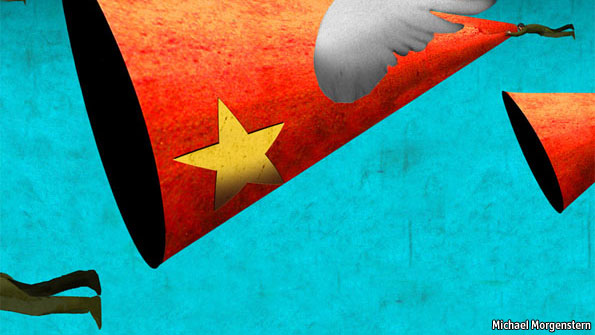 Epoch Times: According to a report by the Jamestown Foundation, Ming Pao has since been “heavily influenced” by the Chinese regime, as have World Journal and Sing Tao Daily.
“Employees at Ming Pao's New York office have told sources that their ‘true boss’ is none other than the Chinese Consulate [in New York], and that they are obligated to do whatever the Consulate asks,” said the Jamestown report.
In April 2008, The Epoch Times wrote a story about Sing Tao, whose Toronto edition is majority owned by the Toronto Star, but whose editorial department maintains close ties with the Sing Tao headquarters in Hong Kong. The story showed that a Star article translated into Chinese by Sing Tao was given controversial edits that significantly changed the angle of the Chinese story from its original English version, and portrayed a significantly pro-Beijing slant on Chinese-Canadians attitudes toward the turmoil in Tibet in 2008. Wilson Chan, then managing editor at the Chinese-language Sing Tao, was let go that fall over the controversy, according to the sources that include two staff members at Sing Tao.. More...
Sunday, November 07, 2010
Psychiatric Torture and Abuse "shockingly common" against dissidents in China
 Painting showing psychiatric torture used against Falun Gong Practitioners in China
NewsBlaze and the Citizen's Commission on Human Rights International - According to reports by Human Rights Watch and others, in China, psychiatric abuse is shockingly common against dissidents, who are jailed and silenced under the guise of psychiatric treatment. In one well-known case, Wang Wanxing was held in an Ankang for 13 years, for staging a brief, one-man pro-democracy protest on Tiananmen Square on the third anniversary of the massacre there. He was released unexpectedly in 2005 and sent to Germany, where he was evaluated by a team of psychiatric experts, who found no mental disorder. Wang told Human Rights Watch about the conditions he had endured. He stated, for example, that he had been forced to watch staff members administer “electric acupuncture treatments” in which the current used was excruciating. One inmate died of a heart attack during such a “treatment.”
According to a recent Epoch Times article, the Falun Gong Human Rights Working Group submitted a report to the United Nations, setting forth 1088 cases of psychiatric torture used against Falun Gong practitioners. More...
'Reckoning With Torture'
 Re-enactment of torture methods used on Falun Gong adherents in China
Epoch Times - Nowak has interviewed thousands of torture victims across the world to present a report at the annual session of the U.N. Human Rights Council. Nowak has looked at cases of torture around the world, he described the current situation in China for Falun Gong...More
Protest in Polish Parliament Against Senior Chinese Official Accused of Genocide
 Epoch Times Poland—A senior Chinese government official accused in Spain of genocide and torture against Falun Gong practitioners in China, was confronted by human rights protesters in the halls of the Polish Parliament in Warsaw Thursday morning. "We wanted to...More
Friday, October 29, 2010
Decade Long Censorship in China of Falun Gong
 Suite 101.com - Falun Gong members are not allowed to practice in China. Viewed as an 'evil cult', the movement was banned in 1999. Not only has this spiritual group been censored online and in print, but practitioners have been heavily persecuted. There are even claims of thousands being tortured and even murdered according to Michael Bristow's BBC News article (July 22, 2009), "China says Falun Gong ban 'works'." This form of religious censorship, enforced by the Chinese government, is an extreme example of censored ideas and beliefs. Why has the persecution of Falun Gong been so intense? What is China trying to protect or preserve by banning this movement? Why should censorship in China matter to the rest of the world?
 The History of Falun Gong in China
Falun Gong is a set of principles that are both Buddhist and Taoist in origin, as well as the integration of qigong exercises. Combining spiritual and philosophical ideas and mind-body medicine, Falun Gong is essentially a way of life, a path to follow for physical and spiritual well-being. Founder Li Hongzhi opened this method of living and spiritual practice to the public in 1992. More...
Thursday, October 28, 2010
The Epoch Times Australia Office Attacked
 ET: Queensland Epoch Times, which publishes a weekly Chinese language edition only, is hosting the visit of Canadian human rights lawyer, David Matas, who will speak at a number of forums this week on illegal organ harvesting from practitioners of Falun Gong in mainland China.
Mr. Matas and former Canadian MP David Kilgour have released a report and a book on the issue, outlining evidence for chronic and continuing organ harvesting from Chinese Falun Gong practitioners, illegally arrested and killed to service a lucrative organ trade in mainland China.
Arctic Host, Icy Visit: China and Falun Gong Face Off in Iceland
 by Herman Salton
Amazon.co.uk - Book Description
In July 1999, when the Chinese Government declared war on a peaceful spiritual movement called Falun Gong, few expected that a showdown would be taking place in one of the most remote countries in the world. Yet when President Jiang Zemin paid an official visit to Iceland in June 2002, the heart of the harsh struggle between these two antagonists moved to the Arctic. In contrast to the violence of the anti-Falun Gong campaign in China, one would have expected democratic Iceland to be even-handed and to allow peaceful protests against Mr Jiang. But the host was in no mood to tolerate dissent: it banned Falun Gong practitioners from the country; used a secret blacklist to identify actual and presumed members of the spiritual movement; ordered the national airline to deny them passage; and arrested those who managed to slip through the net. This book analyzes these little-known yet extraordinary events and argues that they are only one example of the multiple ways in which a rising China successfully manages to export its authoritarian methods abroad. For Beijing, the world has become a stage on which its battle against internal dissent is mercilessly waged.
About the Author
Herman Salton, PhD, was educated at the Universities of Trento (Italy), Auckland (New Zealand) and Oxford (UK). Dr Salton was also briefly a visiting researcher at Sciences-Po Paris and TUJ Tokyo; an officer at the Icelandic Human Rights Centre, Reykjavik, and an associate with the Office of the Under-Secretary-General, United Nations Headquarters, New York. He is the author of 'Veiled Threats: Islam, Headscarves and Religious Freedom in America and France' (2008) and 'Arctic Host, Icy Visit: The Chinese President Visits Iceland" (2010). He is currently working on a third book ('Dangerous Diplomacy: Anatomy of the UN Failure in Rwanda') on the role of the United Nations during the Rwandan genocide. He is fluent in English, Italian, Spanish and French. He lives and works in the United Kingdom
More...
Falun Gong Confirms Tales of Foreign Influence in Canada
 Vancouver Sun: Most Canadians were surprised when Canadian Security Intelligence Service Director Richard Fadden raised the issue last June of foreign influence being exerted on municipal and provincial politicians in this country.
 The Ottawa-headquartered Falun Dafa Association of Canada was not.
Association spokesperson Lucy Zhou issued a news release on Thursday detailing the influence her organization believes the Chinese Government has exerted domestically for the purpose of encouraging local politicans to thwart the Falun Gong's efforts to participate in Canadian life.
"As victims of the Chinese Communist regime's influence in Canada, Falun Gong practitioners' experience in the past 11 years corroborates the general comments of [Fadden]..."
Citing one high profile example, Zhou recalled efforts made by former Vancouver mayor Sam Sullivan, who had visited China, to invoke a city bylaw back in 2005 to try to shut down their vigil with display boards, set up nine years ago at the Chinese Consulate on Granville Street. Such use of that bylaw has since been ruled unconstitutional by the B.C. Court of Appeal.
She says the Chinese have tried to interfere with the holding of 'Falun Dafa Days' in cities throughout Canada. And, Zhou believes, in 2009 the Chinese attempted to have Montreal city councillor Marcel Tremblay block the Falun Dafa's Tian Guo marching band's performance in the Montreal Caribbean Festival.
The news release goes on to state that "these examples show us a serious cause for alarm for all Canadian citizens that our cherished democratic values, freedom and principles of Canada can be eroded and sacrified by foreign influence."
Fadden was strongly criticized at the time of his remarks for tarring all politicians with one brush when he made his vague accusation. But if he has helped flush out instances of interference such as the ones Zhou has detailed, Fadden in fact has done Canadians a service.
Wednesday, October 27, 2010
Chinese police refuse to register human rights lawyer Gao Zhisheng as missing

The Guardian - Once lauded by the government, he angered authorities by taking on clients including members of banned spiritual movement Falun Gong. ...
Nicholas Bequelin, Asia researcher at Human Rights Watch, said: "Gao Zhisheng is definitely one of the most worrying cases.
Nicholas Bequelin, Asia researcher at Human Rights Watch, said: "Gao Zhisheng is definitely one of the most worrying cases.
"The authorities seem to be deliberately using criminal methods as a way of silencing a human rights defender and intimidating others." More...
Unauthorised organ trade an ongoing evil
 Brisbane Times: NOBEL peace prize nominee and Canadian human rights lawyer David Matas will visit Brisbane next weekend to highlight the "continuing abuse" of unauthorised organ transplants in China.
Mr Matas said tens of thousands of Chinese have had their organs "harvested" without consent each year. The problem was increasing despite a drop in "transplant tourism", where foreigners flocked to China for organs, before laws changed in 2007.
Demand for organs from Chinese has replaced foreign demand and Mr Matas believes organs from the followers of Falun Gong, a popular exercise regimen, have been used extensively.
He said the Falun Gong movement started in 1992 and became hugely popular in China but the government branded it a cult in 1999 and persecuted, jailed and executed followers.
He was nominated for the Nobel prize - won this year by China's Liu Xiaobo - with the co-author of Bloody Harvest, David Kilgour. The book documents the abuse of prisoners and dissidents and urges countries to discourage or prevent their citizens from going to China for transplants.
The full extent of the allegations was impossible to prove because the bodies were cremated after the organs were removed and there was no documentation, he said.
The Chinese government reluctantly acknowledged last year that the bodies of executed prisoners had been used to harvest organs and promised to crack down on the practice.
"The abuse in China has to be of concern to the global community because it is a grave human rights violation and because the developed world has been complicit in the abuse," Mr Matas said from Canada last week.
The Swiss section of Amnesty International in August requested China end the use of organs from executed prisoners.
When Mr Matas last spoke at forums at the Gold Coast in 2008 he said he and his volunteers were threatened by a Chinese government police official and booked venues were suddenly cancelled.
Internet participants could ask questions at the forum and Mr Matas said the official asked in a Chinese language: "Are you afraid of death? You are brutally interfering in our party's internal policies. Are you afraid of our revenge? Our revenge against you, we'll take revenge against you, are you not afraid of that?"
Dr Stephen Lynch, chairman of Abdominal Transplantation at Princess Alexandra Hospital in Brisbane, said Australian and New Zealand hospitals now refused to train foreign doctors who could be involved in transplants from prisoners.
Mr Matas will speak at three free forums next weekend at Sunnybank and Inala, south of Brisbane.
For details, email rescue@gmail.com or call 0410 567 618.
David Matas will speak at a Sydney conference next month. For details, see www.humanrightseducation
conference2010.com.au.
kdennehy@fairfaxmedia.com.au
New UN Special Rapporteur highlights persecution of Falun Gong

The recently appointed Special Rapporteur on freedom of religion or belief, Heiner Bielefeldt. (Photo courtesy of the United Nations OHCHR)
Bielefeldt spoke at the General Assembly in New York on Thursday, Oct. 21. In a U.N. release translated from French, he is quoted as saying that members of religions or belief systems in some countries are recognized only based on "particular lists of religions," leaving followers of other religions or belief systems "facing problems.”
"Small communities such as Jehovah's Witnesses, Baha'i, Ahmadi, Falun Gong, and others are sometimes stigmatized as ‘cults’ and are frequently confronted with prejudices that can escalate into becoming conspiracy theories," he said according to the release.
While Bielefeldt’s predecessor Asma Jahangir identified the Chinese regime’s persecution of Falun Gong as one of religion or belief, Bielefeldt’s statement marks the first time the concept was brought to the General Assembly.
None of this was missed by the Chinese delegation, which issued a strong response. More...
Winning the Battle Over Internet Freedom
 CBS News -The whole thing is a mess, perpetrated by not one but two different administrations -- and I certainly share Diehl's frustration with the poverty of the State Department's efforts here. Interestingly, he treads quite lightly on one of the main reasons that the Global Internet Freedom Consortium continues to be denied and slow rolled funding under this initiative: its connection with the Falun Gong spiritual movement which the Chinese government has labeled "an evil cult." My experience suggests this fact played a larger role than he intimated in the State Department's decision not to fund the GIFC. But while Diehl's heart is in the right place in wanting State to get off the dime, and the GIFC has undoubtedly been badly treated, there are in fact good reasons these funds should be directed elsewhere - not that State seems to understand or be able to articulate them after four years of struggling with this effort.
More ...
Qantas Should Reinstate Falun Gong Employee Says Tribunal
 The Epoch Times - “According to the Applicant, she was very scared, possibly the most scared she had ever been in her life. She feared that she had been spied on and that the reason that she had been led into the room was because she was a practitioner of Falun Gong,”...More
Big Brother Tightens Grip in China
 The Epoch Times - The regime introduced new rhetoric on its compliance with international human rights standards that is likely to impede U.S.-China dialogue. The communist regime has become emboldened, saying that its Internet policies are in line with international law. More...
Combating Organ Transplant Tourism
 Epoch Times - - Only in China do the “donors”—virtually all of whom are Falun Gong or convicted criminals—all perish during the transplantation operations because their ...
Thank you to Deputy Valerie Boyer and the 58 other deputies cosigning the proposed law to combat ‘organ tourism’. Also professors Lavee and Navarro and the organization Doctors Against Forced Organ Harvesting. More...
Chinese reproached over treatment of religious minorities
 Ekklesia - The recently appointed United Nations Special Rapporteur on freedom of religion or belief has spoken out over the Chinese government's treatment of religious minorities - and one fast growing spiritual group. In his debut address to the UN General Assembly.
Falun Gong is a spiritual practice that became hugely popular in China during the 1990s. By the end of the decade, state estimates put the number of practitioners between 70 to 100 million. This is a figure outnumbering the members of the ruling Chinese Communist Party.
It is now eleven years since the Chinese government banned Falun Gong...
More...
Subscribe to:
Posts (Atom)