Search This Blog

Sunday, June 04, 2006

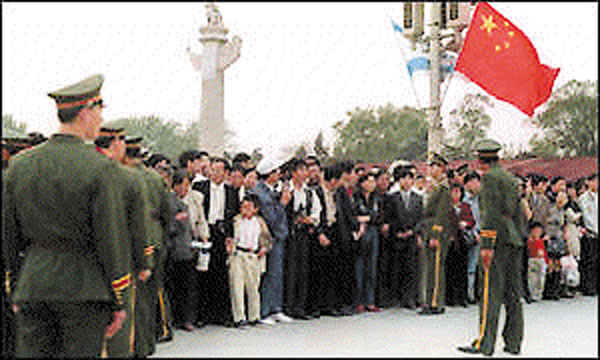
Letter: Remembering Tiananmen

Tiananmen anniversary has come and gone--in a blink of an eye--but its spirit will never die.


National Post: Silent no longer 17 years after Tiananmen

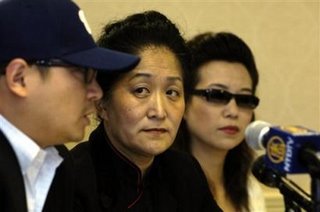
Lu Decheng, recipient of the 'Spirit of Freedom award', speaks out:

"We need to keep the memory [of June 4] alive and keep pushing for a democratic China," Mr. Lu said. "Our action, throwing paint on a portrait of a dead person, was nothing in world terms," he said. "But it cost us inhuman treatment and massive human rights abuses that are indicative of the system that rules China. The treatment we received is a testimonial to the inhumanity of this authoritarian government."

Many young people in China haven't even heard of the Tiananmen protests, Mr. Lu said.

"Still, I live in hope that this time next year, we will be able to hold the commemoration in Tiananmen Square itself." (full report)


Robert Fulford takes a look at the past...

(National Post)...When others in the government rejected his opinion and decided to use the army against the protesters, Zhao (Ziyang) went into the square and, with tears in his eyes, vainly urged the young people to go home and avoid bloodshed…. Those same bullets drove the pro-democracy movement underground and drove Zhao out of government.

(National Post)...A 45-year-old poet and journalist in Chengdu, the capital of Sichuan province, Liao has been in trouble with the authorities for 15 years but nevertheless maintains a devoted audience in China. In 1990 his long poem about the Tiananmen Square killings circulated in manuscript and on a cassette. The authorities tolerated that but didn't like the sound of the film he started working on, to be called The Massacre. They sent him to prison for four years…One of Liao's foreign supporters and translators, a Vancouver-born journalist named Michael Day…

Listen to some awsome tunes by No Man Zero:

  • Remember Tiananmen here and Bye Bye CCP here.
Watch two videos:

And our letters were published in a few more papers besides these two.

Ottawa Citizen: Ruthless beast

by Joan

With all the fuss over China's burgeoning powerhouse economy, it's easy to lose sight of the fact that this is the same regime that ordered the army to mow down thousands of peaceful pro-democracy students on Tiananman Square 17 years ago. Lu Decheng, one of the students who threw paint on Mao's picture during the protest, now lives in Canada after serving six years in a labour camp. He says the West's policy of appeasing Communist China is akin to "drinking poison to quench thirst."

He should know. Let's not forget the ruthless nature of the beast we're dealing with.


Taipei Times: Remembering Tiananmen

by Makina

Monday, Jun 05, 2006,Page 8 - People still tremble when they recall the dark night of June 4, 1989 -- especially those who witnessed the truth about the bloody massacre on Tiananmen Square. We've all heard the popular saying: "The People's Liberation Army is an army for the people."

A quick reality check sure blows that theory to shreds after thousands of pro-democracy students were killed, hundreds of peasants mowed down by paramilitary police over land seizures, not to mention countless liberal scholars, human-rights activists and members of religious groups thrown in jail and tortured. Seventeen years later Christians have peacefully taken back the night, attempting to free themselves from the grip of the regime with more than 10 million people quitting the Chinese Communist Party (CCP).

It is no surprise that the CCP is no longer worshipped as more Chinese recognize the oppressive ways of the Party, the benevolent law of heaven and earth and the value of freedom.

We wish them well as they slowly progress towards a new free China.


BTW, have you joined the Free China Movement lately? Do so by visiting China Support Network!

  • Find out more about the CCP's History of Killing here
  • Thinking of quitting the Party? Quit here
  • Listen to the Nine Commentaries on the Communist Party here
  • Read the Commentaries here
  • Sign a petition to Suport the Tiananmen Mothers here.
Related Articles:

Epoch Times: Changing China: 'We Will Prevail'

Fear and Loathing: A Recipe for Chaos By WU GUOGUANG

Revolution's Dark Legacy By JONATHAN MIRSKY

The Ghosts of Tiananmen By ALLEN T. CHENG and TIM HEALY

Thursday, May 18, 2006

CCP remains greedy and violent

By Paul Lin

Taipei Times: May 18, 2006 - Tuesday was the 40th anniversary of former Chinese Communist Party (CCP) chairman Mao Zedong's "May 16 Notice," which is generally agreed to have marked the official start of the Cultural Revolution in China.

The CCP recognizes the 10-year-long Cultural Revolution as "a disastrous decade" which not only brought the economy to the verge of collapse but which also caused the death and persecution of countless thousands; the actual number is still not known. Research has indicated that millions of people, perhaps as many as 20 million, lost their lives as a consequence of the movement. Even more suffered persecution, an estimated 100 million to 200 million people out of a population which at the time stood at only 800 million to 900 million. The CCP brought an end to discussion on the Cultural Revolution in 1981, and it is said that the party tried to distance itself from it. From that point on they did not permit any more discussion or reflection on the subject, and it remains taboo to this day. The CCP even barred Chinese citizens from taking part in any discussion on the matter abroad.

But why distance itself from it, and forbid commemoration of the event? Fifty years ago, following the death of former Soviet leader Joseph Stalin, during the 20th Party Congress of the Communist Party of the Soviet Union, Nikita Khrushchev released a confidential report denouncing Stalin's violent abuses and immoral conduct. After this, Mao began to worry that people would give him a similar epitaph, and his May 16 notice clearly stated that "people like Khrushchev are nestling among us."

After years of observation, Mao finally decided that the No. 2 man in the CCP, Liu Shaoqi, was none other than this "Chinese Khrushchev." At the time Liu himself had a considerable following, and so Mao bided his time before enlisting the aid of General Lin Biao and Mao's own wife, Jiang Qing, to create a personality cult around him and instigate the "Great Democracy." The Red Guards sowed chaos and succeeded in bringing Liu's so-called "bourgeoisie headquarters" and supporters down in the process, replacing it with Mao's own "proletariat headquarters," supposedly to clean up the mess they had created. To accomplish this, he roped in the "revolutionary cadres" and had the leaders of the Red Guards he had used for his own ends thrown behind bars. It wasn't until after 1976, the year of Mao's death and Jiang Qing's arrest, that social order gradually returned.

The CCP's distancing itself from the Cultural Revolution fell short of a genuine denial, and because of this, de facto Chinese leader Deng Xiaoping and other members of the old guard who had been toppled during the 10 years of the Cultural Revolution were at first unable to regain their power. Nevertheless, it was impossible for the CCP to actually deny the Cultural Revolution, for to have done so would have been to cast Mao as the chief protagonist of the disaster. Mao is the spiritual symbol of the CCP itself, and to have pulled him down would have divested the CCP of the legitimacy to govern China.

This is what led the party to propagate the nonsense that Mao had been exploited by Lin Biao and Jiang Qing. Mao may have made mistakes, but there is no denying that he represented the collective intellect. Deng was to exploit the CCP's refusal to deny the Cultural Revolution to settle old scores of his own, designating three types of undesirable personality and unprincipled characters, and branding Lin Biao and Jiang Qing as members of a "counter-revolutionary group."

The Cultural Revolution originated in the despotic structure of the CCP, and Mao's approach was, at base, a philosophy of violent revolution. Despite the reforms and the opening up of the party, the CCP is still as grounded in avarice and violence as ever, with no real likelihood of change. Deng saw the 1989 student movement as another attempt to wrest power from him, and so he gave the order for the massacre. In the ensuing religious and moral vacuum, Falun Gong arose, only to be banned by former Chinese president Jiang Zemin, who saw them as a threat to the CCP's rule. It was just a replay of the Cultural Revolution.

At the moment the CCP is trying to create two camps in Taiwan, conscripting the pro-China element within Taiwan, represented as the "unification headquarters," to come out in opposition against the localization camp, which is being recast as the "independence headquarters." The CCP is trying to win over the hearts of the Taiwanese, but once it has used the pro-unification element to defeat the pro-independence elements, it will side with the pro-independence groups against the pro-unification groups. It is a classic "pitting the barbarians against each other" strategy, and they intend to use it to bring Taiwan to its knees.

Paul Lin is a New York-based political commentator.


Related Articles:

Mao casts long shadow over China

Gao Zhisheng Invites Investigators to Inspect Persecution of Falun Gong

Tuesday, May 02, 2006

Interview with Attorney Gao Zhisheng


Best viewed in Mozilla

Say no to revolution; spread the Nine Commentaries far and wide!

You don't need to be Chinese to read the Nine Commentaries. In fact the uncensored history of the CCP can be quite sobering especially for those Westerners who might have been already conquered by the dazzling and electric image of Communist China. For the flip side of the coin you can read the revealing series here. Does it have the power to stop revolutions...Gao Zhisheng seems to think so and I agree.

Epoch Times by Gao Ling - 1 May 2006 - It is again April 25th, the anniversary of the day in 1999 when more than 10,000 practitioners peacefully appealed at the Chinese Communist Party (CCP) government compound in Beijing for their basic rights to practice Falun Gong [1]. Over the past seven years, Falun Gong practitioners have commemorated and called for a stop to the persecution on this day. This year is unique in that attorney Gao Zhisheng, who had delivered open letters to the CCP supporting Falun Gong, now stands beside Falun Gong practitioners. An individual in Tianjing City once appraised Gao Zhisheng's letters as having "Thoroughly wiped out the evil names that the Chinese Communist Party (CCP) had tried to impose upon Falun Gong." Many people in China began to see the facts of the persecution of Falun Gong through Mr. Gao's letters. His subsequent harassments by the CCP also drew international attention. On this special occasion and while the brutal persecution of Falun Gong continues, Mr. Gao says, "Keep up the good work!"

Chinese People's Resentment Heightened to a Level of Launching a Revolution

Mr. Gao explains, "I am not exaggerating. The overall resentment of the Chinese public, including that of officials, workers, protestors, and even the military, has increased to a critical level sufficient to launch a revolution." As a farmer in Shanxi Province once said, "We have all the elements necessary for a revolution. The Chinese government tries it's best to conceal this fact, but in reality, the intense resentments continue to grow."

Mr. Gao describes in a recent telephone conversation, an unidentified caller said, "Many people refuse to wait any longer. What are you trying to accomplish by resolving problems in a peaceful manner? We have accumulated forces in every city and province and are ready to take action simultaneously."

During this conversation, the caller continuously changed locations and phone numbers to protect his identity. Mr. Gao repeatedly stressed the idea of reforming China through non-violent means. In the end, Mr. Gao kindly refused the caller's invitation to other methods of reform.

The CCP has admitted to over 80,000 individual group protests this past year in China. The rage of citizens has grown to an intolerable level that has ultimately lead to such expressions of unrest. If this is the case, is there any possibility that this rage can be resolved in a peaceful manner?

Mr. Gao stated, "I believe that there is a chance to solve this problem from its core and eliminate the fundamental causes for this rage—the evil CCP system. However, if this evil rule does not change, then this rage will only continue to increase and accelerate."

Mr. Gao also spoke about a recent case he had heard about: "I've just received phone calls from Harbin City and Shenyang City. They all talked about incidents where Christians were beaten by the police. Although these cases happened at different locations and with different victims, the methods used by the police were identical."

These Christians told Gao that after they were first arrested, the police then released them on bail. A year later, after the police had illegally collected the bail payments from the Christians' bank accounts, they were arrested again and forced to write confessions dictated to them by the police. The Christians did this in order to avoid future arrests. On average, each of them was blackmailed out of 20 to 30 thousand yuan (US$ 2,500 to $4,000).

The Nine Commentaries Helped Me Understand the CCP

Facing ever-raising indignation in China, some people prefer violence, some persist in peaceful reform, while others maintain a pessimistic stance. The widespread distribution of the Nine Commentaries on the Communist Party (The Nine Commentaries) accompanied by the huge wave of withdrawals from the CCP has captured international attention.

Mr. Gao said, "In my opinion, the crux of China's problems is the evil system currently maintained by the CCP. Once the CCP collapses, this system will naturally disintegrate. However, many people still hold unrealistic perceptions of the CCP. How can we help these people eliminate such false hopes or improve their understandings? The Nine Commentaries provides a good means for people to see the CCP for what it is. I believe that spreading The Nine Commentaries is presently the most peaceful and effective way of reforming China. In fact, as you have all seen, The Nine Commentaries' effect on China is already in progress. The number of people withdrawing from the CCP every day continues to break previous records."

Attorney Gao said, "I can say that I now have a better understanding of the Chinese Communist Party (CCP). The Nine Commentaries was very helpful. And this is not only my personal opinion."

Someone from Chongqing told him, "Attorney Gao, I distribute hundreds of copies of The Nine Commentaries to my fellow countrymen every year." He described to Attorney Gao his personal transformation—"Previously, as did most Chinese, I also trusted the CCP without doubt. I felt so sad that first time I read The Nine Commentaries . So I read it a second time and then a third time. Then, I started paying attention to the actions of the CCP which directly affected my daily life."

After that, this person read the three open letters written by Attorney Gao. Now, he has quit the CCP and has been urging his friends to quit as well. He said, "Attorney Gao, now that I have quit the CCP, I feel my soul has been cleansed."

Attorney Gao said, "I think what he said is also a reflection of my own thoughts. Just as I wrote at the end of my CCP-quitting statement: This was the proudest day of my life!"

Attorney Gao said, "Actually, we really did not question much about the CCP's past actions and rules before, especially because we did not know its past history. Someone once asked me why I had not cared about Falun Gong during the previous years and why I only started to pay attention recently. Before 2003, I really did not think about whether it was unjust for the CCP to suppress Falun Gong. I was not intentionally seeking anything when I read The Nine Commentaries , but it has transformed our minds step by step."

"Falun Gong Practitioners, Keep up the Good Work!"

Since the end of 2005, Attorney Gao's fate has been joined together with the cultivation practice of Falun Gong, which has now been persecuted for almost seven years. They have one thing in common: each did not give up their beliefs under the pressure from the CCP, but rather each grew stronger in the resistance against the persecution. On April 25, the date that Falun Gong practitioners commemorate and the date that the CCP is most afraid of, what does Attorney Gao think about this?

Attorney Gao said, "A few months after April 25 will be July 20, which is the 7th anniversary of the persecution of Falun Gong. At this time, I want the outside world to consider this question: During these past seven years, has the persecution of Falun Gong practitioners by the CCP changed at all? My life has been constantly disrupted by the CCP just because of paying close attention to the issue of the CCP's continuing persecution of Falun Gong. This tells you something. What I have done is like stirring up a hornet's nest! The CCP has not lessened a bit in its persecution of Falun Gong."

Correspondent: So, what is your vision of the future of yourself and of Falun Gong?

Attorney Gao answered, "I am quite optimistic about my own future. I will absolutely be around longer than the CCP. As a human being, my life will eventually end. However, I am certain that I will outlive the CCP. I am very optimistic about this."

"As for the future of Falun Gong, I feel most relieved that the CCP no longer suggests that they will "eliminate Falun Gong within three months." As I have said before, even two more CCPs will not be able to suppress Falun Gong!"

Correspondent: Then, at this special period of time, would you like to say something to the practitioners of Falun Gong?

Attorney Gao replied, "April 25 has come again. There are not many congratulations which I can offer since the majority of practitioners are still being persecuted in mainland China. But, I still want to offer a few words: Keep up the good work!"

Notes: [1] On April 25, 1999, more than 10,000 Falun Gong practitioners in China went to the Appeals Office of the State Council on Fuyou Street in Beijing to make an appeal in accordance with the law. They wished to ask the authorities to release the Falun Gong practitioners who had been arrested by the Tianjin public security officers. After Premier Zhu Rongji, the official head of the State Council, personally came out and met with practitioners, the situation was handled and a resolution was reached that was acceptable to both the government and the practitioners. However, after the "April 25th Incident," Chinese president Jiang Zemin used two secret documents to accuse Falun Gong of two crimes that he wanted to charge them with – namely conspiring with foreign forces and being directed by senior insiders in the Communist Party. In the absence of any corroborating evidence, Jiang decided on a policy of persecution. Please refer to this link for detailed information.

[2] The current situation of Attorney Gao: Attorney Gao still spends much of his time at home except during morning exercises which are performed outside. His movements are limited as he is constantly under police surveillance. With him staying at home, the police keep a distance from him. There have been some very funny stories. Please read our other reports.


Sunday, April 30, 2006

Why Wang Wenyi was shouting


Best viewed in Mozilla

Yay! The charges were dropped--there is still hope for Uncle Sam!

Epoch Times: Praise for Dropping the Charges Against Wang Wenyi

...Indeed, the United States should be able to do more and better in stopping the persecution of human rights in China.

The United States and the world have all been looking forward to a humane, free, democratic China. The Chinese communist regime's wanton abuse of human rights and ruthless persecution of Falun Gong are completely opposed to this expectation. We should be clear: the communist regime does not represent China; it is certainly not the same as China.

...More than a month ago, Mr. David Kilgour, former Canadian Secretary of State (Asia Pacific), and renowned human rights attorney Mr. David Matas initiated a joint investigation to probe into organ harvesting from living Falun Gong practitioners.

Three weeks ago, European Parliament Vice President Edward McMillan-Scott met two Falun Gong practitioners in Beijing to understand more about the persecution. (full report)

To join the international Coalition to Investigate the Persecution of Falun Gong (CIPFG) look here.


Is Beijing committing atrocities against the Falun Gong movement?

by Ethan Gutmann

Ethan Gutmann author of ‘Losing the New China’ interviewed the two witnesses (photo: Peter/Wenyi/Annie) who have exposed the Sujiatun Death Camp where Falun Gong practitioners’ organs are harvested for profit and their bodies cremated to hide all evidence. Ethan recounts the story behind the story. First let’s take a look at Media Channel dissector Danny Schechter’s comments on this situation and Wenyi Wang’s appeal.

For the latest Epoch Times reports on this topic go here.

Journalist Tells Story Behind White House Outburst

Well known media analyst Danny Shechter, who has written a book and produced a film about the Falun Gong issue in China, weighed in on the response of Western media to Dr. Wang's actions. He made it clear that he was not commenting directly on the facts of the organ harvesting allegations. Rather, he questioned the reluctance of the major U.S. media to pursue investigations into the story.

"When we look at the press coverage of the event involving Wenyi—and there was a lot of it—there was very little investigation by these media of any of the issues of organ harvesting raised by Ms. Wang," said Shechter.

He added, "I'm a news dissector not an organ dissector and I haven't investigated the facts of this story, however neither have most of my colleagues in the media, and that is what I'm here to talk about."

He dismissed the criticism leveled at Dr. Wang that she violated her reporters' mores by "getting personally involved" with her story, saying that she did what she felt she had to do to call attention to a major issue that was being mostly ignored by the world.

Shechter insisted, "If she had to yell, if she had to screech to be heard—so be it, because no one was asking the questions politely, as one would expect or demand that they do." (full report)


Here's an ingenuous comment from Chicago Sun Times columnist N. Steinberg.

Bush, U.S. media surrender to Chinese leader

Neil Steinberg writes: “Did I miss something? Have we already been conquered by Communist China? Did Chinese President Hu Jintao blow into Washington last week as a triumphant victor, inspecting his vanquished foe? That's how it felt. Because of the ringing silence about China's horrid, ongoing abuse of human rights.” (full report)

Why Wang Wenyi Was Shouting; Is Beijing committing atrocities against the Falun Gong movement? by Ethan Gutmann

Weekly Standard: 29 April 2006 - Wang Wenyi, the woman whose shouts disrupted the welcoming ceremony for Chinese president Hu Jintao on the White House lawn on April 20, is a middle-aged pathologist and a follower of Falun Gong. That spiritual movement was outlawed in China in 1999, and since then Falun Gong has become a focal point for opposition to the Communist party. To that extent, Wang's outburst was understandable. Less obvious was the connection between her profession and the raw intensity of her denunciation of "killing" by Hu's China.

As a doctor and a Falun Gong practitioner, Wang had to be incensed by a hair-raising story coming out of northeast China--of organ harvesting from live Falun Gong prisoners. The reports, which first appeared in print in the March 10 edition of the Falun Gong-associated publication Epoch Times, are still sketchy and confirmation scarce. Yet the allegations are just credible enough to demand attention--too serious to be ignored unless proven false. What's more, recent work by the World Organization to Investigate the Persecution of Falun Gong, headquartered in Boston, has turned up some compelling corroboration. Here, then, is the narrative as it has emerged so far.

Back in 1988, a hospital was constructed on a 21,087-square meter plot (about five acres) a few miles outside of Shenyang, in a satellite city called Sujiatun. It's pronounced Soo-jah-tyun, and you might want get to know that name.

It happened that the hospital--now the Liaoning Provincial Thrombosis Hospital of Integrated Chinese and Western Medicine--had a large basement and an inconspicuous back door. In 2001, some employees in the hospital's accounting and logistics department noticed that the hospital's requests for food, rubber gloves, toilet paper, and surgical equipment suddenly went way, way up. The food and surgical tools would disappear, the trash would get hauled away, yet it was unclear how they were being used. At one point in 2002, the accounting department estimated the logistical increase represented a whopping discrepancy of thousands of patients.

One accountant--called Annie in the Falun Gong literature on the scandal--was aware of the supply mystery, but what concerned her far more was the behavior of her husband, a surgeon at Sujiatun. On the surface, the couple was doing fine. He was bringing home increasingly large amounts of cash, and his job appeared secure. The hospital had even issued him a dedicated cell-phone, which would ring at odd hours and send him back to Sujiatun. Yet when he came home to bed, he had violent nightmares and would wake bathed in sweat. During the day, he was constantly on edge, preoccupied, even fearful of his wife's touch.

It took a year, but eventually he confessed to her: The accounting staff was right. There were extra "patients" in the subterranean depths of the hospital, and some makeshift operating rooms down there, too. When his cell phone rang, it meant that a "patient" had been wheeled in and given a small dose of anesthesia (the hospital had a limited supply). Then he and the other doctors--some hired from the outside, each with a specialty, all constantly on call--would come in and remove the patient's kidneys, skin tissue, corneas, and other organs, seemingly to order. The remains of the "patient" would then be carried down to the old boiler, which doubled as an incinerator. The workers who disposed of the bodies--sometimes still alive--helped themselves to the occasional watch, necklace, or ring as a kind of tip.

The "patients"--men and women, old and young--were all Falun Gong practitioners. It was so much easier that way--no arrest warrants, no need for paper work. If a diagnosis had to be stipulated for some reason, the entry read "mentally destroyed," and the cause of death "suicide." The doctors' silence was bought with generous financial rewards, the assurance that they were simply "cleansing" for the party, and the vague threat implicit in the observation that if you had already done some of these operations then what difference would a few more make? Buck up!

The hospital is still operating, but the Falun Gong "patients" are apparently gone. The Chinese Communist party denies, of course, that they ever were there. More interesting, a recent U.S. consular visit found no cause for concern.

The first account of the horrors at Sujiatun was provided by a Chinese reporter now in hiding in the United States, with whom I spoke briefly. He claims to have many sources, some of whom he paid, as is common in China.

As for Annie, I interviewed her for ten minutes on April 20, after her first, rather chaotic, public appearance. She spoke at a rally at McPherson Square, a few blocks from the White House, to protest human rights abuses in China. Although our interview was hardly the six-hour session that I wanted, we were alone, apart from an interpreter, and could look each other in the eye. My strong impression was not of a Falun Gong devotee put up to a stunt, but of a classic accidental witness: pale, open-eyed, conscientious, and somewhat bewildered by Washington--a beautiful doctor's wife sitting in the back of a van, telling the most explosive story in recent Chinese history.

It must be noted that there are discrepancies between the Chinese reporter's account and Annie's. For example, he called Sujiatun a concentration camp at one point and spoke darkly of barbed wire and massive underground civil defense tunnels allegedly connected to the hospital. Annie portrayed Sujiatun as a regular hospital with a basement large enough to hold thousands of Falun Gong prisoners.

The U.S. State Department states that its "officers were allowed to tour the entire facility and grounds and found no evidence that the site is being used for any function other than as a normal public hospital." And for those who point out that you couldn't clean up Auschwitz in three weeks--the time that elapsed between the publication of the story and the consular visit--the matter ends there.

But, given the political sensitivities involved, particularly during a summit, I still have questions. Anyone who has lived in China knows that three weeks is a long time by Chinese construction standards. Is the State Department certain its officers toured an unaltered facility? Did they take an architect with them? Collect forensic samples? Sift through ashes?

Interview any hospital personnel privately, off-site? And on their tour, did they reject the company of the inevitable CCP handler or hospital operative?

If the answer to these questions is no, then the Americans' findings are interesting but hardly dispositive. The visitors could easily have missed a walled-off underground facility.

Experts have also pointed out that the Sujiatun hospital is prohibited by its legal classification from performing organ transplants in the first place. Yet Annie spoke of organ harvesting, not transplants. In any case, in the new entrepreneurial China, organ transplants at hospitals of a similar classification have been reported on Chinese state-controlled television, apparently without repercussions.

These are all legitimate areas for inquiry--which is difficult in surveillance-rich China. Certainly, investigating Sujiatun would place any Beijing-based media bureau on a collision course with the CCP. No wonder Sujiatun has so far been covered in depth only by the Epoch Times, the same paper that acquired a press pass for Wang Wenyi. It has numerous Falun Gong practitioners on its staff and has become a magnet for Chinese dissidents of many stripes. Like the Jewish papers that published the first accounts of the Holocaust, the Epoch Times and the World Organization to Investigate the Persecution of Falun Gong have made this story their own.

Over the last month, Kevin Yang, a director of the latter group, has led a team making phone calls to hospitals in Tianjin, Shanghai, Shandong Province, and elsewhere in China posing as transplant candidates searching for organs. They made some 80 phone calls, and struck pay dirt at seven different hospitals. Recordings of the incriminating conversations were played for the press on April 18. They would be hard to script. Here are highlights from two of the phone conversations, translated by Yang's team:

Zhongshan Hospital, affiliated with Fudan University in Shanghai, March 16, 2006:

Q: I have to have a fresh and healthy kidney. And it should be alive. You are not going to give me a kidney from a dead person, are you?

A: Of course we will give you a good kidney, how could we give you a bad one?

Q: . . . Do you have ones from people who practice Falun Gong? I heard that they provide very good ones.

A: All that we have here are of this type. Tongji Hospital, Wuhan, March 30, 2006:

Q: . . . Do live transplants, for example, use organs from live people who practice Falun Gong?

A: Sure.

Q: At your place, for example, prisoners, like those who practice Falun Gong, can you guarantee enough live supplies from such people?

A: Yes, sure! When it's convenient for you, come over and discuss the details.

Now, given that many Chinese are consummate salesmen, could some of the responses be construed as simply attempts to please the customer? Perhaps. But the calls also turned up an unexpected timeline. Repeatedly, hospital representatives urged the potential customers to come in April when supplies would be plentiful, and got nervous when customers asked about May. Independently, unnamed sources in China have told the Epoch Times that after its story appeared on March 10, party authorities gave the hospitals until May 1 to end the practice (or at least make it untraceable).

Finally, Yang's team also placed a call to the workers in the boiler room of the Sujiatun hospital. The call confirmed that they burned bodies and had watches to sell.

If it is true that imprisoned practitioners of Falun Gong are being murdered for their organs in China, a remaining question is the scale of the practice. The number of Falun Gong practitioners in custody is disputed; estimates by the Chinese dissident community range from 235,000 to one million or more. An unnamed military doctor from the mainland told Epoch Times that Sujiatun is one of 36 such facilities, created following the directive of Liu Jing, China's former deputy minister of public security, to "stamp out" Falun Gong "before the Olympic Games in 2008." And for several years now, rumors have circulated on the mainland of a death camp in Xinjiang capable of holding 50,000 Falun Gong practitioners.

Personally, I fear the worst. One reason is that the Chinese authorities have always handled Falun Gong with a peculiar vehemence, even in comparison with other enemies of the CCP. When Falun Gong was declared illegal on July 21, 1999, ancient sound trucks drove around Beijing to make sure that no one missed the point. That's unusual. At the time, I was working in Chinese television, and I remember the day well. Several of my Chinese colleagues began laughing nervously and buried their faces in their hands, muttering that they had not seen such a thing since the Cultural Revolution. Since then, Falun Gong participants have regularly disappeared, with no arrest record, nothing but an assigned number, leaving them particularly vulnerable.

But the main reason I'm pessimistic is the money. Organ transplants are a profitable business. Until recently, a website out of Shenyang carried a price list for organ transplant operations in English to attract foreign customers, with a kidney transplant going for $62,000. And there is precedent; it is indisputable that the Chinese Communist party has sanctioned the sale of body parts from executed prisoners. As a former Beijing business consultant, I am familiar with the peculiar combination of state directive and entrepreneurial acumen pervasive in the New China. A directive comes from on high. The money is made down below. If the CCP orders tracking software, say, installed in Internet cafés across China, the local police will sell a version for $200 a pop, and every café had better purchase a copy. The May 1 shutdown will also be familiar to anyone who follows micropatterns of counterfeit enforcement in China. Chinese SWAT teams do not swoop down on illicit factories, even the ones that make fake Johnson & Johnson baby oil that causes skin rashes. Instead, plant managers are told to finish up their production runs and move their equipment elsewhere.

So I suspect that the profits from Chinese organ harvesting dwarf those of the Nazis' soap and hair-pillow-stuffing enterprises--but I also wonder whether they will prove the undoing of the CCP. Where there is money, there's a trail. Epoch Times, in a rush to get the story out, neglected to pursue that line of investigation. What if its reporters had formed a front company that had gone in and inspected the stock of potential organ donors--wired-up, spy-cam, the works--and only then released the statements of witnesses like Annie for corroboration and color? What if they had persuaded Congress to order U.S. intelligence agencies to intercept financial transaction statements and monitor train and truck movements to and from the hospitals of China?

No matter--that's not how Epoch Times handled it, because that's not the way real witnesses behave. Instead, when they are ready to come forward, they feel compelled to testify. And it's not the way real people behave, either, when they believe that family, friends, and fellow congregants are being thrown into incinerators and when they see their own honorable profession grotesquely perverted. Instead, they scream bloody murder--just as Wang Wenyi did--and silently pray that someone is listening.

**Ethan Gutmann is the author of Losing the New China. He has been a frequent speaker at forums organized by the Falun Gong-associated publication Epoch Times.

Related Article:

Friday, April 28, 2006

US, Communist China, India, and Wang Wenyi


China home trouble sways US to India

by Indira Kannan


Best viewed in Mozilla

Communist China may be a risk? Do you suppose that foreign investors got the hint from Wang Wenyi's bold appeal? It is clear that the current state of unrest in China certainly will have repercussions on their economy sooner than later; Bremmer expands on that situation below. Before we get to that...did you ever think that foreign investments might fuel the ongoing persecutions in Communist China? According to a WOIPFG report, the answer is yes. J. Podhoretz and Chris Brown offer some good insights on this topic as follows

A fine protest; will Wenyi Wang’s Words work?

New York Post: 21 April 2006 - China presents a peculiarly difficult challenge for the United States. On the one hand, the government's decision to liberalize its economy offers hope that this most populous nation on earth cannot long remain even partially shackled. On the other hand, it uses its growing economic power to strengthen its hold on its people.

So do we accelerate our business interests in China because, in part, that will accelerate its journey toward liberal democracy? Or are Western businesses inadvertently contributing to the power of the regime?

Do we seek a closer relationship with China? Or do we need to keep more than an arm's length so that we don't serve the interests of a system we want to see replaced as soon as is practicable - replaced because no regime that treats Falun Gong meditation as a crime against the state should survive and thrive?

These are questions that must be asked, and addressed. The great virtue of Wenyi Wang's protest was not only that it caused Hu some discomfort, but that it will provoke Americans to discuss them, and to pay heed to China's crimes even as we welcome China's freer economy. (full report)

Trade Won't Change China by Chris Brown

Front Page Mag (2005) - Trade with China has and will continue to be one-sided, resulting in the constant transfer of wealth to the government of China. This wealth has funded their military build-up, which is particularly focused on ballistic missiles and anti-carrier warfare that one day may be used against the United States or our allies. China has labeled the United States an enemy and declared our existing treaties and security relationships in the Asia Pacific regions to be infringements upon its sovereignty.

For those last true believers in "economic determinism," perhaps they need to consider the political situation within the oil rich nations of the Middle East. Both China and these nations are held up economically by the inflow of wealth from Western nations. This wealth goes to support the oligarchical regimes in both regions. Just as oil wealth has not empowered the people of the Middle East, the wealth from trade and economic assistance seems unlikely to bring democracy to China. Just as the benefits of the wealth from oil is limited to the ruling elites, so too the wealth gained by the Chinese goes to the Communist leadership and their friends, who continue to maintain their own power and position at the expense of the people's freedom and human dignity. (full report)

China home trouble sways US to India

New York (CNN-IBN) 25 April 2006 : China has seen a deluge of US investment and imports ever since it opened up its economy and has used this economic leverage to sideline political objections over lack of freedom or rampant piracy within the country.

But now, with questions emerging over China’s internal tensions, many US investors are eyeing its more stable, democratic neighbour – that’s India.

And with President Hu’s recent visit to the US failing to produce any breakthroughs, this could be an opportunity for Indian business to make itself heard.

Chinese President Hu Jintao’s eventful reception at the White House last week, disrupted by a Falun Gong activist, was an indication of the internal political and social challenges facing the country.

And the American approach to the ceremony was in stark contrast to the state visit protocol extended to Prime Minister Manmohan Singh last year. The Bush administration is believed to be cultivating India in order to contain the growing influence of China outside its borders.

According to experts like Ian Bremmer – President, Eurasia Group, the head of a leading risk advisory firm, American businesses are doing the same, because they are nervous about what’s happening inside China’s borders.

Bremmer says, “There is a big question about to what extent the Chinese political system as it presently exists is sustainable for 5, 10, 15 years. If you are a major automotive manufacturer, telecommunications manufacturer and you are not just talking about selling white goods in China or India, you are talking about setting up shop, putting hundreds of millions of dollars, billions of dollars in the country that you can’t get out tomorrow or in a month, then China represents a growing risk for you and there is no question that those companies are starting to take a more serious look at India and at countries throughout south and south-east Asia as their own hedging strategies. “

China still has tremendous economic leverage with the US. China enjoyed a trade surplus of over $200 billion over the US last year. China is also America’s fastest growing export market, and is the second largest buyer of US treasury bonds.

But as observers point out, crucial disputes remain over issues like the lack of Intellectual Property Rights and the undervalued Chinese Yuan, as well as China's relationship with countries like Iran, Sudan and Venezuela.

The recent summit between President Bush and President Hu failed to make progress on political or economic differences between the two countries. And American industry is also apprehensive about anticipated measures by the Chinese government to strengthen domestic businesses against foreign investors.

This could be a window of opportunity for Indian industry to highlight its advantages and attract more American investment.

Advantage China:

· Trade surplus over US in 2005: $201.7 bn

· Fastest growing export market for the US

· Holds $265.2 bn in US Treasury securities (as of February 2006)

Related Articles:

If China is Asia's hare, India is its tortoise in race that may surprise

Communist China and India: They are not the same


Thursday, April 27, 2006

15,000 march in Taipei to protest organ harvesting in Communist China

Best viewed in Mozilla

And 10 million quit the CCP!

Double WOW! Three cheers for Taipei!

Taiwan: Fifteen Thousand March to Condemn the CCP for Harvesting Organs from Living Practitioners

Falun Gong members march in Taipei to protest organ harvest in China

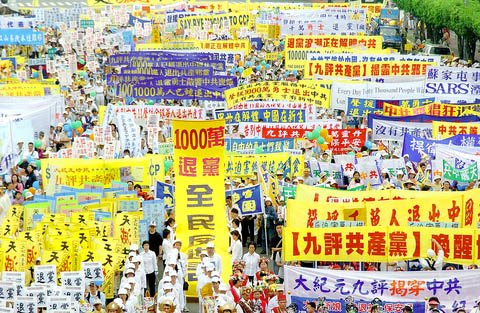
Taipei (Asia Pacific News) 23 April 2006 - Tens of thousands of Taiwanese Falun Gong members marched through Taipei on Sunday to protest China's harvesting of organs from Falun Gong members in labour camps, and to call on Chinese Communist Party (CCP) members to quit the party.

Waving yellow Falun Gong flags and beating drums, Falun Gong members marched through Taipei's main streets, shouting, 'Stop persecuting Falun Gong,' 'Heaven destroy communist China,' and 'Down with the wicked Chinese Communist Party.'

A moving truck showed a scene of Chinese doctors harvesting organs, with several doctors standing around a patient tied to an operation table, scalpel in hand.

Behind the truck, a column of Falun Gong members - in handcuffs, shackles and dark prison clothes - walked silently led by a rope by a whip-cracking prison warden.

Falun Gong has accused China of persecuting its members since 1999 when Beijing banned the group as a sect, and of killing Falun Gong members to harvest their organs for organ transplants.

The Taiwan Falun Dafa Society accused China of running a Nazi concentration camp-style facility to harvest organs from some 6,000 detained Falun Gong members and selling them to patients who need transplants.

Taiwan Falun Gong reported on March 20 that the operations were being performed at Shenyang Thrombosis Hospital in north-east China.

According to their source, an unnamed doctor that has since emigrated to the US, the harvesting of organs was carried out in the hospital's air raid shelters, and the bodies of the Falun Gong members were cremated in a furnace.

China has denied the accusations, and has enacted new interim regulations on organ transplants to be implemented on July 1.

Besides denouncing China's harvesting of organs from Falun Gong members, the demonstration called on members of the CCP to quit the party.

Since the Falun Gong launched the global 'Quit the CCP' movement in 1999, nearly 10 million members have left CCP, about 10 per cent of the party's membership.

'Large numbers of communist party members quitting the party led to the collapse of East Germany and the Soviet Union. So far 10 per cent of CCP members have quit the CCP. This shows the days of CCP are numbered,' Chin Heng-wei, a writer and political commentator, said at the rally before the march.

Falun Gong is a spiritual group which combines meditation and exercise and preaches truth, compassion and endurance.

China banned the 'cult' in 1999 and followers who refuse to renounce their beliefs have been detained for re-education. The movement has millions of followers worldwide.

According to Falun Gong, since 1999, tens of thousands of Falun Gong members have been sent to labour camps, 3,635 have been tortured to death, 7,758 have been detained by police and thousands have been sent to mental hospitals.

Wednesday, April 26, 2006

Video: How Communist China evicts her people


Silencing the people...


This link takes you to a news video covering Chinese people being evicted from their homes and having their homes torn down. It also shows a protest by villagers last year where 6 people were gunned down. It's 12 megabytes.

Prison Planet Blog: 18 April 2006 - Sky News recently produced a segment which highlighted how, despite fierce anger and resistance amongst the people of China, the Communist Government has instilled such fear and has such control over the media that very few dare to stand up and speak out. Those that do are forcibly quashed.

The Government and its contractors are seizing people's land and homes and building their own developments on it, forcing the population into living lives of poverty and squalor.

The state controlled Chinese media does not cover this because they know they would be immediately shut down if they did. The only footage that comes out of China is shot by the people themselves or undercover foreign reporters.

These revelations should remind us of the fact that tyrannical governments, in order to succeed know they have to infiltrate the lives of their populations to every degree, not allowing any form of self sufficiency or independence to endanger their iron fist control. (full report)

Related Article:

The CCP cheats the peasants once and again


Canadian MPs call for organ harvesting investigation


Best viewed in Mozilla

Reports Say Chinese take body parts from live prisoners

By Deborah Gyapong

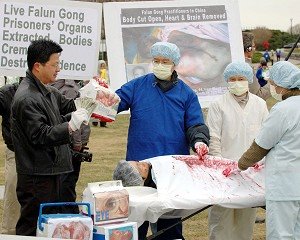
Photo - A group of four Falun Gong practitioners re-enact the organ harvest in Sujiatun Extermination Camp at a rally on Parliament Hill in Ottawa, Canada, 3-06-2006. (Central News Agency)

Sky TV Station Confirms Organs Available in China on Demand

Chinese Organ Extraction Scheme Part of Larger Campaign to Eradicate Falun Gong, Human Rights Group Says

Essential Information on Organ Harvesting from Falun Gong Practitioners in China

Ottawa (Canada Catholic News) April 23, 2006 - Members of Parliament from all the major parties want Canada to investigate allegations the Chinese Communist Party is harvesting organs from live prisoners.

When Parliament opened April 3, about 200 people, most of them practitioners of Falun Gong, demonstrated on the lawn to raise awareness of eyewitness accounts of these abuses. They were joined by several MPs who called for Prime Minister Stephen Harper's government to investigate.

Falun Gong, also called Falun Dafa, is based on qigong, "the practice of refining the body and mind through special exercises and meditation," according to the organization's website.

Among the MPs present were Bloc Quebecois MP Maria Mourani, Liberals Borys Wrzesnewskyj and Larry Bagnell, NDP MP Peter Jullian and Conservative Bruce Stanton.

On April 4, Falun Dafa Association of Canada spokeswoman Lucy Zhou told an Ottawa news conference about three eyewitness accounts from China about "secret concentration camp-like facilities that arestaffed by surgeons and equipped with crematoriums to dispose of corpses and other evidence."

Zhou said one of the sources, a medical doctor who served in the Shengyang military zone, said about 36 concentration camps hold Falun Gong practitioners and "other prisoners of conscience." Zhou, however did not know how many of those prisoners might be Christian.

Amnesty International is in the process of doing its own investigation, according to spokeswoman Beth Berton-Hunter.

MPs who have been following the plight of Falun Gong in China believe the allegations are credible.

"I think China has a proven track record as the worst human rights violator in the world," Conservative MP Rob Anders told CCN April 6.

"They are certainly willing to kill, torture and mutilate people for opposition to their regime. The nuance between torturing and killing people and harvesting their organs isn't very much."

Anders said he has seen evidence of torture that demonstrates to him the Chinese "don't have much respect for the sanity of life."

Liberal MP Dr. Keith Martin told CCN that while he does not know to what extent organ harvesting is taking place, he is not surprised by the allegations.

"The Chinese government commits all manner of atrocities against members of Falun Gong," he said. "The Chinese government has mobile execution groups, and they have harvested organs of people on death row. "

Zhou told the news conference the reporter for Japanese television who broke the story said the estimated two million Falun Gong practitioners in detention are targeted because not enough organs come from death row. According to one of the eyewitnesses, a former staff member at a facility in Liaoning province, about three-quarters of the 6000 Falun Gong prisoners held there had their hearts, kidneys,corneas and skins harvested, Zhou said.

Zhou pointed out the government-sponsored website for the China International Transplantation Network Assistance Center boasts "it may only take one week to find out the suitable donor," a rate she said is not matched in any developed country where organs are donated.

The centre's web site offers organ transplants to an international clientele.

"There are more than 35,000 kidney transplant operations that have been done in public hospitals in 29 cities, provinces and municipalities in China, and the number of kidney transplant operations is at least 5,000 every year all over the country," the site claims.

"So many transplantation operations are owning to the support of the Chinese government."

The site acknowledges that in many areas China's health care is not as advanced as in developed countries, but claims: "in the are of organ transplantation, the mode of the operation is the same all over the world, and the level of medical technology in China is the same as that of a developed country."

Zhou said this site is further evidence the government may be harvesting organs to meet the demands of this international clientele.

Related Articles:

Toronto Sun: China's obscene 'harvest' of organs

Taipei Times: Probe of alleged Chinese organ harvesting urged
UNWILLING DONORS?: Fifty legislators backed a resolution urging an inquiry into the alleged murder of Falun Gong prisoners for their parts

Ogan Transplants Boom; China is the Leader in Transplants, but Busines is Beset by Claims that Organs come from Executed Prisoners


Tuesday, April 25, 2006

How Corrupt is the United Nations?


Best viewed in Mozilla

'CORRUPT' UN IN URGENT NEED OF OVERHAUL

"How corrupt is the United Nations?" is the title of Claudia Rosett's new book (coming out soon) and below is one interesting comment. Unfortunately Claudia fails to mention the new genocide in Communist China. The FalunGong cannot wait ten more years before the UN sends the envoy to investigate the China laogai--the organ-harvesting death camps deserve immediate attention as the CCP is killing them like flies. For the latest reports on this topic look here.

"The UN vowed "never again" to abdicate as it did in Rwanda and Srbrenica when faced with genocide. Yet in Darfur, with genocide underway, it has refrained from acting against Sudan -- which is a member of its Human Rights Commission in Geneva, along with such bastions of liberty as China, Cuba, Saudi Arabia and Zimbabwe."

The London Free: 25 April 2006 - Press After a decade or so of United Nations debates on the need to reform the world body, Secretary-General Kofi Annan tabled his proposals for change last month. He noted that "previous reform efforts . . . have addressed the symptoms rather than causes of the organization's weaknesses," and said that a "radically expanded range of activities calls for a radical overhaul of the UN secretariat."

In peacekeeping alone, he said that in the first 44 years of peacekeeping since the Suez War, 18 peace missions were authorized,while in the next 16 years since 1990, there were 42 new missions -- with costs tripling and staff numbers soaring.

While Annan is right in his assessment of the need for change, unmentioned is that he may be one of the reasons that need is so acute.

It was Winston Churchill, in 1946, who urged that the newly formed UN become "a force for action, and not merely a frothing of words . . .in a Tower of Babel."

Churchill's pithiness inspired the title of an excellent book -- Tower of Babble, by Israel's former UN ambassador, Dore Gold -- that shows how hopeless and craven the UN can be.

Annan even undermined UN weapons inspections aimed at bringing Saddam Hussein to heel long before the U.S. invasion of Iraq, and after Saddam had defied 16 UN resolutions to change his ways -- or else.

Now a new book is in the works by Claudia Rosett that promises to be a devastating indictment of UN corruption. April's Commentary magazine runs her assessment: "How Corrupt is the United Nations?"

The simple answer: Very.

The UN even misleads the world on its funding, claiming its "core" budget is $1.9 billion, with 29,000 employees. When various UN agencies are included, such as UNICEF, the UN Development Program (UNDP) and the World Food Program (WFP), the total budget is closer to $30 billion with 60,000 employees (excluding 80,000 peacekeeping (troops).

Paul Volcker's probe into the UN's oil-for-food program, designed to help Iraqis, confirmed massive corruption involving "bid-rigging, conflicts of interest, bribery, theft, nepotism and sexual harassment."

Saddam himself skimmed off up to $17 billion from the $64-billion program which, Rosett writes, "was buying 'milk' from a Chinese weapons manufacturer, contracting for 'vehicles' and 'detergent' with Sudan, and negotiating for missiles with North Korea."

Annan (whose son was implicated in the program scandal) has since described oil for food as a mistake in a good cause -- neglecting to point out that the UN collected 2.2 per cent of oil revenues as agent fees, roughly $1.4 billion into the secretary-general's spending fund.

Small wonder Saddam felt immune. Small wonder Annan wanted no military action against Iraq. Small wonder that his former chief of staff, Iqbal Riza, shredded three years' worth of oil-for-food documents the Volcker inquiry wanted to examine.

Although founded to advance peace and prosperity, in the age of terror the UN "has been in most ways useless and in some ways positively dangerous," Rosett argues. It has become a gigantic bureaucracy. Its lax controls, diplomatic immunity and culture of impunity make the UN ripe for corruption and "for arms deals masked as medicine and soap."

The UN vowed "never again" to abdicate as it did in Rwanda and Srbrenica when faced with genocide. Yet in Darfur, with genocide underway, it has refrained from acting against Sudan -- which is a member of its Human Rights Commission in Geneva, along with such bastions of liberty as China, Cuba, Saudi Arabia and Zimbabwe.

In contravention of its own charter, Rosett says, the UN has evolved into "a predatory, undemocratic, unaccountable and self-serving vehicle for global government."

While facets such as the World Health Organization and UNESCO serve a purpose, the UN now threatens more than strengthens global peace, security and freedom.

Related Article:

What Ever Happened to Reforming the UN?